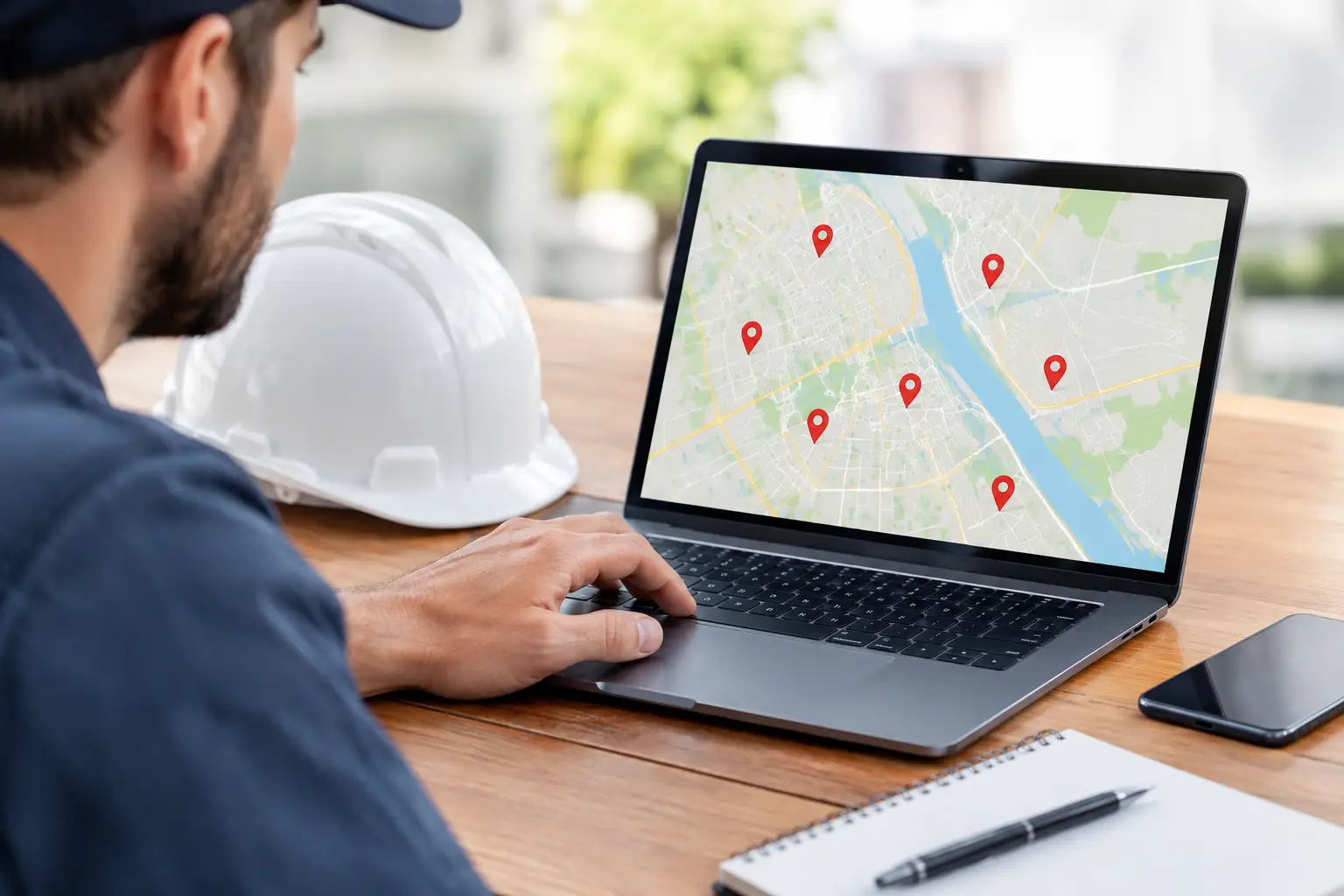
A homeowner with a leaking roof, failed AC unit, or backed-up drain rarely researches for a week. They search, scan the map, call two or three companies, and hire the one that looks credible and available. Contractor map ranking determines whether your business is in that short list or invisible when demand is highest.
For local contractors, the map pack is not a vanity metric. It is one of the shortest paths between a service-area search and a booked job. Better visibility can create more calls, direction requests, quote requests, and branded searches. But getting there requires more than adding a few keywords to your Google Business Profile.
How Contractor Map Ranking Actually Works
Google does not publish a fixed map ranking formula, but the pattern is clear. Local results generally depend on relevance, distance, and prominence. Relevance is how confidently Google can connect your business to the service a person needs. Distance is the searcher’s location or the location named in their search. Prominence is the evidence that your business is real, trusted, and established in the market.
That means a top result in one neighborhood may not appear in the top three five miles away. It also means no agency can honestly guarantee a permanent number-one position across an entire metro area. Proximity matters. Competition matters. Search results also change based on the query, device, and searcher’s location.
The right goal is stronger coverage in the locations and service categories that produce profitable work. A roofing company may care most about storm-damage searches in specific suburbs. A plumber may prioritize emergency searches within a fast dispatch radius. Map optimization should follow your actual service model, not a generic ranking report.
Build a Google Business Profile That Earns Trust
Your Google Business Profile is the foundation of local visibility. Treat it as an active sales asset, not a listing you set up once and forget.
Start with accuracy. Your business name, phone number, website, operating hours, and address or service area must match how you operate in the real world. Do not add city names, services, or marketing slogans to the business name unless they are part of the legal, customer-facing name. Keyword stuffing can trigger edits, suspensions, and lost visibility.
Choose the most precise primary category available. This is one of the clearest relevance signals you control. A general contractor, for example, should not select a broad category if a more accurate specialty category reflects the work that drives revenue. Add a limited number of relevant secondary categories, but avoid turning the profile into a catch-all. Every category should be defensible.
Complete the services section with plain-language descriptions of the jobs you want to win. Include specific services such as water heater repair, panel upgrades, roof replacement, foundation repair, or commercial HVAC maintenance where appropriate. These details help Google interpret your business and help customers confirm they found the right company.
Photos matter because customers judge contractors quickly. Upload current, original images of completed work, branded vehicles, your team, equipment, office or showroom, and job-site results. A stock photo may fill a gap, but it will not build the same confidence as proof that you do this work locally. Keep adding photos as projects are completed.
Service-area businesses need extra discipline
If customers do not visit your location during stated business hours, your address should generally be hidden and your service area configured correctly. Do not create multiple profiles for every city you serve or use virtual offices to manufacture proximity. Those shortcuts can create suspensions and make long-term local growth harder.
A single, well-managed profile paired with strong location-focused pages is usually the durable approach. If you have legitimate, staffed locations that serve customers in person, each may qualify for its own profile. The distinction matters.
Reviews Turn Visibility Into Calls
Review quantity helps, but review quality, recency, detail, and response habits matter too. A contractor with 150 old five-star reviews can lose calls to a competitor with fewer reviews that consistently receives new feedback and responds professionally.
Build a review request process into the closeout stage of every completed job. Ask when the customer has seen the result and is most satisfied. Make the request simple, direct, and compliant. Do not offer discounts, cash, or gifts in exchange for reviews. Do not pressure customers to leave only positive feedback.
The best reviews naturally mention the service, local area, communication, punctuality, and result. You should never script those words for customers, but you can ask an open question such as, “Would you share what work we completed and how the experience went?” That creates useful, credible detail.
Respond to every review, including the difficult ones. A calm response to a complaint shows prospective customers that your company takes ownership. Keep private details out of public replies, acknowledge the concern, and offer a practical next step. A defensive argument on your listing can cost more business than one negative review.
Make Your Website Support the Map Listing
Your map profile cannot carry the entire local strategy. Google needs to see a website that confirms your services, locations, and credibility.
Create strong core service pages before building dozens of thin city pages. Each priority service page should explain what the job involves, when a customer should call, what makes your process different, and what service areas you cover. Include original project examples, FAQs based on real customer questions, licensing or insurance details where relevant, and clear calls to request service.
Location pages can work when they offer local value. A useful page for “AC repair in Coral Gables” might address common system issues in South Florida heat, dispatch expectations, local customer testimonials, nearby project context, and the services available there. A page that simply swaps one city name for another is unlikely to build authority or convert well.
Technical basics still matter. Your site must load reliably on mobile, use clear page titles and headings, include consistent business information, and make it easy to call or request an estimate. Add structured data where it accurately reflects your business, services, locations, reviews, and FAQs. Structured data does not guarantee map rankings, but it reduces ambiguity for search engines and AI-powered discovery systems.
This is where local SEO and Answer Engine Optimization connect. Clear service information, credible proof, consistent entities, and well-structured answers help search engines understand your company. They also give AI search tools more reliable information when they surface local recommendations or summarize providers.
Build Local Prominence Beyond Your Own Website
Prominence comes from third-party evidence. Search engines compare what you say about your company with what trusted sources across the web say about it.
Start by correcting inaccurate business listings on major directories and industry platforms. Your business name, address, phone number, website, and hours should be consistent. Exact formatting does not need to be identical everywhere, but contradictions create confusion.
Then focus on authority that competitors cannot easily copy. Local chamber memberships, supplier relationships, community sponsorships, trade associations, local news coverage, project features, and partnerships can all strengthen market credibility when they are legitimate. A press mention about a meaningful company milestone is more useful than a pile of low-quality directory links.
For contractors, project proof is especially valuable. Publish before-and-after examples, case studies, and customer stories with permission. Explain the problem, the work completed, and the outcome. This content supports conversion, gives your sales team material to share, and helps establish topical authority around the services you provide.
Measure Rankings the Way an Operator Would
A single search from your office is not a reliable ranking report. Your location, search history, and device can influence what you see. Use grid-based local rank tracking to measure visibility across the neighborhoods that matter, then compare those trends against calls, form submissions, booked estimates, close rates, and revenue.
Watch for patterns. If your rankings rise but leads do not, the issue may be poor review strength, weak photos, slow response times, or a listing that attracts the wrong service queries. If calls increase but close rates fall, you may need better qualification or clearer pricing expectations. Rankings are a means to revenue, not the finish line.
Review your profile monthly, but respond to operational issues immediately. Incorrect hours, unanswered questions, duplicate listings, and a broken call button can waste demand you already earned.
Contractor map ranking is won through consistent proof: accurate business data, focused services, real customer feedback, credible local authority, and a website built to turn urgency into action. The companies that keep those signals current do not just appear more often. They look like the safest call to make when the job cannot wait.