
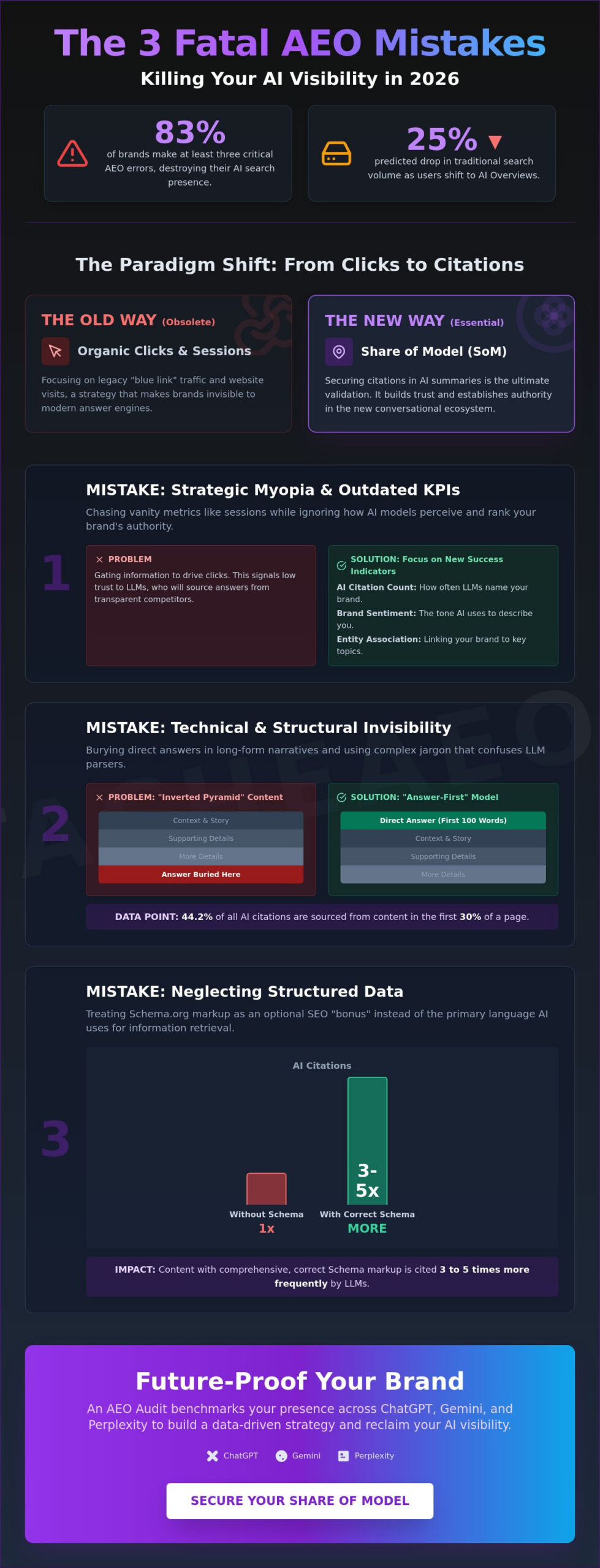
A 2026 study of over 500 brands found that 83% make at least three fatal common AEO mistakes that destroy their AI search visibility. With Gartner predicting a 25% drop in traditional search volume this year, the pressure to adapt is higher than ever. You’ve likely noticed your organic click-through rates softening as Google AI Overviews and ChatGPT take center stage. This shift creates a sense of uncertainty, yet the solution lies in understanding how LLMs actually process your data.
We’re here to provide clarity and a proactive path forward. You’ll learn how to identify and fix the critical blunders preventing your brand from being cited by Perplexity and other conversational engines. This article outlines a clear list of what not to do while providing a framework for auditing your current content. We’ll move beyond legacy methods to ensure your brand remains a validated authority in the age of automated responses. By the end of this guide, you’ll have a roadmap to reclaim your visibility and secure your place in the future of information retrieval.
Key Takeaways
- Pivot your strategy from traditional clicks to “Share of Model” visibility to secure your place in AI-generated summaries.
- Correct common AEO mistakes such as burying direct answers in narrative content or neglecting essential Schema.org markup.
- Build trust with LLMs by replacing promotional language with factual, authoritative content that satisfies modern E-E-A-T requirements.
- Secure local dominance by optimizing for conversational geo-queries and the citations that power AI knowledge bases in Miami.
- Use a specialized AEO audit to benchmark your brand’s presence across ChatGPT, Gemini, and Perplexity for a data-driven strategy.
The Strategic Shift: Why Traditional SEO Metrics Lead to AEO Failure
Traditional search metrics are no longer sufficient for measuring digital authority. Chasing organic clicks while ignoring how AI models perceive your brand is one of the most common AEO mistakes we see in 2026. The search landscape has evolved into a conversational ecosystem where the user journey often begins and ends within a chat interface. If you’re still prioritizing legacy “blue link” clicks over “Share of Model” visibility, you’re effectively making your brand invisible to the engines that matter most.
The “Zero-Click” paradox has redefined success. Appearing in an AI summary is the new Position One. While legacy agencies mourn the loss of referral traffic, modern specialists recognize that being cited by an LLM is the ultimate form of validation. This visibility builds immediate trust. We measure this through Share of Model (SoM), a critical metric that defines your brand’s authority within conversational search. Answer Engine Optimization (AEO) is the framework we use to capture this share, ensuring your brand isn’t just indexed, but cited as the primary solution.
The Obsession with Organic Sessions
Consumer behavior in 2026 prioritizes speed over exploration. Users want synthesized answers immediately. Many businesses still gatekeep their information, fearing that clear, extractable content will reduce website visits. This is a strategic error. If you don’t provide the answer, an AI will find it elsewhere, likely from a competitor who understands the value of transparency. To stay relevant, you must shift your internal KPIs away from raw sessions. Focus instead on these modern indicators of success:
- AI Citation Count: How many times LLMs name your brand as a source.
- Brand Sentiment Score: The tone AI models use when describing your services.
- Entity Association: How strongly models link your brand to specific industry keywords.
Ignoring the AI Feedback Loop
Large language models don’t just scrape data; they learn from user interactions. When an AI cites your brand and the user continues the conversation based on that citation, the model’s confidence in your authority increases. This creates a validation loop that traditional SEO cannot replicate. Ignoring AI Overviews is a direct surrender of market share. You need to track how your brand is represented across ChatGPT, Gemini, and Perplexity to ensure you aren’t being filtered out by the algorithms that now dictate consumer choice. Proactive monitoring allows you to correct hallucinations and reinforce your position as a market leader.
Invisible to Engines: Technical and Structural AEO Failures
Technical infrastructure acts as the silent gatekeeper of your AI visibility. You can have a brilliant strategy, but if LLM scrapers cannot parse your site’s architecture, your brand remains invisible. Many organizations fall into the trap of using complex, jargon-heavy language that confuses neural networks. This is one of the most common AEO mistakes in 2026. Models like GPT-4o and Claude prioritize clarity and factual density over creative flair. When language is too abstract, AI models fail to map your brand to the specific entities users are searching for.
Long-form narrative content, while traditionally good for legacy SEO, often creates friction for answer engines. When you bury the primary answer under layers of storytelling, you risk being filtered out. Research shows that 44.2% of all AI citations come from content located in the first 30% of a page. If your site structure is messy or your language is overly academic, LLMs will likely skip your content in favor of a source that provides a more direct, extractable response. Ensuring your content is “snippetable” is now a technical requirement, not a stylistic choice.
The Death of the “Inverted Pyramid” in AEO
In the AI era, the traditional inverted pyramid has been replaced by the “Answer-First” model. You must provide the core solution within the first 100 words of any given section to maximize extraction potential. LLMs prioritize the first paragraph of a section as the definitive source for determining relevance and providing immediate answers to conversational queries. If you’re struggling to restructure legacy pages, a comprehensive AEO audit can pinpoint exactly where your content flow is breaking down.
Schema Markup and Technical Clarity
Structured data is no longer an optional SEO bonus; it is the primary language of 2026 information retrieval. Content with comprehensive, correct schema markup is cited 3 to 5 times more frequently than identical content without it. You need to move beyond basic Article tags and implement specialized markup like Speakable and FAQPage. These tags act as a roadmap for LLMs, telling them exactly which parts of your page are designed for conversational extraction.
Finally, check your technical gates. A critical error is blocking AI crawlers in your robots.txt file. Ensure you are allowing modern user-agents like GPTBot, OAI-SearchBot, and PerplexityBot. If these crawlers are blocked, your authority cannot be validated. You’ll be left out of the AI feedback loop entirely. Clear the path for these bots to ensure your brand is the one being synthesized in the next user query.
The Authority Gap: Why LLMs Hallucinate Your Brand
AI models prioritize objective factuality over persuasive marketing. When your content relies on promotional fluff or vague claims, LLMs often discard it as low-value noise. This creates an authority gap. If an engine cannot find definitive, structured facts about your services, it may synthesize an answer based on outdated or incorrect third-party data. Failing to distinguish between helpful data and sales pitches is among the most common AEO mistakes that lead to your brand being misrepresented or ignored entirely.
Inconsistent brand data is the primary fuel for AI hallucinations. When your website, social profiles, and directory listings provide conflicting information, LLMs struggle to form a cohesive “understanding” of your business. They don’t just stop at your homepage. They look for a consensus across the web. Without a centralized, authoritative FAQ section to anchor your facts, you leave your brand’s reputation to the mercy of probabilistic guessing. You must become the definitive source for your own story to prevent AI engines from filling the blanks with misinformation.
Fighting Brand Hallucinations
AI models guess when they cannot find direct, verifiable facts. This “guessing” is what we call a brand hallucination, and it can be devastating for your credibility. To combat this, you need a “Single Source of Truth” on your domain. This page should clearly define your entities, founders, and core offerings. Link these facts to trusted second-party citations, such as press releases or industry associations. This helps build a “Knowledge Graph” that LLMs can verify, reducing the risk of the model providing false details about your pricing or capabilities.
The Role of E-E-A-T in 2026
AI engines in 2026 are highly sensitive to signals of Experience, Expertise, Authoritativeness, and Trustworthiness. Research shows that sites with high domain authority and strong backlink profiles are 3.5x more likely to be cited by ChatGPT and Perplexity than lower-authority sites with similar content. One of the common AEO mistakes brands make is using faceless, AI-generated content to try and win citations. This backfires. LLMs prioritize content written by verified experts. Use original data, proprietary case studies, and named authors to prove you are a primary source. This level of transparency makes your content indispensable to the models and the users they serve.
Local Invisibility: AEO Mistakes Specific to Miami Brands
Miami’s rapid evolution into a global tech hub has changed the local search game. If you’re a South Florida business, ignoring geo-specific context is a critical error. LLMs like Perplexity and Claude prioritize local sentiment and regional relevance when answering user queries. One of the most common AEO mistakes for Miami brands is treating their local presence as a static directory listing rather than a dynamic part of the AI knowledge graph. You aren’t just competing for clicks; you’re competing for the AI’s trust as a regional authority.
Conversational queries are inherently local. Users in Miami don’t just type keywords. They ask their AI assistants for recommendations based on neighborhood authority. Failing to optimize for terms like “Best AEO agency in Miami” or ignoring regional industry terminology limits your visibility in the very hub you serve. If your content doesn’t reflect the specific language of the Miami tech sector, AI models won’t associate your brand with the local ecosystem. This leads to a total loss of visibility in conversational results that prioritize location-based expertise.
The Miami AI Search Landscape
Competition in South Florida’s emerging tech sector is fierce. You must optimize for “near me” intent without relying on outdated keyword stuffing. AI models look for proximity and regional authority through local news mentions and community presence. Securing mentions in South Florida publications provides the validation LLMs need to recommend your brand to local users. This creates a localized feedback loop that legacy SEO strategies often miss. Your content should speak directly to the Miami market while maintaining the technical structure AI engines require.
Local Knowledge Graph Optimization
Consistency is the foundation of local trust. Your office address, services, and contact details must be identical across every digital touchpoint. Local backlinks from Miami-based organizations act as significant “votes of confidence” for answer engines. When you participate in local events or partnerships, you trigger signals that help AI models categorize your brand as a regional leader. This structural clarity prevents hallucinations and ensures your Miami business is the one being suggested. It’s about building a digital footprint that screams local relevance to every scraper that visits your site.
Stop letting local competitors outshine you in conversational search results. You can reclaim your territory by implementing a targeted AEO strategy that prioritizes South Florida’s unique digital ecosystem. Don’t let your brand become a victim of common AEO mistakes that keep you hidden from your neighbors.
Beyond the Blunders: How an AEO Audit Future-Proofs Your Brand
Fixing errors is a reactive step. True leadership in the AI era requires a proactive, systematic framework. While a traditional SEO audit focuses on technical health for crawlers, a specialized AEO audit evaluates semantic clarity for synthesizers. Identifying common AEO mistakes is just the starting point. You need to understand how LLMs categorize your brand as a solution rather than just a data point. This transition ensures your business remains visible as search engines evolve into answer engines.
For SME teams and entrepreneurs navigating this shift, a Business With AI Strategist provides the expert consultancy and strategic implementation needed to align these technical audits with a broader AI roadmap.
Our process begins with identifying your current Share of Model (SoM). We analyze how often ChatGPT, Gemini, and Perplexity cite your brand relative to your competitors. Once we establish this baseline, we move to restructuring high-value content. This isn’t about changing your message; it’s about making that message immediately extractable for AI models. Finally, we implement a continuous tracking and reporting system. AI models are updated frequently, and your visibility depends on staying synchronized with these algorithmic shifts.
The Mustache AEO Audit Framework
We assess how AI search engines interpret and cite your current brand narrative. This involves a deep dive into your “Optimization Gaps.” These are the structural or content-based flaws that lead to hallucinations or, worse, total omissions from AI answers. Our framework provides a strategic roadmap to dominance in conversational search. We don’t just tell you what’s wrong. We show you how to align your digital footprint with the way modern neural networks process information. This builds a foundation of trust that legacy tactics simply cannot match.
Execution and Content Optimization
We optimize content specifically for large language models by prioritizing factual density and entity clarity. This means moving away from the fluff of legacy search tactics and adopting a proactive AEO strategy. We ensure your most valuable insights are positioned for maximum extraction potential. The goal is to make your brand the most logical, authoritative answer for every relevant query. This systematic approach transforms your website from a passive brochure into an active participant in the AI knowledge graph.
The digital landscape is moving fast. Brands that fail to adapt will find themselves silenced by the very systems designed to provide answers. You have the opportunity to lead this shift rather than follow it. Ready to stop being invisible? Schedule your AEO Audit with Mustache AEO today and secure your brand’s future in the age of intelligence.
Own Your Space in the Conversational Future
The era of passive search indexing has ended. Success in 2026 requires a structural alignment with the neural networks that now dictate brand perception. You’ve seen how legacy metrics and hidden answers create an authority gap that AI models simply won’t bridge. By prioritizing “Share of Model” and eliminating the common AEO mistakes discussed, you position your brand as a validated, cited authority in every conversational response.
We specialize in bridging this technical divide. Our Miami-based AI SEO experts provide the specialized AEO Audit and Strategy necessary to transform your digital footprint. We deliver LLM-focused Content Optimization that ensures your insights are the first ones synthesized by ChatGPT and Perplexity. It’s time to stop reacting to the shifting landscape and start defining it. You have the tools and the framework to lead this transition with confidence.
Secure Your Brand’s AI Visibility with a Mustache AEO Audit
The transition to automated information retrieval is a massive opportunity for brands that act now. Your brand’s voice deserves to be heard by the engines of the future.
Frequently Asked Questions
What is the biggest mistake businesses make with AEO?
Chasing clicks instead of “Share of Model” visibility is the most significant error. Traditional SEO focuses on keywords, but AEO requires optimizing for the meaning and relationships between concepts. If your content doesn’t provide a direct, extractable answer in the first few paragraphs, LLMs will likely skip your site in favor of a more concise source.
Can I use my existing SEO agency for AEO?
Most traditional agencies are still catching up to the shift from search engines to answer engines. However, specialized digital marketing firms like Exclusive Business Marketing are already helping brands bridge this gap by integrating conversational authority into their broader strategies. AEO is a specialized sub-category of optimization that requires deep technical knowledge of how LLMs like GPT-4o and Claude parse data. While standard SEO fundamentals help, a dedicated AEO Strategy is necessary to ensure your brand is prioritized within automated responses.
How does AEO affect my traditional Google rankings?
AEO and traditional SEO are complementary rather than conflicting. Research indicates that 38% of Google AI Overview citations come from pages already ranking in the top 10 organic results. Improving your AEO signals often strengthens your overall domain authority, making you a more attractive source for both human searchers and AI scrapers.
Is AEO only for big national brands, or does it matter for Miami small businesses?
Local AEO is critical for Miami brands aiming to capture conversational search traffic. AI shopping assistants and virtual agents rely on structured data to recommend local services. Small businesses that ignore geo-specific queries risk becoming invisible to users asking for the “best options near me” through voice or chat interfaces.
Why is Perplexity citing my competitor instead of me?
Perplexity prioritizes sources that demonstrate high topical authority and clear content structure. If a competitor is being cited instead of you, they likely have more comprehensive schema markup or a stronger backlink profile. AI engines favor sites that provide direct, factual answers without the promotional fluff often found in legacy marketing materials.
How often should I audit my brand’s AI visibility?
You should conduct an AEO Audit at least quarterly to stay synchronized with rapid algorithmic updates. AI models are constantly retraining and updating their knowledge bases. Regular Tracking & Reporting allow you to identify new “Share of Model” opportunities and correct any hallucinations before they impact your brand’s reputation.
Does AEO require me to rewrite all my website content?
You don’t need to rewrite your entire site, but you must restructure your high-value pages for immediate extraction. This process involves moving direct answers to the top of the page and implementing specialized schema. Targeted Content Optimization focuses on the 20% of your pages that drive the most authority, ensuring they are perfectly formatted for LLM scrapers.
What is the ROI of fixing AEO mistakes if I lose website clicks?
The ROI of fixing common AEO mistakes is found in brand validation and long-term relevance. While you might see a shift in raw website clicks, appearing as the primary cited source in an AI answer establishes immediate trust. With traditional search volume predicted to drop 25% by the end of 2026, being the “chosen answer” is the only way to maintain market share.