
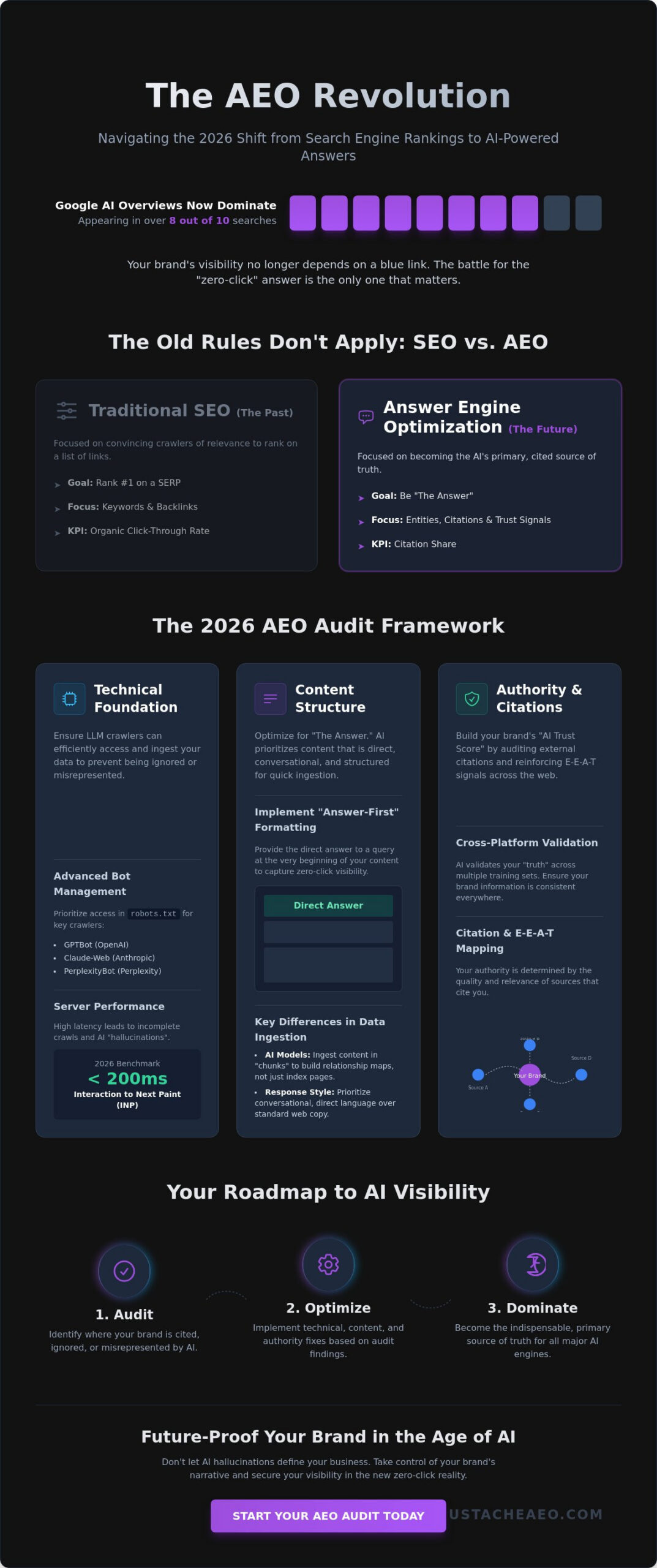
Did you know that as of early 2026, Google AI Overviews now appear in more than eight out of ten searches? Your brand’s visibility no longer depends on a simple blue link. The battle for the “zero-click” answer is now the only one that matters. It is a shift that feels both sudden and overwhelming. You’re likely watching organic click-through rates soften while feeling anxious about AI bots hallucinating facts about your business. Managing a dozen different AI crawler bots shouldn’t feel like a full-time job.
We understand the complexity of this new landscape. That’s why we’ve built a comprehensive, 2026-ready AEO audit checklist to help you master the transition from traditional search to AI-driven answers. This framework ensures your content architecture is future-proofed and your brand is cited accurately across platforms like ChatGPT and Perplexity. You’ll gain a clear roadmap to AI visibility, moving from being ignored to being the primary source of truth. This guide previews the technical requirements for seven major AI engines and shows you how to optimize your content for the automated systems that now define digital discovery.
Key Takeaways
- Understand the shift from legacy search results to conversational engines to protect your brand’s digital footprint.
- Use our AEO audit checklist to manage AI crawlers and optimize server response times for efficient data ingestion.
- Implement the “Answer-First” formatting rule to capture visibility in zero-click search environments.
- Audit your external citations and E-E-A-T signals to build a high trust score with leading language models.
- Create a prioritized roadmap that transforms technical audit findings into a scalable AI visibility strategy.
Why Your 2026 Marketing Strategy Starts with an AEO Audit
The digital landscape has fundamentally changed. In 2026, the traditional search engine results page is no longer the primary gateway to your customers. Users now interact with conversational interfaces that provide direct, synthesized answers. This shift necessitates Answer Engine Optimization (AEO); the strategic process of ensuring Large Language Models (LLMs) and AI platforms prioritize your brand as their primary source. An AEO audit checklist is the first step in this transition. It identifies where your brand is being cited and, more importantly, where it’s being misrepresented by AI hallucinations. Without a dedicated audit, you’re essentially leaving your brand’s reputation in the hands of an automated guesser.
Traditional SEO audits are structurally inadequate for this new era. They focus on keyword density and backlink counts, which are legacy signals. An AEO audit looks at the citation layer. It examines how AI models ingest, process, and output information about your business. With ChatGPT processing close to half a billion search queries every week, the cost of being “hallucinated” or ignored is too high. This audit serves as a tool for both visibility and brand safety, ensuring that when an AI engine speaks for you, it speaks the truth.
The Shift from Ranking to Citation
Being number one on a list of ten blue links is a legacy goal. Today, visibility means being “The Answer.” As of early 2026, Google AI Overviews appear in more than eight out of ten searches. These summaries effectively capture the traffic that used to flow to top-ranked websites. This environment creates a zero-click reality where the user never leaves the search interface. Consequently, “Citation Share” has replaced traditional rankings as the most critical KPI. If an AI engine provides a detailed answer but fails to cite your brand, your authority is invisible. Your AEO audit checklist must prioritize these citations to maintain market share in an AI-first world.
Answer Engine Optimization vs. Traditional SEO
Traditional SEO focuses on keywords to convince a crawler of relevance. AEO is entity-centric. It focuses on how an LLM “ingests” and connects your brand to specific concepts. Understanding what is an AEO audit reveals the technical gap between legacy indexing and modern AI training. While old crawlers mapped pages, AI models map relationships. Consider these key differences:
- Data Ingestion: AI models ingest content in “chunks” rather than full pages to build relationship maps.
- Validation: AEO requires cross-platform validation to prove your brand’s “truth” across multiple training sets.
- Response Style: Answer engines prioritize conversational, direct language over standard web copy.
By shifting your focus to these automated systems, you ensure your content is structured for the way information is retrieved today. It’s a proactive approach to a disruptive technology.
Technical AEO Checklist: Ensuring LLM Crawlers Can Access Your Truth
Your technical foundation determines whether AI engines see your brand as a reliable source or a digital ghost. A modern AEO audit checklist must prioritize machine accessibility above all else. If an LLM cannot ingest your data efficiently, it cannot cite you. This technical layer isn’t just about speed; it’s about providing a clear, structured roadmap for non-human visitors. By ensuring your server response times are crisp and your bot permissions are intentional, you secure your place in the training sets of the future.
Advanced Bot Management for 2026
Managing crawler access is no longer a binary choice of “allow” or “block.” In 2026, a professional AEO standard requires covering at least seven major platforms, including ChatGPT, Perplexity, and Claude. You must prioritize access for GPTBot, Claude-Web, and PerplexityBot within your robots.txt file to ensure your latest updates are reflected in their responses. This creates a delicate balance between feeding the models that drive your visibility and protecting your intellectual property. Bot Transparency is the 2026 technical requirement for providing clear, machine-readable instructions to AI agents regarding data consumption and attribution rights.
Server performance also plays a critical role in how efficiently these bots scrape your site. According to 2026 benchmarks, your Interaction to Next Paint (INP) should remain under 200ms. High latency can lead to incomplete crawls, which results in “hallucinated” brand facts when the AI tries to fill in the gaps. If you’re unsure where your technical stack stands, our AI SEO specialists can help you identify these hidden friction points.
Schema Markup and Entity Tagging
Structured data is the language of the Knowledge Graph. Using JSON-LD to define your brand as a unique entity allows AI models to categorize your business with precision. This goes beyond basic metadata. You should implement SameAs tags to link your website directly to authoritative industry profiles and social platforms. This cross-referencing validates your authority. Detailed product and service schema are also vital; they provide the granular data points that AI comparison engines need to recommend you over a competitor.
Finally, verify that your site architecture favors semantic clusters over traditional silos. Each piece of content should link to 3-5 other relevant internal pages. This structure helps AI crawlers map the relationships between your ideas, which reinforces your topical authority. A well-connected site is easier for an LLM to digest, ensuring your “truth” remains consistent across the entire digital ecosystem.
Content Structure Audit: Optimizing for the Zero-Click Answer Engine
AI engines don’t read your pages; they extract data from them. Your 2026 AEO audit checklist must evaluate how efficiently an LLM can pull a specific answer from your content architecture. If your core message is buried under paragraphs of introductory preamble, the engine will likely source its answer from a competitor who gets straight to the point. We call this the “Answer-First” formatting rule. It requires you to treat every heading as a prompt and every following paragraph as a direct, authoritative response. This level of directness is what secures your brand’s place in the zero-click search environment.
Beyond directness, you must audit for natural language and conversational headers. Legacy SEO prioritized rigid keyword strings in H2 and H3 tags. Modern AEO demands headers that mirror the way real people speak to their AI assistants. This means shifting from “Miami AEO Services” to “How do I improve my brand’s AI visibility in Miami?” This conversational approach helps LLMs map your content to specific user intents, increasing the likelihood of a direct citation. It’s about being helpful rather than just being found.
The Inverted Pyramid for AI Extraction
Directness is the primary currency of AEO. You must place the core answer within the first 50 words of any given section to facilitate successful AI extraction. AI crawlers favor “chunkable” content that minimizes the computational effort required to identify the primary intent. Bulleted lists are essential here; they provide a clear, machine-readable structure for parsing complex information or multi-step processes. Vague, long-winded “fluff” content is toxic to AEO because it introduces linguistic noise that increases the risk of AI hallucination or total omission from the final answer.
Mapping the Conversational Buyer Journey
The buyer journey has moved from the search bar to the chat interface. You need to identify the “Who, What, Where, Why” questions most relevant to your specific Miami niche. A high-performance FAQ section is a non-negotiable part of your audit. According to 2026 best practices, a dedicated FAQ section should contain 8-12 questions with concise answers of 30-60 words each. This specific formatting is designed to trigger AI Overviews and featured snippets across platforms like ChatGPT and Gemini.
Finally, assess your site for “Comparison Content.” AI models are frequently asked to compare Brand X with Brand Y. If you don’t provide this data yourself, the AI will synthesize a comparison using third-party sources that you don’t control. By auditing for these gaps, you ensure that your unique value proposition is clearly defined and ready for AI synthesis. This proactive content layering turns your website into a definitive resource that AI engines trust and cite repeatedly.
Authority and Citation Mapping: Building Your Brand’s AI Trust Score
AI engines don’t just take your word for it. They cross-reference your claims against a massive web of external data to assign a confidence score to your brand. If the digital consensus doesn’t match your self-description, the AI won’t cite you as a primary source. Mapping this external footprint is a core component of any professional AEO audit checklist. You need to know exactly where the AI is sourcing its information about your brand to ensure that data is both accurate and authoritative. This process moves beyond your own domain to evaluate how the broader ecosystem validates your expertise.
Your digital footprint is the sum of every mention, review, and citation your brand has ever received. In 2026, AI models use these signals to determine if you are a “safe” answer to provide to a user. A fragmented or inconsistent footprint creates a vacuum that AI engines fill with their own logic. By auditing these external touchpoints, you identify the gaps where your authority is being diluted or ignored. This is a proactive defense against being marginalized in the conversational search era.
E-E-A-T for Large Language Models
AI systems evaluate Experience, Expertise, Authoritativeness, and Trustworthiness by looking for signals across the entire web. They verify author credentials by checking for mentions on academic sites, industry publications, and established social profiles. Third-party reviews and citations act as social proof for the machine, raising your brand’s confidence score in conversational responses. We assess these signals to see how engines perceive your brand authority compared to your competitors. High-quality citations from verified experts are now more valuable than thousands of low-tier backlinks.
Fact-Checking and Hallucination Prevention
Hallucinations often stem from data friction. When an AI engine encounters conflicting information, such as different headquarters locations or founding dates across various platforms, it may attempt to synthesize a “logical” but entirely false answer. Standardizing these core brand facts across all directories and profiles is essential for brand safety. You must monitor AI responses to branded queries to catch these inaccuracies before they become part of the model’s permanent training set. Inconsistent data is the primary trigger for AI-generated errors.
Proactive steps are required when an engine gets your brand facts wrong. This involves updating structured data on high-authority sites and ensuring your official channels provide a clear, singular source of truth. Correcting the record isn’t just about accuracy; it’s about maintaining control over your narrative in a world where AI speaks for you. To stay ahead of these shifts, consider our Tracking & Reporting services to monitor your citation accuracy in real-time.
Beyond the Checklist: Implementing Your Miami AEO Roadmap
Completing an AEO audit checklist is a vital milestone, but data without implementation is just noise. You now have a list of technical gaps, content friction points, and citation errors that need immediate attention. The next step is prioritization. We recommend addressing “Bot Access” and “Schema Validation” first, as these are the gatekeepers of your brand’s truth. Once the machines can see you, you can focus on the nuance of how they describe you. This transition from audit to action is what separates the legacy brands from the AI pioneers.
Miami is a competitive, tech-forward market where being “first to the answer” provides a massive commercial advantage. Integrating your audit findings into a broader aeo services plan ensures your strategy isn’t just reactive. It becomes a dynamic roadmap for growth. By positioning your brand as a definitive source of truth early in the 2026 search cycle, you capture the “Citation Share” that competitors are still trying to understand. This is about securing your digital real estate before the landscape becomes even more crowded.
Tracking Success in a Conversational World
Traditional metrics like “clicks” only tell half the story in a zero-click environment. You need to shift your focus to “Citation Rate” and “Sentiment Analysis.” Using the best aeo tracking tools allows you to monitor how often AI engines mention your brand and the context of those mentions. For Miami businesses, geo-fenced monitoring is essential. AI responses can vary based on the user’s perceived location, and you need to ensure your “Magic City” authority remains consistent across all seven major AI platforms. We recommend a daily monitoring cadence for active campaigns to catch and correct hallucinations before they scale.
Your Strategic AEO Partner in Miami
Mustache AEO turns a static AEO audit checklist into a high-performance growth engine. We specialize in the intersection of marketing and emerging technology, providing the technical expertise that generalist firms often lack. Choosing a dedicated aeo agency means you’re working with partners who understand the specific requirements of LLM training and ingestion. We don’t just find the problems; we build the architecture to solve them. Don’t let your brand’s visibility fade as search evolves. Get your professional AEO audit from Mustache AEO today and lead the conversational era with confidence.
Dominating the Conversational Era
The transition from traditional search to AI-driven answers is no longer a future prediction. It’s your current reality. By implementing a rigorous AEO audit checklist, you move your brand from the periphery of search results to the center of the AI conversation. Success in 2026 requires a shift in mindset; you must prioritize being the definitive answer over being just another link. This means mastering technical bot access, structuring content for rapid extraction, and protecting your brand from AI hallucinations through consistent data mapping across the entire web.
You don’t have to navigate this shift alone. Mustache AEO is a specialized AEO agency for Miami tech leaders, pioneering AI SEO strategies since the initial LLM shift. As part of the Mustache and Cognizant family, we provide the high-level technical expertise needed to secure your citation share in an automated world. Secure your brand’s future with a professional AEO audit from Mustache AEO. Your brand deserves to be the voice of authority that AI engines trust and cite every single day. Let’s build your AI visibility together.
Frequently Asked Questions
What is the most important part of an AEO audit in 2026?
Machine accessibility and citation mapping are the most critical components. An AEO audit checklist must first ensure that engines like GPTBot can access your site architecture without friction. Once accessibility is confirmed, the focus shifts to verifying that AI models pull from authoritative, accurate sources across the entire digital ecosystem. This ensures your brand is the primary reference point for conversational answers.
How often should a Miami business perform an AEO audit?
You should perform a comprehensive audit at least quarterly to keep pace with rapid model updates. The AI landscape moves faster than traditional search algorithms, requiring frequent check-ins on your technical health. For high-growth Miami firms, monthly monitoring of citation shares provides the best protection against emerging competitors and shifting AI response patterns. Staying current is the only way to maintain authority.
Can I use a traditional SEO tool like Semrush for an AEO audit?
Traditional tools like Semrush are insufficient because they track keyword rankings rather than LLM citations. While they help with legacy search, they cannot monitor how ChatGPT or Claude synthesizes your brand facts. A true audit requires specialized tools designed to analyze conversational answers and identify the specific data points AI models use to build their responses. You need metrics that reflect the zero-click reality.
Does an AEO audit help with ranking in Perplexity and ChatGPT?
Yes, the primary goal of an AEO audit is to secure your brand’s presence in conversational engines like Perplexity and ChatGPT. By optimizing your content for entity recognition and direct extraction, you increase the likelihood that these models will cite you as a primary source. This process transforms your website from a collection of pages into a trusted data node for AI training sets and real-time retrieval.
What is the difference between an AEO audit and a Content Audit?
A content audit evaluates human engagement and UX, while an AEO audit focuses on machine extraction and citation authority. The AEO audit checklist specifically targets how “chunkable” your data is for LLM ingestion and how clearly your unique value proposition is defined for AI synthesis. It prioritizes machine-readable structure over traditional readability metrics to ensure your content is ready for automated answers.
How long does it take to see results after implementing AEO audit changes?
You can typically expect to see shifts in AI citations within 30 to 60 days of implementation. This timeline aligns with the 2026 standard for content freshness signals, as AI platforms prefer recently updated sources. Regular updates to your structured data and FAQ sections help maintain this momentum and keep your brand at the top of automated responses. Consistency is key to staying relevant in conversational search.
Is an AEO audit necessary if I already rank #1 on Google?
Ranking #1 on Google is no longer enough in a landscape where AI Overviews appear in over 80% of searches. These AI-generated summaries often push traditional results down the page, capturing the majority of user attention. An AEO audit ensures you are the source for that summary, protecting your visibility even when users never click through to your site. You must optimize for the summary, not just the link.
How does an AEO audit address AI hallucinations about my brand?
An audit addresses hallucinations by identifying and correcting data friction across the web. AI models often hallucinate when they encounter conflicting brand facts, such as different headquarters locations or service lists. By standardizing your information and providing a singular, machine-readable source of truth, you significantly reduce the risk of AI engines generating inaccurate claims about your business. Accuracy starts with a unified digital footprint.