
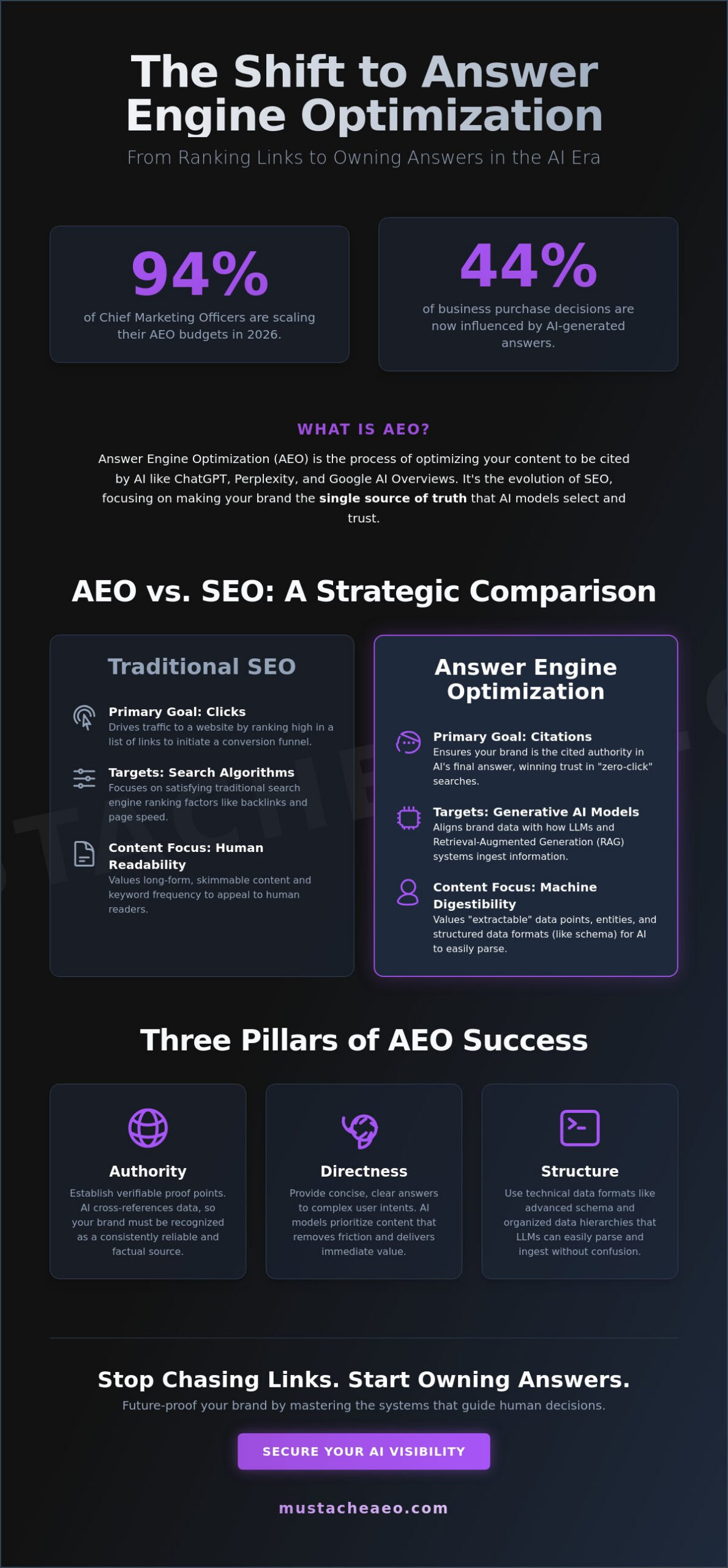
94% of Chief Marketing Officers are scaling their AEO budgets in 2026. This isn’t just a trend; it’s a survival tactic. You’ve likely felt the sting of declining click-through rates as traditional search results shrink and AI agents take over the discovery process. Understanding what is aeo in marketing is now the primary difference between being a cited authority and becoming invisible. We understand the anxiety surrounding brand hallucinations and the dense technical fog of LLMs and RAG. You need clarity, not more confusion.
We’re here to bridge that gap. This guide promises to show you how to pivot your strategy from simply ranking links to winning high-value AI citations that drive real business outcomes. We’ll provide a clear framework to compare AEO against your existing SEO efforts and deliver actionable steps to dominate AI visibility. You’ll move from wondering how these engines work to mastering the systems that now influence 44% of business purchase decisions. It’s time to stop chasing links and start owning the answers.
Key Takeaways
- Shift your focus from ranking page-one links to becoming the definitive ‘single source of truth’ for AI answer engines.
- Understand what is aeo in marketing and how it evolves traditional SEO by prioritizing AI citations and brand sentiment over simple clicks.
- Demystify the technical role of Retrieval-Augmented Generation (RAG) to ensure LLMs ingest and reference your brand data accurately.
- Learn to leverage a comprehensive AEO Audit to restructure your content into the high-authority formats that AI agents prefer.
- Secure an early-mover advantage in tech-forward markets by future-proofing your brand’s visibility before AI search saturation occurs.
Defining Answer Engine Optimization (AEO) in the 2026 Marketing Landscape
AEO is the next phase of digital visibility. It represents a fundamental transition from organizing information to synthesizing it. Answer Engine Optimization (AEO) is the process of optimizing content to be cited by AI answer engines like ChatGPT, Claude, Perplexity, and Google AI Overviews. While traditional Search Engine Optimization (SEO) focused on securing a spot in a list of search results, AEO aims to make your brand the single source of truth that AI models select when generating a response. Understanding what is aeo in marketing is now a requirement for any brand that wants to remain relevant. Put simply, AEO is the structural bridge between brand content and Large Language Models.
The Rise of the Answer Engine
The era of the “10 blue links” has ended. In 2026, users have migrated from rigid keyword searches to fluid, conversational queries. They no longer want to click through multiple websites to find a single piece of data. Instead, they demand immediate, multi-source answers that are synthesized into a single, cohesive response. This shift in search behavior has moved the goalposts for marketers. You’re no longer competing for a high rank on a page; you’re competing for the citation itself. If an AI agent doesn’t read your site, your brand effectively disappears from the customer journey. We ensure your brand remains at the center of this synthesis by aligning your content with how these engines actually think.
Key Components of AEO
Effective AEO requires a specialized approach to content creation and technical architecture. It isn’t about stuffing keywords. It’s about providing value that an algorithm can validate. You must focus on three critical areas to win in this environment:
- Directness: You must provide concise answers to complex user intents. AI models prioritize content that removes friction and delivers immediate clarity.
- Authority: You need to establish verifiable proof points. Answer engines cross-reference data across the web, so your brand must be recognized as a reliable source through consistent, factual output.
- Structure: You must use technical data formats that LLMs can easily parse. This includes advanced schema and organized data hierarchies that allow an AI to ingest your brand’s expertise without confusion.
Winning in 2026 starts with a clear view of your current standing. Before you can optimize, you need to understand how AI currently perceives your brand. We recommend starting with a comprehensive AEO Audit to identify gaps in your authority and structure. This foundational step ensures your AEO strategy is built on data, not guesswork. By mastering these components, you move beyond legacy marketing and into the future of automated discovery. It’s about building trust with the machines that now guide human decisions.
AEO vs. SEO: A Strategic Comparison for Modern Brands
SEO and AEO are not competitors. They are complementary layers of a modern visibility stack. While SEO targets traditional search engine algorithms to drive traffic, AEO targets generative AI models to secure brand mentions. If you’re still asking what is aeo in marketing, think of it this way: while SEO builds the road, AEO provides the fuel for the AI driver. One creates the path to your site, while the other ensures the AI has the necessary data to recommend you in the first place. You need both to maintain a presence in 2026.
Primary Goal Divergence
The objectives of these two disciplines have shifted significantly. Traditional SEO focuses on driving clicks to a website to initiate a conversion funnel. AEO focuses on ensuring your brand is present in the AI’s final answer, regardless of whether the user ever clicks through to your site. This makes “zero-click” search the primary battleground for AEO. In 2026, being the cited answer is often more valuable than a raw hit to your homepage because it establishes immediate trust at the point of inquiry. We help you win this space by aligning your brand with the synthesized responses users now prefer.
Technical and Content Differences
The structural requirements for these strategies differ at a granular level. SEO often values long-form, skimmable content designed for human readers. AEO values “extractable” data points that a machine can easily digest and repurpose. This requires a shift from keywords to entities. AI cares about things, not strings; it looks for the relationships between concepts rather than just the frequency of words. For a deeper look at these technical shifts, you can explore this comprehensive guide for 2026 which details how intent-based optimization is evolving.
The currency of authority has also changed. Backlinks remain a signal for SEO, but citations are the new standard for AEO. An AI model needs to see your brand mentioned and validated across diverse, high-authority datasets. This is why we prioritize an AEO Strategy that focuses on sentiment and factual accuracy. Schema markup is the final piece of this puzzle. While SEO uses basic schema to help search engines understand page types, AEO uses structured data to feed the “black box” of LLMs with specific, verifiable facts. By providing this level of detail, you ensure your brand isn’t just seen, but correctly understood and cited by the machines that now filter the world’s information. It’s a proactive approach that turns your content into a reliable resource for automated systems.
How Answer Engines Process Information: From LLMs to Citations
Answer engines don’t just read your website; they ingest it into a complex neural network. To understand what is aeo in marketing, you must first understand the “black box” of Large Language Models (LLMs). These models store brand data as high-dimensional vectors, mapping the relationships between your products and user needs. In 2026, the primary mechanism for search is Retrieval-Augmented Generation (RAG). This process allows an AI to pull real-time, factual data from your site to ground its conversational response. Without a clear AI SEO strategy, your brand risks being left out of this retrieval loop entirely.
Hallucinations are the biggest threat to your digital reputation. These errors occur when an AI model lacks specific, structured data and “fills in the gaps” with incorrect information. We eliminate this risk through precise Content Optimization. By providing the AI with unambiguous, verifiable facts, you ensure it represents your brand accurately. Data freshness is the new gold standard. Answer engines prioritize real-time indexing to provide the most current answers possible, meaning your technical infrastructure must be built for speed and clarity.
The Indexing Phase: Feeding the Model
AI crawlers operate differently than the legacy Googlebot. While traditional bots focused on link equity and keyword density, AI crawlers prioritize semantic meaning and declarative statements. They look for “ingestible” content that clearly defines what your brand does and who it serves. Technical cleanliness is non-negotiable. If your site is slow or your code is cluttered, the AI agent will move on to a more efficient source. We use targeted Tracking & Reporting to monitor how these bots interact with your data, ensuring your site remains a primary feed for the world’s most powerful models.
The Synthesis Phase: Winning the Citation
The synthesis phase is where the AI decides which sources to trust. It calculates a “Credibility Score” by evaluating your brand authority across multiple digital touchpoints. It asks: Is this information consistent? Is it validated by other high-authority sources? To become the “Preferred Source” in conversational search, your content must be structured as the definitive answer to a specific query. Winning the citation isn’t about luck. It’s about building a digital footprint that is so authoritative and well-structured that the AI has no choice but to cite you as the expert. This is the core of a successful AEO Strategy, turning your website into a fundamental building block for AI-generated answers.
Core AEO Strategies: Building Authority for Conversational AI
Transitioning to AI-driven visibility requires a structured roadmap. Understanding what is aeo in marketing is the first step, but execution is what separates leaders from legacy brands. We follow a five-step framework to ensure your brand becomes the preferred citation for Large Language Models. This isn’t about general advice; it’s about technical precision and authoritative content delivery.
Begin with a comprehensive AEO Audit to establish your baseline. This evaluation reveals exactly how AI engines currently perceive your authority and where your technical data is failing. Once you have a clear picture of your visibility gaps, you can move toward corrective action. We prioritize data-backed insights over guesswork to build a foundation that machines can trust.
Restructure your content using the “inverted pyramid” style. This method places the most crucial information at the beginning of the text, ensuring immediate ingestion by AI agents. Follow this with robust Schema.org implementation to enhance entity signals. Structured data acts as a translator, turning your human-centric content into machine-readable facts that LLMs can easily parse. This level of AI SEO ensures your brand’s core identity remains intact across all platforms.
Secure third-party validation through digital PR and high-authority reviews. AI models cross-reference information to verify truth; external citations are your new digital currency. Finally, monitor your progress with specialized AEO tracking tools. Consistent Tracking & Reporting allows you to pivot your strategy as AI models evolve. It’s about maintaining a proactive stance in an automated environment.
Content Structuring for Answerability
Adopt a “Snippet-First” writing style to win the citation. You must answer the user’s prompt within the first 50 words of your content to satisfy the retrieval process. Use your H2 and H3 tags as direct questions that mirror common conversational queries. In 2026, FAQ sections are no longer optional. They provide the clear, punchy data points that RAG systems crave. We specialize in this level of Content Optimization to keep your brand at the top of the response stack.
Building Off-Page AI Authority
Your brand’s presence on Wikipedia, LinkedIn, and industry-specific hubs is vital. These platforms are often used as high-weight training data for LLMs, making them essential for long-term visibility. Digital PR isn’t just about brand awareness; it’s about influencing the very data sets that AI models use to form opinions. Manage your brand sentiment aggressively to ensure AI recommendations remain positive and factual. It’s time to take control of your digital reputation. Reach out to us to develop a custom AEO Strategy that secures your brand’s future.
Future-Proofing Your Brand: Why AEO is the New Standard for Miami Businesses
Miami has solidified its position as a global hub for high-tech innovation. This rapid evolution creates a unique pressure on local businesses to stay ahead of consumer behavior. You can’t rely on legacy search tactics in a city that moves this fast. Understanding what is aeo in marketing is the only way to capture the attention of a tech-savvy audience that uses conversational AI to discover services. In 2026, if you aren’t in the answer, you don’t exist.
Being an early mover provides a massive competitive advantage. 58% of marketers are already optimizing for answer engines, and that number is growing as traditional search volume shifts toward synthesized responses. If you wait until the market is saturated, the AI Knowledge Graph will have already established its preferred sources. We help you secure that spot now. It’s about validation. By the time your competitors realize the game has changed, you’ll already be the cited authority in your niche. We provide the AEO Strategy and AI SEO expertise required to win this race.
AEO for Local Miami Visibility
Local discovery is no longer just about a map pin or a basic business listing. Conversational AI synthesizes your location, real-time reviews, and service descriptions into a single, authoritative recommendation. You must optimize for complex “near me” queries that happen inside AI interfaces. We ensure your local business data is consistent and verifiable across the entire AI Knowledge Graph. This allows engines like Gemini or Perplexity to confidently recommend your firm. This is exactly why local businesses need Answer Engine Optimization to maintain dominance in a crowded market.
Next Steps: Starting Your AEO Journey
Your journey starts with a professional benchmark. You need to know exactly how AI models currently rank your brand’s credibility compared to your peers. We recommend a full AEO Audit to identify your technical and content gaps. Shift your team’s focus immediately. They should stop writing for keywords and start writing for extractable answers. This transition requires a specialized approach to Content Optimization that prioritizes clarity and machine readability.
Partner with a specialist who understands the nuances of the 2026 landscape. Use our AEO agency selection guide to find a partner capable of building a technical roadmap. We offer the Tracking & Reporting necessary to measure your impact in a zero-click world. Don’t let your brand become a relic of the link-based era. Take control of your AI visibility today and ensure your brand is the answer the world is looking for.
Own the Answer in 2026 and Beyond
The digital landscape has shifted from discovery to synthesis. You now understand what is aeo in marketing and why it’s the structural bridge between your brand and the AI agents guiding consumer decisions. Success in this new era requires a pivot from tracking clicks to winning high-value citations. By prioritizing extractable data and verifiable authority, you ensure your brand remains a primary source for LLMs and RAG systems. This isn’t just about visibility; it’s about establishing trust within the automated ecosystems that define modern commerce.
As Miami-based AI search pioneers and part of the Cognizant/Mustache creative family, we specialize in navigating these technical complexities. We’ve moved beyond legacy tactics to provide the specialized services your business needs to thrive. Don’t let your brand’s visibility fade into the “black box” of unverified data. Take a proactive step toward digital dominance. Secure your brand’s future with a comprehensive AEO Audit from Mustache AEO. We’ll help you turn your content into the definitive answer the machines are looking for. Your future visibility starts with a single, data-driven decision. Let’s build something authoritative together.
Frequently Asked Questions
What is the difference between SEO and AEO?
SEO targets search engine algorithms to drive website traffic, while AEO targets generative AI models to secure brand citations. Traditional SEO focuses on keyword rankings and link equity. In contrast, AEO prioritizes factual accuracy and machine-readable data structures. Understanding what is aeo in marketing helps you realize that while SEO builds the road to your site, AEO provides the data fuel that AI agents require to recommend your brand.
How do I rank my business in ChatGPT and Perplexity?
You rank by providing structured, verifiable data that these models can ingest through Retrieval-Augmented Generation (RAG). Focus on creating clear, declarative content that answers specific user prompts within the first 50 words. High-authority third-party citations and robust entity signals are essential for becoming a preferred source. We use targeted AI SEO tactics to ensure your brand is the most credible option when an AI model synthesizes a response.
Is AEO more important than traditional SEO in 2026?
Neither is more important; they are complementary layers of a modern visibility stack. SEO still captures users who prefer to browse and compare options. However, AEO captures the growing segment of users who demand immediate, synthesized answers without clicking through multiple links. In 2026, a balanced strategy ensures you maintain a presence in both the legacy search results and the new conversational discovery layer.
Can I do AEO for a local Miami business?
Local AEO is critical for capturing conversational “near me” queries in the Miami market. You must ensure your business data is consistent across the AI Knowledge Graph so engines can confidently recommend your firm. We implement localized Content Optimization to bridge the gap between your physical location and AI retrieval systems. This ensures your business appears when users ask AI for the best local service providers.
What is an AEO audit and why do I need one?
An AEO Audit is a technical assessment of how AI engines currently perceive your brand’s authority and data structure. You need one to identify visibility gaps and “hallucinations” that might be providing users with incorrect information about your company. It provides the baseline data required to build an effective roadmap. This audit is the first step in any professional AEO Strategy to ensure your brand is cited accurately.
How does Schema markup help with Answer Engine Optimization?
Schema markup acts as a digital translator that turns human-centric content into machine-readable facts. It facilitates Answer Engine Optimization by defining the specific relationships between your brand and the services you provide. This structure makes it easier for LLMs to parse and cite your expertise without confusion. Without deep structured data, AI models may struggle to validate your brand as a reliable source for their generated answers.
Will AEO help my brand appear in Google’s AI Overviews?
Yes, AEO is specifically designed to feed the retrieval systems used by Google AI Overviews. By optimizing for directness and authority, you increase the likelihood of your content being selected for the synthesized summary at the top of the SERP. This approach helps you maintain visibility even as “zero-click” searches become more prevalent. It turns your website into a fundamental building block for Google’s automated responses.
Do I need special software to track AEO performance?
Traditional analytics don’t track how often AI models cite your brand in conversational responses. You need specialized Tracking & Reporting tools designed to monitor AI visibility, brand sentiment, and citation frequency. These tools allow you to measure your success in an environment where user clicks are no longer the primary metric. We provide the technical infrastructure to help you understand exactly how AI engines are interacting with your data.