
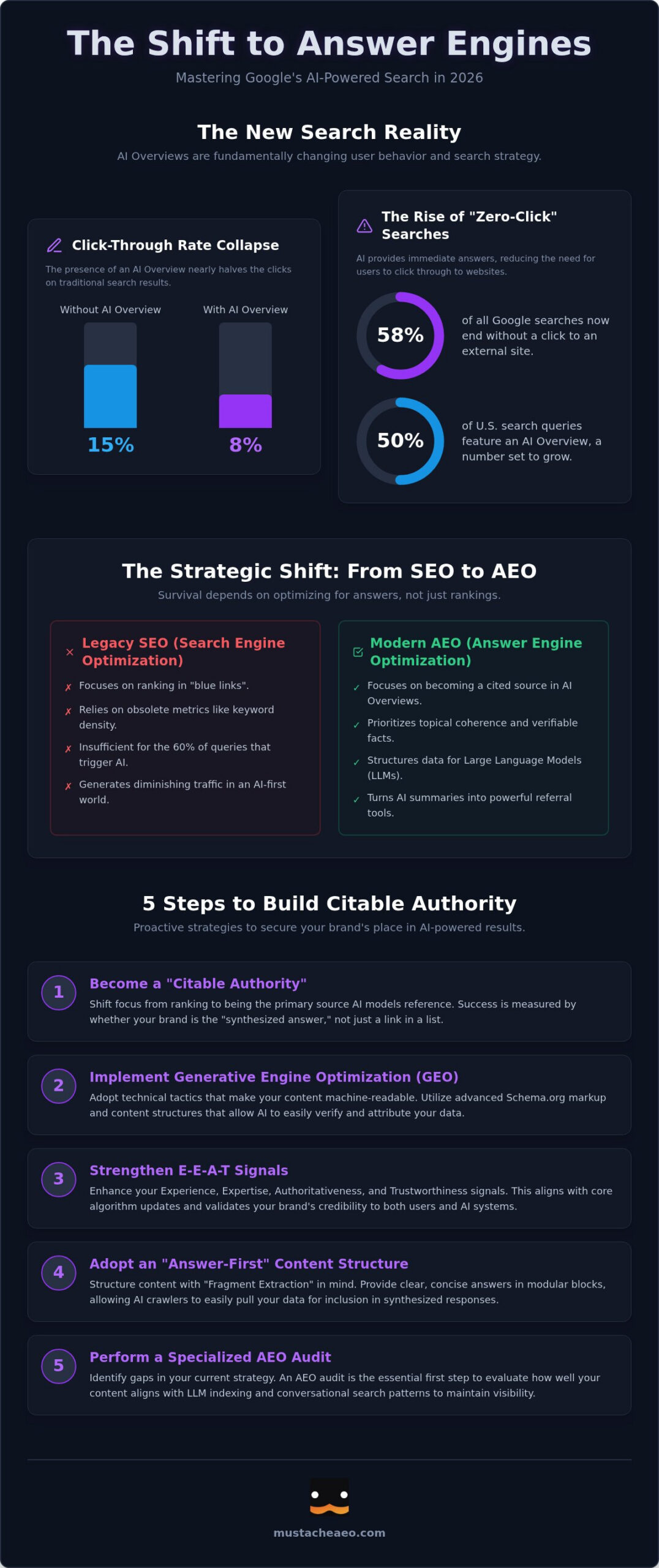
Users now click a traditional search result only 8% of the time when an AI Overview is present, compared to 15% when it’s absent. As of early 2026, these generative summaries appear in approximately 50% of all U.S. queries, effectively pushing legacy “blue link” results out of the spotlight. You likely feel like the search engine you once mastered has turned into a closed ecosystem that summarizes your expertise without sending traffic your way. It’s a valid concern for any brand watching their organic reach dwindle in the face of automated responses. Learning how to optimize for Google SGE is no longer a luxury; it’s a survival tactic for the current digital environment.
This guide will help you master the technical and structural content shifts required to secure your brand’s place in Google’s AI-powered search results. We’ll demystify the confusion between SEO and Answer Engine Optimization (AEO) to ensure your site becomes a primary source for the algorithm. You’ll learn how to build “Citable Authority” and understand the specific ROI of AEO strategies that turn AI summaries into your most powerful referral tools. We’re moving beyond traditional rankings to focus on the verified visibility that defines success in 2026.
Key Takeaways
- Transition from traditional ranking to building “Citable Authority” to ensure your brand is the primary source AI models reference.
- Learn how to optimize for Google SGE by implementing Generative Engine Optimization (GEO) and advanced Schema.org markup.
- Strengthen your E-E-A-T signals to align with the March 2026 Core Update and validate your expertise across the digital ecosystem.
- Adopt an “Answer-First” content structure that allows AI crawlers to easily extract and present your data in synthesized responses.
- Discover why a specialized AEO Audit is the essential first step for maintaining search visibility in an increasingly zero-click environment.
Google SGE and AI Overviews in 2026: The New Search Reality
Search is no longer a directory of links. What began as the Search Generative Experience (SGE) has evolved into a permanent, ubiquitous fixture known as Google’s AI Overviews. In 2026, these synthesized summaries appear in approximately 50% of all U.S. searches. They provide immediate, conversational answers that often satisfy a user’s intent without a single click to an external site. For Miami brands, this shift means that appearing on page one is no longer the ultimate win. The new objective is becoming the primary source that the AI cites to validate its response. Understanding how to optimize for Google SGE requires a move toward technical transparency and citable authority.
Traditional SEO is now a legacy tactic. While it still matters for certain transactional queries, it’s insufficient for the 60% of question-style searches that now trigger an AI response. We’ve entered the era of Answer Engine Optimization (AEO). This is the strategic process of structuring your data so it’s easily digestible for Large Language Models (LLMs). Success is no longer measured by where you rank in a list, but by whether your brand is the “synthesized answer” at the top of the page.
How Google’s Generative AI Processes Information
Google uses advanced LLMs to interpret the semantic meaning behind your content. These models don’t just look for words; they look for relationships between entities. To remain visible, your site must provide clear, verifiable facts that the AI can cross-reference with other authoritative sources. This is called “Citation Logic.” It’s the specific set of rules Google uses to determine which websites are credible enough to be featured in the AI summary box. If your content lacks structure or clarity, the AI will simply bypass your site in favor of a competitor who provides a more “quotable” answer.
Why Traditional SEO is No Longer Enough
The era of the “Blue Link” is fading fast. Approximately 58% of Google searches now end without a click, a trend driven by the efficiency of AI-powered answers. Keyword density has become an obsolete metric. Modern search engines prioritize topical coherence and verifiable expertise over how many times a phrase appears on a page. If you want to maintain visibility, you need to identify where your current strategy is failing. A specialized AEO audit is the most effective way to uncover these gaps. This process evaluates how well your content aligns with LLM indexing and conversational search patterns. Success in 2026 demands a proactive shift toward these automated systems.
Generative Engine Optimization (GEO): Technical Tactics for AI Citations
Generative Engine Optimization (GEO) is the technical framework that ensures your content is both machine-readable and citable. While traditional SEO focuses on human-centric ranking signals, GEO prioritizes the structural elements that allow Large Language Models (LLMs) to verify and attribute your data. In 2026, being featured in an AI Overview requires more than just high-quality writing; it demands a site architecture that mirrors the logic of the engines themselves. Master the technical shifts of how to optimize for Google SGE to ensure your brand isn’t just indexed, but actively recommended.
Your website now needs a dedicated manifest for AI crawlers. Much like the robots.txt file guided legacy search bots, the llms.txt file serves as a roadmap for modern generative models. This file explicitly defines which parts of your site are optimized for training and citation, helping AI engines avoid “hallucinations” by providing them with a clear source of truth. Without this manifest, your content risks being processed as noise rather than a primary authority. Implementing this technical layer is a foundational step in any forward-looking AEO Strategy.
Google’s AI models utilize a process called “Fragment Extraction” to build their responses. Instead of reading an entire page, the AI identifies specific, high-value blocks of text that directly answer a user’s query. If your information is buried in long, winding paragraphs, the AI will likely pass it over. You must structure your content to be “extractable” by providing immediate value in every section. This technical precision is what separates brands that get cited from those that remain invisible.
Semantic HTML and Content Chunking
Semantic HTML tags act as anchors for AI summarization. Use H2 and H3 headings to define clear topical boundaries that the AI can easily parse. We recommend the “Inverted Pyramid” of AEO, where the most direct answer to a potential query is placed in the very first sentence of a section. Content Chunking is the process of breaking data into 50-100 word citable units. This specific length is the “sweet spot” for AI models looking for concise, authoritative snippets to include in a generated overview.
Advanced Schema for Answer Engines
Standard Article schema is no longer enough to maintain visibility. You need to implement advanced Schema.org types like Speakable and FAQPage to signal that your content is ready for conversational retrieval. Additionally, using Dataset schema for any proprietary facts or statistics allows Google to verify your data against other authoritative sources. To monitor how these technical changes impact your reach, you should integrate the best AEO tracking tools available in 2026. These platforms provide real-time data on your AI citation frequency and technical health, ensuring your brand remains a primary source in the generative ecosystem.
The Authority Shift: Why Miami Brands Need Citable E-E-A-T
Google’s AI doesn’t just read your content. It fact-checks it. In 2026, AI Overviews utilize a consensus-based validation system to ensure the accuracy of synthesized answers. If your website makes a claim that isn’t supported by other authoritative sources, the AI will simply exclude you from the summary. To master how to optimize for Google SGE, you must transition from a content creator to a “Citable Authority.” This means your brand must be the definitive source that other experts, publications, and AI models reference as a foundation for their own information.
Authority is now a cross-platform metric. Off-site mentions and brand sentiment are more critical than ever because they provide the social proof AI engines require. When multiple high-authority domains link to or mention your brand in a positive context, it signals to the LLM that your data is trustworthy. Content that lacks this external validation is often dismissed as “AI noise.” You must focus on creating original, experience-led insights that cannot be easily replicated by automated tools. First-hand experience is your greatest defense against obsolescence.
Building Brand Authority in the Magic City
Local relevance serves as a powerful trust signal for generative models. For Miami-based businesses, this means anchoring your digital presence in regional entities. Partnerships with Miami tech hubs or features in local publications act as a “trust bridge” for the AI. Utilizing specialized AEO services helps translate your local reputation into machine-readable authority. When Google’s AI sees your brand consistently associated with established Miami institutions, your “AI trust score” increases. This regional validation makes your brand a safer choice for the AI to cite in geographic-specific queries.
Author Entities and Digital Footprints
Google now treats authors as distinct “Entities” within its Knowledge Graph. Your author bios are no longer just for human readers; they’re data points for the algorithm. Every writer on your site needs a verifiable digital footprint that includes a consistent publishing history and third-party validation. If the AI cannot verify the credentials of the person behind the content, it will not risk citing them. This strict verification process prevents your brand from being “hallucinated” or misrepresented in search results. A well-defined author entity ensures that your expertise is recognized across the entire digital ecosystem, securing your place in the generative future.
5 Steps to Optimize Your Content for Google’s AI-Powered SERPs
Success in the generative era requires a systematic approach to content architecture. Learning how to optimize for Google SGE isn’t about chasing a single ranking; it’s about building a multi-layered presence that AI models can easily parse. Follow these five steps to align your digital assets with the requirements of 2026 search engines and secure your brand’s place in the AI Overview.
Step 1 begins with a comprehensive audit of your current AI visibility. You must identify which of your high-traffic keywords currently trigger an AI Overview and determine if your brand is being cited. In 2026, AI penetration has reached 50% of searches, making it vital to see where you’re already winning and where competitors are capturing the “zero-click” real estate. This audit serves as the baseline for your entire optimization roadmap.
Step 2: Mastering the Answer-First Format
Direct, objective answers should appear within the first 200 characters of your content blocks. AI engines prioritize high-density information that they can extract without secondary processing. Using tables and bulleted lists facilitates this extraction by providing clear, structured data points. AEO content optimization Miami focuses on this structural shift to ensure your brand is the first choice for synthesized responses. By placing the “answer” at the top, you provide the AI with a ready-to-use snippet for its summary box.
Step 3: Anticipating Conversational Follow-ups
Users often interact with SGE follow-up bubbles to refine their search or ask deeper questions. You must map your content to address the next three logical questions a user might ask after their initial query. Topic clusters that provide comprehensive semantic coverage are essential for maintaining visibility across a full conversation. A conversational tone also plays a significant role in ranking for ChatGPT search, as these engines favor natural, informative dialogue. For Miami businesses, incorporating local landmarks and regional context into these follow-ups helps anchor your brand in the local Knowledge Graph.
Step 4 involves implementing AI-specific technical markups and LLM-friendly files. As discussed in previous sections, your site needs a manifest like the llms.txt file to guide AI crawlers. These technical signals tell the AI exactly what information is available for citation. Finally, Step 5 requires you to monitor your brand citations using specialized AEO tracking software. This technology allows you to see how often your content is being used as a source, providing the data needed to refine your strategy in real time. To stay ahead of these shifts, you can start building your AEO Strategy with our expert team today.
Future-Proofing Your Brand with a Professional AEO Audit
Generic SEO agencies are struggling to keep up. Most are still chasing legacy “blue link” rankings while the digital landscape has moved toward synthesized answers. If your current marketing partner doesn’t understand LLM indexing or citation logic, your brand is at risk of becoming invisible in a zero-click environment. Mustache AEO offers a different path. We provide data-driven audits and strategic AI roadmaps that prioritize how to optimize for Google SGE in a way that generates real business outcomes. Our focus is on citable authority, ensuring your brand isn’t just indexed, but actively recommended by the engines themselves.
A professional AEO strategy delivers more than just visibility. It provides the attribution and validation your brand needs to thrive in 2026. By aligning your content with the technical requirements of generative search, you secure a position as a primary source for automated responses. This shift from traditional SEO to a specialized AEO approach is the only way to maintain search visibility as AI Overviews continue to dominate the SERP. Taking action now prevents your expertise from being “stolen” by AI without the benefit of traffic or brand recognition.
The AEO Audit: Your Roadmap to AI Visibility
An AEO Audit is the essential first step toward generative success. We evaluate how AI search engines interpret and cite your existing content, looking for technical gaps in your schema or semantic structure. This process identifies “Blind Spots” where your brand is currently invisible to generative models. Understanding these gaps allows us to restructure your high-value pages into the “Answer-First” format required for 2026. Choosing the right partner for this transition is critical, and our aeo agency selection guide can help you navigate this specialized field.
Ongoing Tracking and AI Sentiment Analysis
Static rankings are dead. In 2026, “Citation Share” is the metric that matters most. This KPI measures how often your brand is cited as a source across conversational AI platforms like Google Gemini, Claude, and Perplexity. We provide continuous Tracking & Reporting to monitor your brand’s sentiment and authority within these automated systems. This proactive attitude ensures your content remains fresh and citable as LLMs update their training data. You must monitor how the AI perceives your brand to ensure your data is never misrepresented or hallucinated.
Securing your brand’s future requires immediate engagement with these new technologies. Don’t wait for your organic traffic to hit zero before adapting to the generative shift. Secure your brand’s future—Request your AEO Audit today and master the technical shifts required for lasting search visibility.
Own the Generative Search Future
The transition from traditional search to AI-powered results is complete. You’ve seen that success in 2026 is defined by citable authority and technical precision rather than simple keyword placement. By focusing on “Answer-First” structures and verified author entities, you transform your content into a primary source for Google’s LLMs. Mastering how to optimize for Google SGE ensures your brand remains visible as organic click-through rates continue to shift toward zero-click summaries.
You now have the framework to move beyond legacy tactics. Implementing GEO-specific markups and identifying visibility gaps through a dedicated audit are the most effective ways to protect your digital footprint. Our Miami-based AI SEO experts specialize in securing LLM citations through proven, data-driven strategies. We provide the technical roadmap you need to turn AI overviews into a consistent source of validation and brand authority. Claim your specialized AEO Audit and dominate the AI search landscape. Your brand is a leader in its field; it’s time to ensure the algorithms agree.
Frequently Asked Questions
What is the difference between SGE and AI Overviews?
AI Overviews is the official name of the feature formerly known as SGE. SGE refers to the experimental beta phase that preceded the full global rollout. In 2026, AI Overviews are a standard component of approximately 50% of U.S. search results. While the terms are often used interchangeably, AI Overviews represent the mature, public-facing product that synthesizes information across the digital ecosystem.
Will optimizing for SGE hurt my traditional SEO rankings?
Optimizing for generative search won’t damage your traditional rankings. In fact, most AEO tactics align with the March 2026 Core Update’s focus on E-E-A-T and topical coherence. Learning how to optimize for Google SGE often improves your visibility in both the AI summary and the legacy blue links. These strategies are complementary because they both prioritize verifiable expertise and structured data.
How do I track if my website is appearing in Google’s AI Overviews?
You need specialized AEO tracking software to monitor your “Citation Share” and citation frequency. Traditional SEO tools often fail to capture your presence within synthesized answers. Tracking your visibility requires monitoring conversational platforms like Gemini and Gemini-powered SERPs. These modern tools provide real-time data on how often your brand is cited as a primary source for the AI’s response.
Does local SEO matter for Google SGE in Miami?
Local SEO remains a critical anchor for Miami businesses in the generative era. Google’s AI uses regional entities and local partnerships to verify your brand’s physical authority. Being cited in Miami-based tech hubs or local publications increases your “AI trust score” for geographic queries. Strong local signals help prevent the AI from misrepresenting your service area or local credentials.
What is Generative Engine Optimization (GEO)?
Generative Engine Optimization (GEO) is the technical subset of search strategy focused on LLM visibility. It prioritizes the structural elements that allow AI models to verify and attribute your content. GEO goes beyond keywords to focus on semantic relationships and machine-readable manifests like the llms.txt file. This approach ensures your information is “extractable” for the process of fragment extraction.
How long does it take to see results from SGE optimization?
Results can appear quickly because AI models have a strong bias toward recent information. Some brands see citation shifts within a few weeks of a major content refresh. We recommend updating high-value content at least once every three months to remain relevant for GEO. The speed of your results depends on how quickly the AI crawlers process your updated schema and “Answer-First” structures.
Can AI search engines hallucinate my brand’s information?
AI engines can and do hallucinate when they encounter contradictory or poorly structured information. If your brand data isn’t verifiable across multiple authoritative sources, the AI might misrepresent your offerings. Implementing advanced Schema.org markups and clear, objective answers provides the “source of truth” the AI needs. This technical precision is your best defense against being misrepresented in a synthesized answer.
Do I need a specialized AEO agency to rank in SGE?
Specialized AEO agencies are often necessary because generic SEO firms lack the technical focus on LLM indexing. Most traditional agencies are still catching up to the March 2026 Core Update shifts. A specialist understands the nuance of “Citation Logic” and conversational search patterns. Partnering with an expert ensures your strategy includes the specialized AEO audits and strategic roadmaps required for 2026 visibility.