
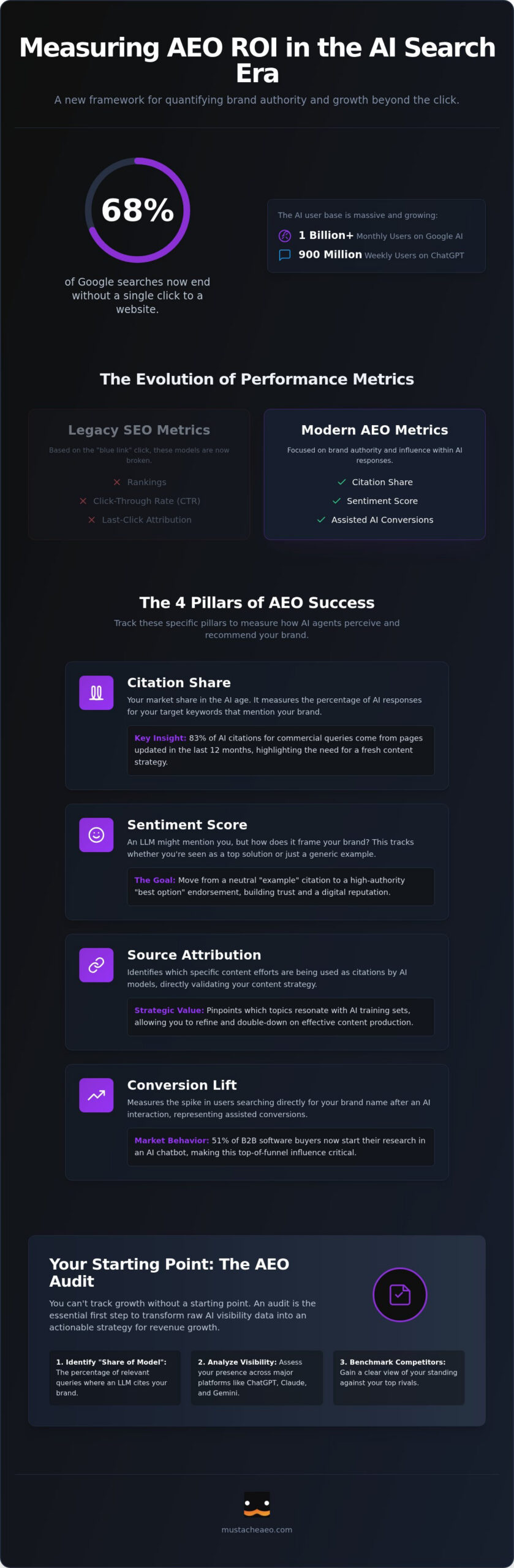
68% of Google searches in the US now end without a single click to a website. This shift toward zero-click responses isn’t just a trend; it’s the new reality of a market where ChatGPT reached 900 million weekly users and Google’s AI Mode surpassed 1 billion monthly users. You’ve likely seen your traditional referral traffic dip while AI Overviews claim more real estate. It’s unsettling to watch your brand become a source for an AI agent without knowing if that visibility translates into profit. You need to know how to measure AEO ROI before your stakeholders write off Answer Engine Optimization as a vanity project.
We’re here to bridge that gap. You’ll learn how to quantify the business value of AEO by tracking citations, sentiment, and conversion lift across platforms like ChatGPT and Perplexity. We’ll provide a clear framework for AEO reporting and specific KPIs that correlate AI citations with revenue. This guide also identifies the mid-tier and enterprise tools available in 2026 to automate your tracking process; this turns the AI black box into a transparent engine for growth.
Key Takeaways
- Redefine success by moving beyond traditional clicks to measure Brand Authority Equity and the frequency of AI-driven recommendations.
- Master the ROCI formula to understand how to measure AEO ROI by comparing content optimization costs against the dollar value of primary citations.
- Monitor Citation Share and Sentiment Scores to ensure AI engines are recommending your brand as a top-tier solution rather than a generic example.
- Utilize specialized tracking tools and APIs to quantify brand mentions across conversational platforms like ChatGPT and Perplexity.
- Establish a baseline with an AEO Audit to transform raw AI visibility data into an actionable strategy for revenue growth.
Why Traditional ROI Models Fail in the Age of AI Search
Legacy marketing relies on the “blue link” click. This model is broken. In 2026, 68% of Google searches result in zero clicks because AI answers the query directly. If you’re still judging success by website traffic alone, you’re missing the bigger picture. AEO ROI is the measurable impact of brand citations and recommendations within AI-driven search environments. It’s about being the answer, not just a result. Understanding how to measure AEO ROI requires a shift from tracking clicks to tracking brand authority.
Legacy Search engine optimization (SEO) metrics like rankings and Click-Through Rate (CTR) are fading in relevance. Today, success is defined by citation share and sentiment. Citation share represents how often an LLM mentions your brand compared to others. Sentiment determines if the AI recommends you as a top-tier solution or merely lists you as a generic example. Miami brands must stop chasing links and start securing authority within these automated ecosystems.
The Death of Last-Click Attribution
Conversational AI disrupts the traditional marketing funnel. Users no longer follow a linear path from search to click to purchase. Instead, they interact with a chatbot, receive a recommendation, and might later visit your site directly or via a branded search. This makes last-click attribution nearly impossible. We now focus on “Assisted AI Conversions.” AI search acts as a top-of-funnel discovery engine. It bypasses traditional search results entirely; it provides users with a curated list of trusted brands before they ever see a list of links.
Establishing an AEO Baseline
You can’t track growth without a starting point. Performing an AEO audit is the essential first step in your journey. This process identifies your “Share of Model,” which is the percentage of relevant queries where an LLM cites your brand. We analyze your visibility across major platforms like ChatGPT, Claude, and Gemini. By setting benchmarks against your top three local Miami competitors, you gain a clear view of your current standing. This data provides the foundation for how to measure AEO ROI as your strategy matures over time.
The 4 Key Metrics for Answer Engine Optimization Success
Visibility in AI search isn’t a vanity metric. It’s the new foundation for digital authority. To understand how to measure AEO ROI, you must track four specific pillars that define your presence within large language models (LLMs). These metrics move beyond the simple click and focus on how AI agents perceive and recommend your brand.
- Citation Share: This is your market share in the AI age. It measures the percentage of AI responses for your target keywords that mention your brand. Since 83% of AI citations for commercial queries come from pages updated in the last 12 months, this metric also tracks the freshness of your content strategy.
- Sentiment Score: An LLM might mention you, but how does it frame you? We track whether the engine recommends you as the “best” option or just lists you as a generic “example.” High-intent sentiment is a direct driver of trust.
- Source Attribution: This identifies which specific content optimization efforts are actually being used as citations. It validates which topics are resonating with AI training sets and helps you refine your production.
- Conversion Lift: 51% of B2B software buyers now start their research in an AI chatbot. While direct links are rarer, AEO drives significant branded search volume. We measure the spike in users searching for your brand name directly after an AI interaction.
Traditional methods for calculating ROI for content often focus on immediate clicks. AEO requires a more nuanced view of brand equity and assisted conversions. You must look at the total ecosystem impact rather than isolated sessions.
Measuring Brand Sentiment in LLMs
AI engines are recommendation engines. We use natural language processing (NLP) tools to grade the quality of these recommendations. A neutral citation is a start. A high-authority endorsement is the goal. For Miami firms, positive AI sentiment builds a digital reputation that functions as a 24/7 referral network. This qualitative data is essential for determining how to measure AEO ROI accurately. It proves that the AI isn’t just aware of you; it trusts you. Identifying these shifts requires specialized tools and expertise in linguistic analysis.
Tracking Citation Accuracy and Hallucinations
ROI drops when AI engines provide incorrect information. We monitor for “Brand Hallucinations.” This happens when an LLM invents services or pricing you don’t actually offer. Misinformation drives away potential customers. It creates friction in the sales process. Accurate citations are the only way to ensure your Answer Engine Optimization efforts yield a positive return. Our Tracking & Reporting experts help you decode these complex signals and maintain your brand integrity across all major platforms.
Tools and Platforms to Quantify AEO Performance
Measuring visibility in 2026 requires more than a simple rank tracker. You need a stack of modern tools designed to parse conversational data and citation patterns. Many businesses still struggle with traditional marketing metrics that fail to capture the nuances of LLM interactions. To understand how to measure AEO ROI, you must integrate tools that look beyond the click and into the prompt itself.
The Semrush AI Visibility Toolkit is a powerful baseline for tracking citations across Google AI Overviews. It shows you exactly which phrases trigger your brand as a primary source. For deeper conversational insights, the Perplexity Pages & API offers direct measurement of brand mentions within their unique conversational results. These platforms provide the raw data, but the real value comes from synthesis. Our Tracking & Reporting service provides managed analysis for businesses that need human-led strategic insights to turn these numbers into growth. We move past the “AI Black Box” by translating technical citations into business outcomes.
Custom GA4 dashboards remain relevant if configured correctly. You must set up specific referral filters for domains like “ai.com”, “perplexity.ai”, and “openai.com”. This allows you to isolate traffic originating from Answer Engines. While this only captures the users who actually click through, it remains a vital component of how to measure AEO ROI in a multi-channel ecosystem.
Best AEO Tracking Tools for Enterprise vs. Local Brands
Enterprise-grade platforms like Botify and BrightEdge are built for massive data sets. They provide the scale needed for global corporations to monitor thousands of keywords across multiple regions. Conversely, local Miami brands often find better value in niche tools like Geoptie for quick AEO tracking and grading. Most small businesses benefit more from managed agency reporting than from expensive SaaS seats. We provide the expertise to interpret the data without the overhead of enterprise software licenses.
Automating Your AEO Dashboard
Traditional marketing models struggle with the persistence of AI training data. Unlike a social media post that vanishes in hours, a citation in an LLM remains part of that model’s knowledge base for its entire lifecycle. This longevity means one successful optimization effort pays dividends for months. To understand how to measure AEO ROI, you must shift your focus toward Return on Content Investment (ROCI). This metric accounts for the long-term brand equity generated when AI agents recommend your services.
The ROCI formula is straightforward: (Value of AI-Driven Brand Lift – Cost of Content Optimization) / Cost of Optimization. We calculate the “Value of AI-Driven Brand Lift” by assigning a dollar value to primary citations. We use equivalent PPC costs as a proxy for this value. If a lead generation click for your industry costs $15 on a search engine, a direct recommendation from ChatGPT carries at least that much weight. While we don’t manage PPC, we use these market rates to validate the financial impact of your AI visibility.
AEO also creates a “Halo Effect” on your broader digital presence. High-authority citations in AI search results often correlate with improvements in organic SEO and direct brand traffic. When an AI engine validates your expertise, users frequently bypass the search results page to visit your site directly. This cross-channel lift is a vital component of your total return.
Calculating the Value of a Primary Citation
Miami firms face unique competitive pressures in local AI search. We track ROI for “near me” conversational queries specifically within the South Florida market. When an AI engine recommends your Miami office for a local service inquiry, it drives physical foot traffic and direct phone calls. Being the first firm cited in your niche provides a massive first-mover advantage. This local visibility is often the difference between a lead choosing you or a competitor. Ready to stop guessing? Start your AEO Strategy today and turn your content into a revenue engine.
Scaling Your Success with a Miami AEO Agency
Raw data is just noise without a strategic narrative. A spreadsheet showing a spike in citations doesn’t explain why an LLM prioritized your brand over a competitor. A specialized AEO agency provides the technical lens needed to decode these complex signals. We turn ROI reports into actionable content roadmaps. This ensures your marketing efforts are never wasted on low-impact tactics. We translate the “AI Black Box” into a clear path for business growth.
Ongoing AEO services are essential for maintaining your citation share. AI models are not static; they are constantly updated and retrained on new data sets. If you stop optimizing, your authority will eventually erode. AEO is a long-term equity play rather than a short-term hack. You are building a permanent digital footprint that influences how automated systems perceive your business for years to come. This is about securing your brand’s legacy in the machine-readable world.
From Measurement to Optimization
Metrics serve as the compass for your content production. We use ROI data to identify which specific content formats the AI prefers for your niche. For some Miami firms, the engine might favor structured FAQs and schema markup. For others, it may prioritize technical whitepapers and authoritative case studies. We refine your AEO strategy based on these monthly performance shifts. This proactive approach bridges the gap between raw tracking tools and revenue-generating content. Understanding how to measure AEO ROI is only the beginning. The real value lies in using that data to outpace the competition through superior content architecture.
Next Steps: Securing Your AI Visibility
Speed is your greatest asset in this shifting digital landscape. Waiting to implement a tracking framework allows local competitors to claim the digital authority that belongs to you. Once an AI engine establishes a “preferred” source for a specific query, displacing that brand requires significantly more effort. You need a custom framework to understand how to measure AEO ROI within your specific industry. Our team provides the transparency and results you need to lead your market with quiet confidence. We help you move from a state of curiosity to a state of conversion quickly. Contact Mustache AEO to start your audit today and claim your place in the future of search.
Securing Your Brand’s Authority in the AI-First Era
Digital marketing has evolved beyond the blue link. You’ve seen why legacy metrics fail and how primary citations in LLMs provide higher trust than traditional search links. Mastering how to measure AEO ROI is no longer optional for businesses that want to survive the zero-click landscape. You now have the metrics, tools, and the ROCI formula to prove the value of your content optimization efforts. You know that sentiment and citation share are the new gold standards for digital visibility.
It’s time to turn these insights into a competitive advantage. We provide pioneering AI search visibility frameworks and expert sentiment analysis to help you scale. Our team creates strategic roadmaps for Miami brand authority that move your business from being a generic example to a high-trust recommendation. Your brand’s future is being written in the responses of AI agents today. Let’s make sure it’s a powerful endorsement.
Maximize Your AI ROI with a Mustache AEO Audit
Frequently Asked Questions
How long does it take to see ROI from AEO efforts?
ROI typically materializes within three to six months as LLMs update their training data or access real-time web results. Initial visibility shifts often appear sooner in “live” engines like Perplexity or Google AI Overviews. Because AI citations persist longer than social posts, the return accumulates over time. Consistency in content optimization ensures that your brand remains part of the model’s preferred knowledge base for future updates.
Can I use Google Analytics to track traffic from ChatGPT and Perplexity?
You can track referral traffic by configuring custom filters in GA4 for domains like openai.com and perplexity.ai. While this captures users who click through, it doesn’t account for the “zero-click” interactions where users get their answer directly. This is why learning how to measure AEO ROI requires looking beyond analytics to track brand sentiment and assisted conversions that occur outside your website.
What is a “good” citation share for a local Miami business?
A citation share between 15% and 25% is considered strong for a local Miami business in a competitive niche. This means your brand appears in roughly one out of every four AI-generated answers for your target queries. Achieving this level of visibility establishes you as a local authority. We use our Tracking & Reporting services to benchmark this against your top local competitors to ensure you lead the market.
Is AEO ROI higher than traditional SEO ROI?
AEO often delivers a higher conversion rate because AI recommendations carry significant trust and authority. While traditional SEO might drive more raw traffic volume, AEO focuses on high-intent users who are looking for specific solutions. When an AI agent recommends your brand as the “best” option, the user is already pre-sold. This tailored discovery process frequently results in a superior Return on Content Investment compared to generic search clicks.
Do I need expensive software to measure my brand visibility in AI?
You don’t necessarily need enterprise software, as mid-tier tools like Goodie AI or FogTrail offer monitoring for $199 to $499 per month. However, raw data from these tools requires strategic interpretation to be useful. Most Miami firms find that a managed AEO Audit provides better value than managing multiple SaaS subscriptions. We provide the specialized tracking and analysis needed to turn these metrics into a clear business growth strategy.
How do I explain AEO metrics to stakeholders who only care about sales?
Frame AEO metrics in terms of “Brand Authority Equity” and cost savings. Explain how to measure AEO ROI by comparing the value of an AI recommendation to the equivalent cost of a lead generation click. Use the ROCI formula to show that being the primary source in ChatGPT is a high-value endorsement that drives direct branded searches. This shifts the conversation from vanity metrics to tangible business assets and long-term revenue potential.
What happens to my ROI if the AI engine updates its model?
AI model updates can cause temporary shifts in citation share, similar to a Google core update. However, content that prioritizes E-E-A-T and technical structure tends to remain resilient. Ongoing Content Optimization ensures your brand stays relevant across new training iterations. By maintaining a fresh and authoritative digital footprint, you protect your ROI from being eroded by model updates or new competitors entering the AI search space.
Does being cited in an AI Overview always lead to a website click?
Being cited does not guarantee a click, as 68% of US Google searches now end without a click. The value lies in brand validation and being the “answer” provided to the user. Even without a click, the citation builds trust and drives users to search for your brand directly later in their journey. This “Halo Effect” is a critical component of the total return generated by your Answer Engine Optimization strategy.