
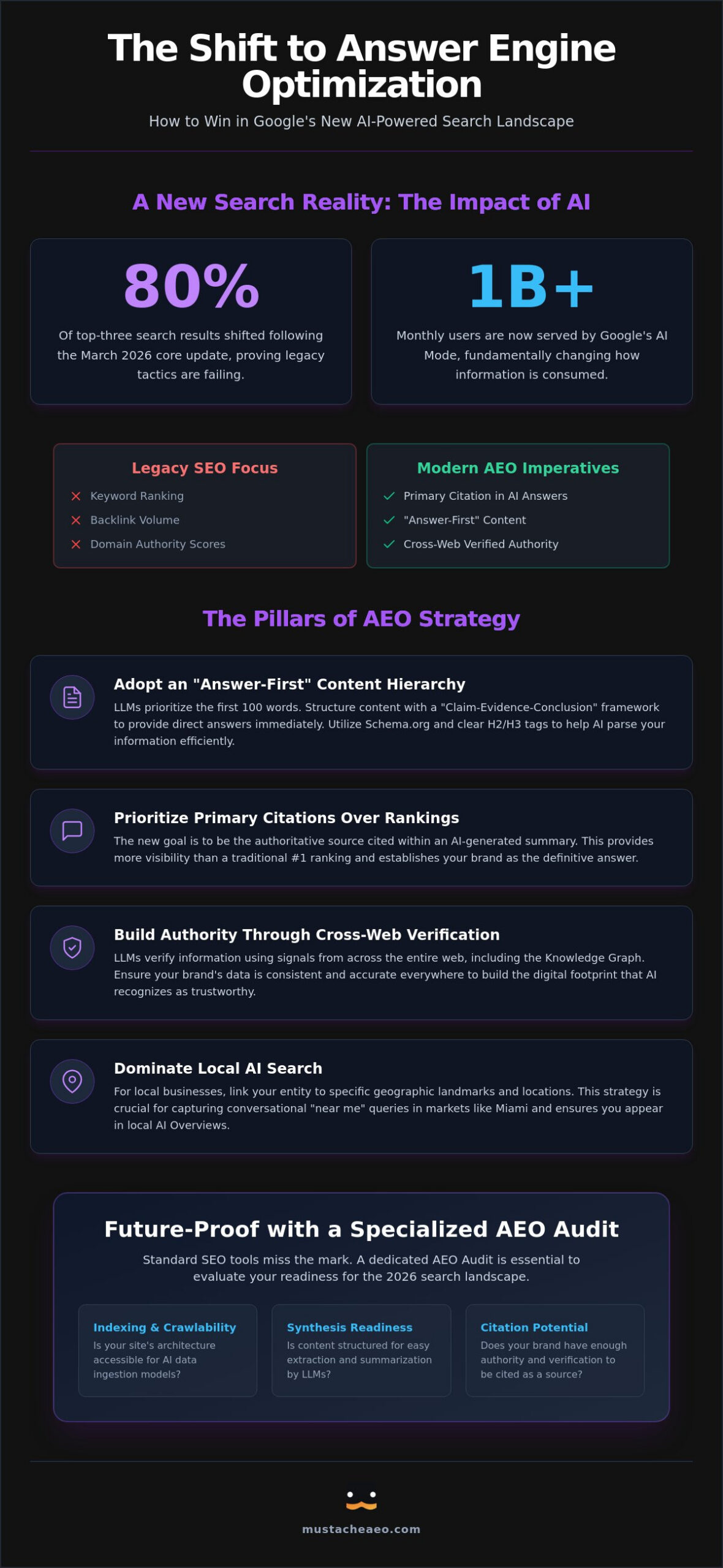
Did you know that nearly 80% of top-three search results shifted following the March 2026 core update? This massive volatility confirms that legacy search tactics are no longer enough to maintain visibility. You’ve likely felt the pressure of declining click-through rates as Google’s AI Mode, which now serves over one billion monthly users, reshapes how information is consumed. You need to know how to improve Google AI overview results for my business to avoid being ignored by the very systems your customers now rely on. It’s natural to feel concerned about LLM hallucinations or losing your brand’s voice in an automated summary.
We’re here to bridge that gap with a strategic roadmap for Answer Engine Optimization (AEO). You can master the transition from traditional search to AI-driven answers by focusing on verified brand authority and answer-ready architecture. This guide previews the technical requirements for the new June 2026 Search Console reports and explains how to secure consistent citations. We’ll show you how to establish your brand as a definitive source; this ensures your expertise is validated and prioritized within the Google AI ecosystem.
Key Takeaways
- Shift your focus from traditional keyword ranking to securing primary citations. Learn how to distinguish your strategy between standard search results and AI-generated responses.
- Adopt an “Answer-First” content hierarchy to capture LLM attention. We show you how to structure the first 100 words of your pages and use Schema.org to assist AI parsing.
- Learn the exact steps to improve Google AI overview results for my business through cross-web verification. This process builds a digital footprint that LLMs recognize as authoritative and trustworthy.
- Dominate local AI search by linking your business to specific geographic landmarks. This strategy ensures your brand appears in conversational “near me” queries for the Miami market.
- Identify visibility gaps with a specialized AEO Audit. This goes beyond standard SEO to evaluate your site’s indexing, synthesis, and citation potential for the 2026 landscape.
Understanding Google AI Overviews and the Shift to Answer Engine Optimization
Google’s search interface has undergone its most radical transformation to date. By mid-2026, the traditional list of ten blue links has been largely superseded by synthesized summaries that appear at the very top of the page. Understanding Google AI Overviews is the first step toward reclaiming your digital presence in this automated environment. These summaries don’t just list websites; they provide direct, conversational answers by aggregating data from across the web. If you want to improve Google AI overview results for my business, you must recognize that ranking first in organic results no longer guarantees the highest visibility. Being the primary citation within an AI summary is the new gold standard for digital authority.
Legacy SEO tactics often fail to trigger these AI summaries because they focus on keyword density rather than information synthesis. AI models look for “answer-ready” content that can be easily extracted and rephrased. If your site provides a great experience but hides its core value behind fluff, the LLM will simply pass you by. Transitioning to a strategy that prioritizes being the definitive answer is no longer optional; it’s a requirement for survival in a zero-click world. You must shift your mindset from being a destination to being the data source that feeds the engine.
The Evolution from Search Engines to Answer Engines
Large Language Models (LLMs) don’t browse the web like traditional crawlers. While older bots indexed keywords, modern LLMs prioritize intent and entity resolution to understand the deep context of a query. They look for relationships between concepts, brands, and locations rather than just matching strings of text. This shift requires a new approach called What is Answer Engine Optimization? to ensure your content is digestible for these models. Answer Engine Optimization (AEO) is the process of optimizing content for synthesis by AI models.
Why Traditional SEO Metrics are Lagging
High domain authority scores don’t guarantee an AI Overview spot anymore. We’ve seen sites with massive backlink profiles lose visibility to smaller, more concise competitors who provide direct answers. This happens because AI search prioritizes accuracy and ease of extraction over legacy popularity signals. With Google’s AI Mode now serving over one billion monthly users, the necessity of being the cited source is paramount. Google uses the Knowledge Graph to verify claims in 2026, meaning your data must be consistent across the web to gain the LLM’s trust. Optimizing for these signals is the only way to improve Google AI overview results for my business effectively. If your business information is fragmented, the AI will likely cite a competitor’s details instead of yours.
The Anatomy of an AI-Cited Page: Content Structure and Technical Signals
Winning the citation game in 2026 requires more than just high-quality writing. It demands a specific architecture that mirrors how Large Language Models ingest and synthesize data. To improve Google AI overview results for my business, you must treat every page as a structured data entry for an answer engine. This means front-loading the most valuable information and removing the fluff that traditional SEO once rewarded. LLMs are efficient; they scan for immediate relevance and factual density rather than keyword frequency.
Structuring Content for AI Synthesis
The “Answer-First” hierarchy is your most potent tool for visibility. LLMs prioritize the first 100 words of a page to determine if it contains the direct solution to a user’s query. Use a Claim-Evidence-Conclusion framework for every key topic. State your primary point clearly, provide supporting data or examples, and then summarize the takeaway. AI models prioritize content that provides a direct answer within the first paragraph. Use H2 and H3 tags as semantic signposts. These headings tell the AI exactly what each section covers, making it easier for the model to extract your brand as the definitive source.
Technical performance remains a foundational requirement for these automated systems. Fast load times and high accessibility ensure that AI crawlers can access and parse your site without friction. If your site is slow or technically fragmented, it won’t be indexed for real-time synthesis. Optimizing for conversational queries is also essential. Users now ask long-tail, natural language questions. If you want to improve Google AI overview results for my business, your content must reflect the way people actually speak, providing clear answers to complex “how” and “why” prompts.
Advanced Schema and Metadata for 2026
Structured data is the primary language of AI retrieval. In 2026, standard Schema is merely the baseline. You must implement Speakable and FactCheck markup to provide the high-level trust signals Google demands for its Overviews. These specific tags help demonstrate E-E-A-T for your brand by verifying your claims against established datasets. Use JSON-LD to define your business as a unique, verifiable entity in the Knowledge Graph. This ensures the AI associates your brand name with specific expertise and geographic locations.
Don’t ignore the “About” and “Mentions” schema properties. These links connect your content to established topics and other authoritative sources across the web. This creates a web of relevance that LLMs use to validate your expertise. If you’re unsure where to start with these technical requirements, a professional AEO Strategy can help align your site’s metadata with the latest AI parsing standards. By providing these clear signals, you make it easy for Google to trust and cite your business as the primary answer.
Strengthening Brand Authority and E-E-A-T for AI Retrieval
Google’s AI models are increasingly skeptical of isolated claims. They don’t just trust what you write on your own website; they verify your authority through cross-web synthesis. To improve Google AI overview results for my business, you need to cultivate a digital footprint that signals expertise across multiple platforms. This process involves securing third-party citations, industry mentions, and press coverage that validate your brand’s core competencies. When an LLM sees your business mentioned consistently as an expert source on high-authority domains, it’s far more likely to cite you as the definitive answer in a search summary.
E-E-A-T in the Age of Generative AI
Experience and Expertise have become the primary filters for AI-driven search. Author bios and verified credentials aren’t just for readers anymore; they’re essential data points for crawlers. You should aim to become a “seed source” for industry-specific data by publishing original research or unique insights that others cite. This creates a trail of authority that Google’s algorithm follows back to your domain. Trustworthiness is built through transparent sourcing and high-quality outbound links to established peer-reviewed or government sources. If the AI can verify your facts against a trusted baseline, your citation potential skyrockets.
Managing Your Brand Entity in the Knowledge Graph
Consistency is the foundation of entity resolution. Your Google Business Profile, LinkedIn, and even specialized industry directories must align perfectly to prevent confusion. If your messaging is fragmented, you risk “AI Hallucinations” where the model misrepresents your services, pricing, or location. LLMs verify business data by triangulating information across multiple high-authority domains; for instance, AMCO.NET LLC maintains precise cross-web data to ensure its Houston insurance operations are correctly identified. This triangulation ensures that the AI’s understanding of your brand is grounded in broad consensus rather than a single, potentially outdated page.
Visibility strategies also differ depending on the platform you’re targeting. While Google prioritizes its own Knowledge Graph and E-E-A-T signals, learning How to Rank in ChatGPT requires a focus on different training sets and conversational context. Both systems, however, reward brands that establish themselves as clear, unambiguous entities. To improve Google AI overview results for my business, you must ensure that every mention of your brand across the web reinforces a singular, authoritative identity. This cohesive digital presence acts as a shield against being ignored by modern answer engines.
Local AEO: Winning AI Overviews for Miami Businesses
Local search is evolving beyond the standard map pack. In 2026, Google’s AI Overviews prioritize businesses that demonstrate deep integration with their local environment. If you want to improve Google AI overview results for my business, you must move beyond basic NAP (Name, Address, Phone) consistency. AI models now look for semantic connections between your brand and the specific geographic entities that define the Magic City. This means your digital presence shouldn’t just say you’re in Miami; it should prove you’re an active participant in the local ecosystem through verified data and neighborhood-specific context.
Geo-Entity Optimization for the Miami Market
Geo-entity optimization is the process of linking your brand to recognized landmarks and neighborhoods. Don’t just target “Miami” as a broad, generic term. Integrate specific neighborhood names like Brickell, Wynwood, and Coconut Grove into your content’s semantic core. When an AI model synthesizes a response for a query like “best boutique in Wynwood,” it looks for content that mentions proximity to the Wynwood Walls or local galleries. Create location-specific service pages that answer regional questions, such as parking availability during Art Basel or local event tie-ins. This level of specificity helps improve Google AI overview results for my business by establishing your firm as a hyper-local authority that the AI can confidently cite.
The Role of Local Citations and Reviews
The sentiment and detail of your reviews now dictate your citation frequency in AI responses. AI models don’t just count stars; they parse the text of your reviews to understand your business’s true capabilities and niche expertise. Encourage your customers to use descriptive keywords in their feedback. A review mentioning “the best vegan empanadas in Little Havana” is far more valuable for AI synthesis than a generic “great service” comment. Managing local directories also remains critical to ensure entity alignment. Every mention of your firm across Miami-specific platforms must reinforce the same factual data to avoid AI confusion. You can see how we approach this in our Miami AEO Services guide.
Winning in a competitive market like Miami requires a specialized approach that traditional agencies often overlook. We focus on the conversational nature of local search, ensuring your business is the first answer when users ask their AI assistant for recommendations. If you’re ready to dominate the local landscape and secure your spot in the summaries, it’s time to implement a tailored AEO Strategy that puts your brand at the center of the Magic City’s digital conversation.
Future-Proofing Your Visibility with a Professional AEO Audit
Standard SEO audits are no longer sufficient for the 2026 search environment. While traditional audits focus on technical health and keyword rankings, they often ignore how Large Language Models (LLMs) actually perceive your brand. An AEO Audit is the next evolution in digital strategy. It identifies the specific gaps that prevent your content from being synthesized into a primary answer. If you want to improve Google AI overview results for my business, you must evaluate your site through the lens of an answer engine rather than a simple crawler. This process requires a deep dive into your data’s structure, clarity, and citation potential.
A comprehensive audit prioritizes three critical pillars: Indexing, Synthesis, and Citation potential. Indexing ensures that AI models can access your data without technical friction or gated barriers. Synthesis evaluates if your content is “answer-ready,” meaning it uses the clear hierarchies and direct language we discussed in previous sections. Citation potential measures your brand’s authority across the broader Knowledge Graph. By analyzing these factors, you can develop a long-term roadmap for AI search dominance. Request a professional AEO Audit to identify your brand’s visibility gaps and secure your spot at the top of the page.
Measuring What Matters: AEO Tracking and Reporting
Tracking and Reporting must evolve alongside the technology. Traditional rankings are secondary to citation share and share of voice in AI summaries. You need to know how often your brand is the primary source compared to your competitors. Mustache AEO tracks authority across conversational platforms, monitoring how LLMs describe your business in real-time. We use specialized tools to detect when your brand is cited and, more importantly, when it’s being “hallucinated” or misrepresented. This data allows for rapid adjustments to your strategy, ensuring your messaging remains consistent and authoritative as search behavior shifts toward agentive experiences.
Next Steps: Implementation and Content Optimization
Implementation begins with prioritizing your highest-value pages for AEO restructuring. You don’t need to rewrite your entire site overnight; instead, focus on the queries that drive the most qualified leads. Content Optimization for AI requires a relentless focus on factual density and semantic clarity. As you’ve learned, the goal is to become the “seed source” that Google trusts for specific industry queries. Continuous monitoring is essential because AI algorithms evolve weekly. What works today might require refinement as Google rolls out new features like Personal Intelligence or agentive search tasks. To improve Google AI overview results for my business, you must stay proactive. Contact Mustache AEO to start your AI search transformation today and ensure your business remains visible in the future of search.
Claim Your Authority in the AI-Driven Search Landscape
The transition from traditional search to generative responses isn’t just a trend; it’s a fundamental shift in how your customers interact with the web. You now have the roadmap to structure your content for synthesis and strengthen your brand’s entity within the Knowledge Graph. By prioritizing an answer-first hierarchy and local geo-entity signals, you can improve Google AI overview results for my business and ensure your expertise isn’t lost in the noise. Legacy methods are falling behind as automated systems prioritize factual density and technical clarity.
We’ve been pioneering AEO strategies since 2024. As part of the Cognizant family of experts, we provide a specialized focus on AI search visibility that goes far beyond what legacy SEO firms can offer. It’s time to move past outdated tactics and embrace a digital ecosystem where your brand is the definitive answer. Secure Your Brand’s Future with a Mustache AEO Audit and identify exactly where your visibility stands today. The landscape is changing fast, but you have the tools to lead this transformation with quiet confidence.
Frequently Asked Questions
Is Google AI Overview the same as SGE?
No, AI Overviews are the permanent evolution of the experimental Search Generative Experience (SGE). While SGE was an opt-in laboratory phase, AI Overviews are now integrated directly into the primary search results for over one billion monthly users as of May 2026. This transition marks the move from experimental testing to a core, agentive search feature that synthesizes information in real-time.
How do I know if my business is being cited in an AI Overview?
You can monitor citations through the new Search Generative AI performance reports in Google Search Console, which launched in June 2026. These reports provide specific data on impressions and clicks within AI Overviews and AI Mode. You should also perform manual conversational queries to see if your brand is the primary source for your target keywords and phrases.
Can I opt out of Google AI Overviews while still appearing in search?
You can’t opt out of AI Overviews specifically without affecting your overall search visibility. Using the “nosnippet” or “max-snippet” tags tells Google not to use your content for summaries, but this also removes your traditional organic snippets. It’s more effective to focus on how to improve Google AI overview results for my business rather than attempting to hide from the primary interface of modern search.
Does having a Google Business Profile help with AI Overview visibility?
Yes, a verified Google Business Profile is a foundational entity signal for local AI visibility. AI models use this profile to verify your location, services, and customer sentiment through review synthesis. Maintaining a consistent profile ensures the Knowledge Graph has accurate data to triangulate your authority when generating local responses, especially for geo-specific queries in markets like Miami.
How long does it take to see results from AEO optimization?
Results from AEO optimization typically appear within 4 to 8 weeks, depending on your site’s crawl frequency and the density of your technical signals. Unlike traditional SEO, which can take months to move rankings, AI models can update their synthesized summaries quickly once they recognize your content as the most authoritative answer. Consistent tracking and reporting help identify these shifts as they occur.
What is the most important factor for ranking in AI search in 2026?
The most important factor is providing a direct, verifiable answer that demonstrates genuine expertise and authority. Google’s May 2026 core update reinforced that AI models prioritize “answer-ready” content that can be easily extracted and synthesized. To effectively improve Google AI overview results for my business, you must ensure your content is structured for extraction and backed by cross-web validation.
Do I need a specialized AEO agency, or can my SEO team do this?
While a traditional SEO team understands keywords, a specialized AEO agency focuses on the technical nuances of LLM parsing and entity resolution. AEO requires a different set of technical skills, such as advanced Schema implementation and semantic content restructuring. Specialized agencies bridge the gap between legacy search and the automated future of information retrieval by prioritizing synthesis over simple ranking.
Will AI Overviews replace organic search results entirely?
AI Overviews won’t replace organic search entirely, but they have fundamentally shifted the click-through landscape. Traditional blue links still exist below the fold for deeper exploration, but the AI summary captures the majority of immediate intent. Your strategy must adapt to win the citation spot, as being the cited source is the primary way to drive traffic and validation in 2026.