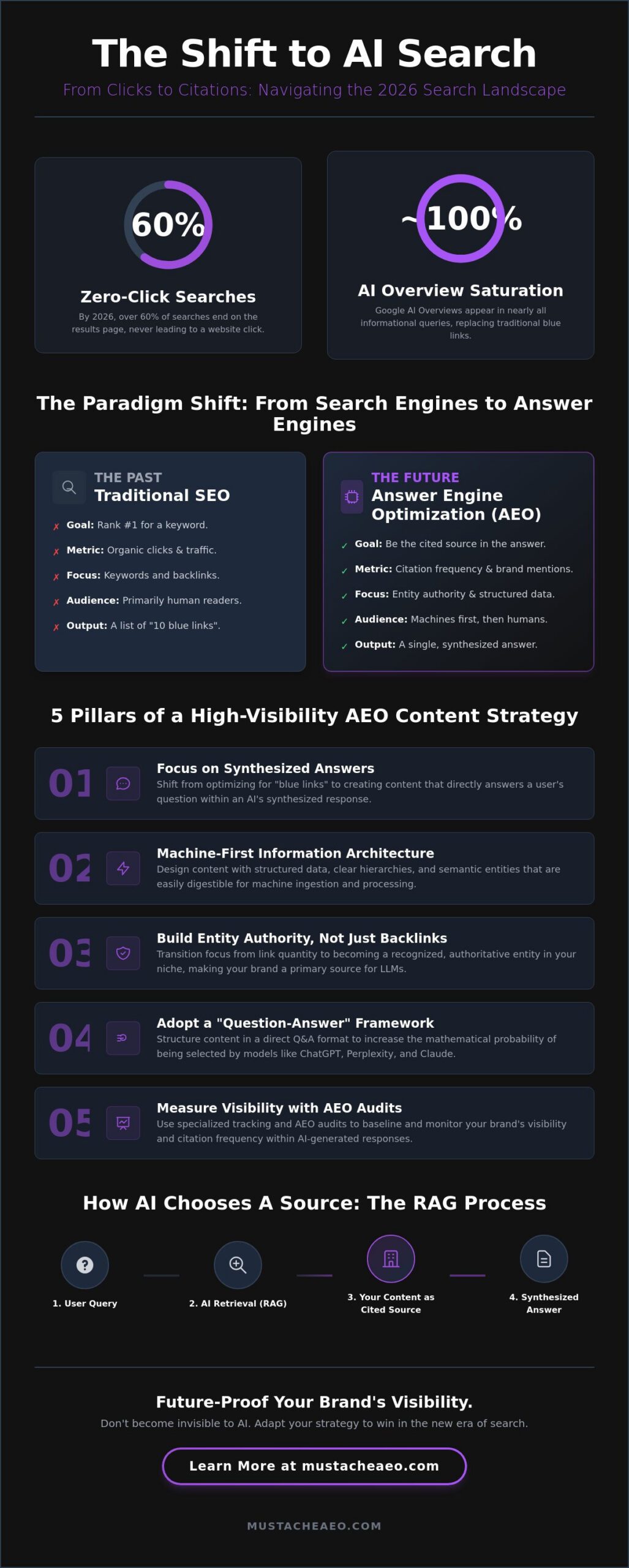
Over 60% of all searches in 2026 now end without a single click to a website. As Google AI Overviews appear in nearly 100% of informational queries, the traditional goal of ranking first is being replaced by the necessity of being cited. Success now depends on your content strategy for AI search engines. It’s no longer about winning a click; it’s about becoming the most mathematically probable answer for a Large Language Model.
You’re likely feeling the pressure of declining organic traffic and the uncertainty of how platforms like Perplexity or ChatGPT choose their sources. It’s a valid concern. If your data isn’t structured for machine readability, your brand effectively doesn’t exist to an AI. This article provides a clear roadmap to transition from legacy SEO to a citation-first strategy. You’ll learn how to build a future-proofed content infrastructure that secures authoritative brand positioning and high citation frequency across all major generative engines.
Key Takeaways
- Identify the definitive shift from traditional “blue link” rankings to synthesized answers in the 2026 conversational search landscape.
- Master a content strategy for AI search engines that focuses on information architecture designed specifically for machine ingestion.
- Transition your focus from traditional backlinks to brand citations and entity authority to become a primary source for LLMs.
- Adopt a structured “Question-Answer” content framework to increase your probability of being cited by ChatGPT, Perplexity, and Claude.
- Learn how to use AEO Audits and specialized tracking to baseline your brand’s visibility within AI-generated responses.
The Shift from Search Engines to Answer Engines in 2026
The search landscape has fundamentally fractured. For decades, Search engine optimization (SEO) focused on the “blue link” economy. Success was measured by how many users clicked through to your domain from a list of results. In 2026, that model is obsolete. Users no longer want a list of websites; they want a synthesized answer that solves their problem instantly. This transformation marks the rise of Answer Engines. Platforms like Perplexity and SearchGPT don’t just point to information. They consume it, summarize it, and deliver it within a conversational interface.
Miami businesses are seeing this tipping point firsthand. Local search has moved beyond the map pack into the era of conversational dominance. When a user asks an AI for the best commercial contractor in Brickell, they don’t want to browse ten websites. They want a single, authoritative recommendation backed by synthesized reviews and verified data. If your content strategy for AI search engines isn’t optimized for this machine ingestion, your brand remains invisible. Discovery now happens through synthesis, not selection.
The Decline of Organic CTR
The data is clear. In 2026, between 58% and 62% of all searches are zero-click. This means the majority of users get their answers directly on the results page without ever visiting a website. While Google still holds 87.6% of the search market, its AI Overviews now appear in up to 99.9% of informational queries. This shift has decimated traditional organic click-through rates. You can’t rely on traffic alone to build brand equity.
The Zero-Click Reality is a search environment where the value of a brand is determined by its presence within an AI’s synthesized response rather than its position in a list of links. Success now requires “Citation SEO.” You must ensure that when an LLM generates an answer, your brand is the primary source it cites. This builds awareness and trust even when the user doesn’t click. It’s about being the authority the AI trusts most.
Answer Engine Optimization (AEO) Defined
AEO is the technical and strategic process of making your data digestible for Large Language Models. It is the evolution of traditional search. While legacy algorithms prioritized keywords and backlinks, generative models prioritize entity authority and structured clarity. Your primary audience is no longer just the human reader; it’s the machine that interprets your content for them. You’re optimizing for the algorithm’s ability to summarize you accurately.
Effective AEO requires a specific content strategy for AI search engines. You must move away from long-form fluff and toward high-density, structured information. This ensures that an AI can easily parse your expertise and attribute it to your brand. Generative models don’t “rank” pages in the traditional sense; they select facts. By treating LLMs as your primary distributors, you secure your place in the future of digital discovery. For help developing the creative assets necessary for this new environment, click here to learn about AHS Digital. We help you move from being a link to being the answer.
What is Content Strategy for AI Search Engines?
A modern content strategy for AI search engines is the intentional architecture of information designed for machine ingestion. It moves beyond the legacy focus on keyword density. Instead, it prioritizes the creation of semantic entities and knowledge graphs that an AI can easily map. Your core objective is to maximize the mathematical probability of being selected as the primary source for an AI response. If an LLM cannot verify your brand’s data against its existing knowledge base, it will likely ignore or hallucinate your information. We ensure your data is indisputable.
Trust is the new currency in 2026. For a user to trust an AI’s answer, the AI must cite a credible source. By positioning your brand as that source, you secure a level of authoritative positioning that traditional “blue links” could never provide. This requires your content to evolve for both search engines and AI simultaneously. You aren’t just writing for people; you’re building a digital reputation that machines can validate and distribute at scale.
Understanding RAG: Retrieval-Augmented Generation
Retrieval-Augmented Generation (RAG) is the mechanism that allows AI engines to provide real-time, accurate answers. Unlike older models that relied solely on static training data, RAG allows engines like Perplexity to “retrieve” fresh content from the web before “generating” a response. This is why AEO content optimization Miami requires a technical foundation. If your site’s data isn’t structured for this retrieval process, you won’t appear in the three billion queries ChatGPT processes monthly. Your content must be accessible, current, and formatted for instant machine extraction.
The Anatomy of an AI-Ready Content Piece
AI-ready content follows a specific structural logic. It prioritizes clarity over creative flair to ensure an LLM captures the correct intent. Every piece of content should employ the “Bottom Line Up Front” (BLUF) approach. State the answer immediately. This reduces the processing power the AI needs to understand your point, making you a more attractive citation. Essential components include:
- Direct Answer Blocks: Concise, declarative sentences that provide an immediate solution to a specific query.
- Structured Data and Schema: Technical tags that act as a digital roadmap for AI crawlers.
- Declarative Language: Using precise, factual statements to minimize the risk of AI hallucination.
By refining these elements, you create a content infrastructure that is both human-centric and machine-readable. If you’re unsure where your current assets stand, conducting a professional AEO Audit is the most efficient way to identify gaps in your machine-readability.
AEO vs. SEO: Structural Authority and Citation Mechanics
Traditional SEO built authority through a web of backlinks. In 2026, AI engines prioritize entity authority and brand citations above all else. An AI doesn’t just look at who links to you; it looks at who mentions you and in what context. This shift is the cornerstone of a successful content strategy for AI search engines. You must move from being a popular destination to being a verified source of truth. Authority is now a measure of how often your brand is cited as a factual reference by the models themselves.
There’s a massive difference between ranking #1 in a list of blue links and being the sole cited source in a ChatGPT response. When an AI provides a single synthesized answer, the winner takes all. If you aren’t the citation, you’re invisible. This requires a Content Strategy That Survives AI Search by focusing on factual density rather than word count. AI engines evaluate the “truthfulness” of your brand by cross-referencing your data against a vast knowledge graph of established facts. If your information is inconsistent, you’ll be excluded from the response.
The New Hierarchy of Authority
Authority is no longer just about domain rating. AI models now calculate a “Source Credibility” score based on how often your brand’s facts are corroborated across the web. High-trust platforms like Wikipedia, industry-specific niche directories, and local Miami citations carry immense weight. These sites act as the “ground truth” for LLMs. Large Language Models verify facts by cross-referencing your claims against thousands of other digital touchpoints to ensure consistency and accuracy. If your business information varies between your website and your social profiles, the AI will likely flag it as unreliable and choose a competitor instead.
Modular Content Design
Long-form, rambling articles are a liability for machine ingestion. AI engines prefer “modular content” broken into distinct knowledge chunks that they can easily extract and summarize. Each section should serve as a standalone answer to a specific user intent. Use your H2 and H3 headings as direct query targets for conversational search. This structure helps you rank in ChatGPT by mirroring the natural conversational patterns users employ. By designing content in modules, you provide the AI with the exact “blocks” it needs to build a response.
- Fact-First Headers: Use headings that state a clear fact or answer rather than a vague topic.
- Entity Association: Ensure your brand name is consistently paired with your core services in every paragraph.
- Data Consistency: Audit all digital touchpoints to ensure your brand’s “story” is identical everywhere.
We specialize in transforming legacy content into these modular formats. Our AEO Strategy ensures your brand’s data is not just present, but prioritized by the retrieval systems that power modern search.
5 Pillars of a High-Visibility AEO Content Strategy
Building a content strategy for AI search engines requires a shift from keyword targeting to entity validation. You aren’t just trying to rank; you’re trying to become the definitive source for a machine’s synthesized response. This involves a structural overhaul of how your data is presented and distributed across the digital ecosystem. A high-visibility strategy ensures that when an LLM retrieves information, your brand is the most logical and authoritative choice for a citation.
Executing this transition involves five core steps designed to maximize your machine-readability and authority:
- Step 1: Perform a comprehensive AEO Audit to baseline your current AI visibility.
- Step 2: Transition to a “Question-Answer” content architecture that mirrors conversational intent.
- Step 3: Implement advanced Schema markup to provide explicit entity validation for crawlers.
- Step 4: Distribute modular content across high-authority “Answer Engine” hubs and niche directories.
- Step 5: Monitor your citation frequency and share of voice using best aeo tracking tools.
Pillar 1: The AEO Audit
You can’t optimize what you haven’t measured. An audit assesses how Perplexity, ChatGPT, and Claude currently “see” your brand. It identifies citation gaps where competitors are being preferred by the models despite your brand having better data. Understanding what is an AEO audit is critical because it replaces the traditional technical SEO audit. Instead of looking for broken links, we look for “knowledge gaps” that prevent an AI from trusting your information. We identify exactly why an LLM might be hallucinating your brand details or ignoring your expertise entirely.
Pillar 2: Conversational Keyword Research
Traditional short-tail keywords are losing their utility. Modern content strategy for AI search engines focuses on “natural language” questions that map the actual customer journey. You must optimize for “Who, What, Where, and Why” queries rather than high-volume fragments. In Miami, this means capturing local intent that triggers AI-driven local packs. For example, instead of targeting “Miami real estate,” you should target “What are the trending commercial real estate zones in Miami for 2026?” This provides the direct, factual answer that generative engines crave.
Beyond keywords, your strategy must include advanced Schema markup. This acts as an explicit digital ID for your brand, telling AI crawlers exactly who you are and what you do without any ambiguity. Once your technical foundation is set, you must distribute your modular content to high-authority hubs. AI models prioritize data that is corroborated across multiple trusted sources. By ensuring your facts are consistent on Wikipedia, niche industry sites, and local directories, you increase your “Source Credibility” score.
Finally, tracking is no longer about “rankings.” You need to monitor how often your brand is cited as the primary source in an AI Overview. This data allows you to refine your strategy in real-time. Ready to dominate the new search landscape? Book your AEO Strategy session and secure your brand’s authority today.
Future-Proofing Your Brand with a Miami AEO Agency
Generic SEO agencies in Miami are struggling. They’re still optimizing for a search world that relies on blue links and site traffic. As we’ve established, the 2026 landscape is dominated by zero-click results and AI-synthesized answers. A traditional approach can’t solve for the technical requirements of LLM ingestion. You need a specialized AEO agency that understands the mathematical probability of citations. This is your primary competitive advantage in a market that is rapidly automating brand discovery.
Misrepresentation is a significant risk for businesses today. When an LLM lacks a structured content strategy for AI search engines to follow, it fills the gaps itself. This often leads to “hallucinations” where the AI provides incorrect contact details, outdated pricing, or non-existent services. We eliminate this risk by building an airtight technical foundation. Our approach ensures that every piece of your digital footprint is verified and indisputable. We don’t just hope the AI finds you; we make it impossible for the AI to ignore you.
Mustache AEO: Your Miami Partner for the AI Revolution
We treat Answer Engine Optimization as a distinct, results-driven discipline. Our focus isn’t on vanity metrics like impressions or keyword rankings. We prioritize citation frequency and share of voice within AI Overviews. For Miami enterprises, this means customized strategies that dominate local conversational search. Whether a user is asking about logistics in PortMiami or luxury real estate in Coral Gables, your brand must be the cited authority. We provide the technical audits and strategic roadmaps necessary to own that niche.
Next Steps: Securing Your AI Visibility
The transition to a citation-first model doesn’t happen overnight. It starts with a comprehensive Miami AEO Audit to identify where your brand is currently being misrepresented or overlooked. From there, we implement a modular content strategy for AI search engines that scales with the evolving models of ChatGPT, Perplexity, and Claude. Most clients begin to see a measurable increase in brand citations and entity authority within the first 90 days of implementation.
The search world has changed. Don’t let your brand become a relic of the legacy SEO era. Secure your position as a trusted source in the AI ecosystem today. Schedule your 2026 AEO Strategy session with Mustache AEO and take control of your digital future.
Take Control of Your Brand’s AI Future
The search landscape has moved past the era of blue links. In 2026, your visibility is defined by how effectively LLMs can retrieve and cite your brand’s data. Success requires a robust content strategy for AI search engines that prioritizes factual density and modular information architecture. By shifting your focus from site traffic to citation frequency, you secure a position as a trusted authority in the conversational ecosystem. You’ve seen the roadmap; now it’s time to implement it.
You don’t have to navigate this technological shift alone. Mustache AEO provides the specialized expertise needed to ensure your brand is prioritized, not hallucinated. Our Miami-based AI search experts use a specialized AEO Audit Framework and citation-focused reporting to give you total transparency into your brand’s machine-readability. We provide the technical roadmap to future-proof your digital presence and keep you ahead of the competition.
Get Your Brand Cited: Book Your 2026 AEO Audit with Mustache AEO
The evolution of information retrieval is an opportunity for those ready to adapt. We’re here to help you own your niche and lead the way in the Magic City’s AI revolution.
Frequently Asked Questions
What is the main difference between SEO and AEO content strategy?
Traditional SEO focuses on earning clicks through a list of links, while AEO focuses on providing the direct answer used by an AI. SEO rewards keyword placement and backlink volume. AEO rewards factual density, entity authority, and the ability of a machine to summarize your information accurately. The goal shifts from driving a website visit to becoming the definitive answer.
How do AI search engines choose which websites to cite?
AI engines prioritize sources that offer structured, verifiable, and corroborated information. They use Retrieval-Augmented Generation (RAG) to pull the most relevant facts from the web in real-time. If your content is consistently mentioned across high-authority directories and niche platforms, the AI’s credibility score for your brand increases, making you the preferred citation for a response.
Can I still rank in Google if I focus entirely on AEO?
Focusing on AEO actually improves your Google visibility because their 2026 algorithm is heavily centered on AI Overviews. These overviews now appear in nearly 100% of informational queries. By optimizing for machine-readability and E-E-A-T, you satisfy both the generative engine and the traditional ranking factors Google still employs to determine authority.
How much does a professional AEO audit cost for a Miami business?
The investment for a professional audit depends on the complexity of your digital footprint and the volume of content requiring analysis. We provide tailored quotes based on a Miami business’s specific needs rather than using a one-size-fits-all pricing model. It’s best to consult with an AEO specialist to determine the exact scope of technical work required for your brand.
Which AI search engine is the most important to optimize for in 2026?
ChatGPT is currently the most significant standalone AI search engine, processing over 3 billion queries monthly as of June 2026. However, a balanced content strategy for AI search engines must also account for Google AI Overviews and Perplexity. Each platform has unique retrieval nuances, but they all reward the same core principles of structured data and factual consistency.
How do I prevent ChatGPT from hallucinating facts about my brand?
You prevent hallucinations by using clear, declarative language and advanced Schema markup to define your brand’s facts. LLMs often hallucinate when they encounter ambiguous or conflicting data across different websites. Maintaining absolute consistency in your contact details, services, and brand story across all digital touchpoints ensures the AI has a single, verifiable truth to retrieve.
Do I need to rewrite all my existing content for AI search?
You don’t need to rewrite every page, but you should prioritize your most authoritative assets for a modular overhaul. A successful content strategy for AI search engines starts with pages that answer high-intent questions. Transforming these into knowledge chunks with fact-first headers allows AI engines to extract your expertise without processing unnecessary fluff.
How can I track my brand’s visibility in conversational AI results?
Tracking visibility in 2026 requires moving beyond traditional ranking reports to citation-focused metrics. Specialized tracking tools now measure how often your brand appears in AI responses and your share of voice compared to local competitors. These insights allow you to see exactly which content pieces are being used as primary sources by platforms like Perplexity and SearchGPT.