
Google’s AI Overviews now appear in nearly 55% of all searches, reaching over 2.5 billion monthly active users. This massive shift has forced a new conversation around AEO vs SEO. You’ve likely noticed your organic click-through rates dipping as Gemini 3.5 Flash provides answers directly on the results page. It’s a common frustration to see your brand’s traffic stall even when your rankings remain high. You might even worry about how ChatGPT finds its information or if AI hallucinations are affecting your brand authority.
We’ll help you bridge the gap between traditional search and the automated future. You can maintain your Google authority while ensuring LLMs cite your brand as a primary source. This guide provides a clear roadmap for 2026 search visibility. You’ll learn the technical steps to get cited by AI models and how to navigate new transparency requirements like the EU AI Act. We’ll show you how to turn AI Overviews from a threat into your greatest competitive advantage.
Key Takeaways
- Identify the fundamental shift in AEO vs SEO where the priority moves from traditional search volume to question frequency and citation share.
- Learn why a technical AEO Audit is now the critical first step to ensuring your brand appears in conversational AI responses.
- Master the “Authority Loop” to leverage your current search rankings as trust signals for Large Language Models.
- Implement specific Schema.org markups like Speakable and FAQ to improve your content’s readability for AI engines.
- Follow a specialized roadmap to move beyond simple keyword tracking and achieve measurable AI citation dominance.
What is AEO vs SEO? Understanding the 2026 Search Paradigm
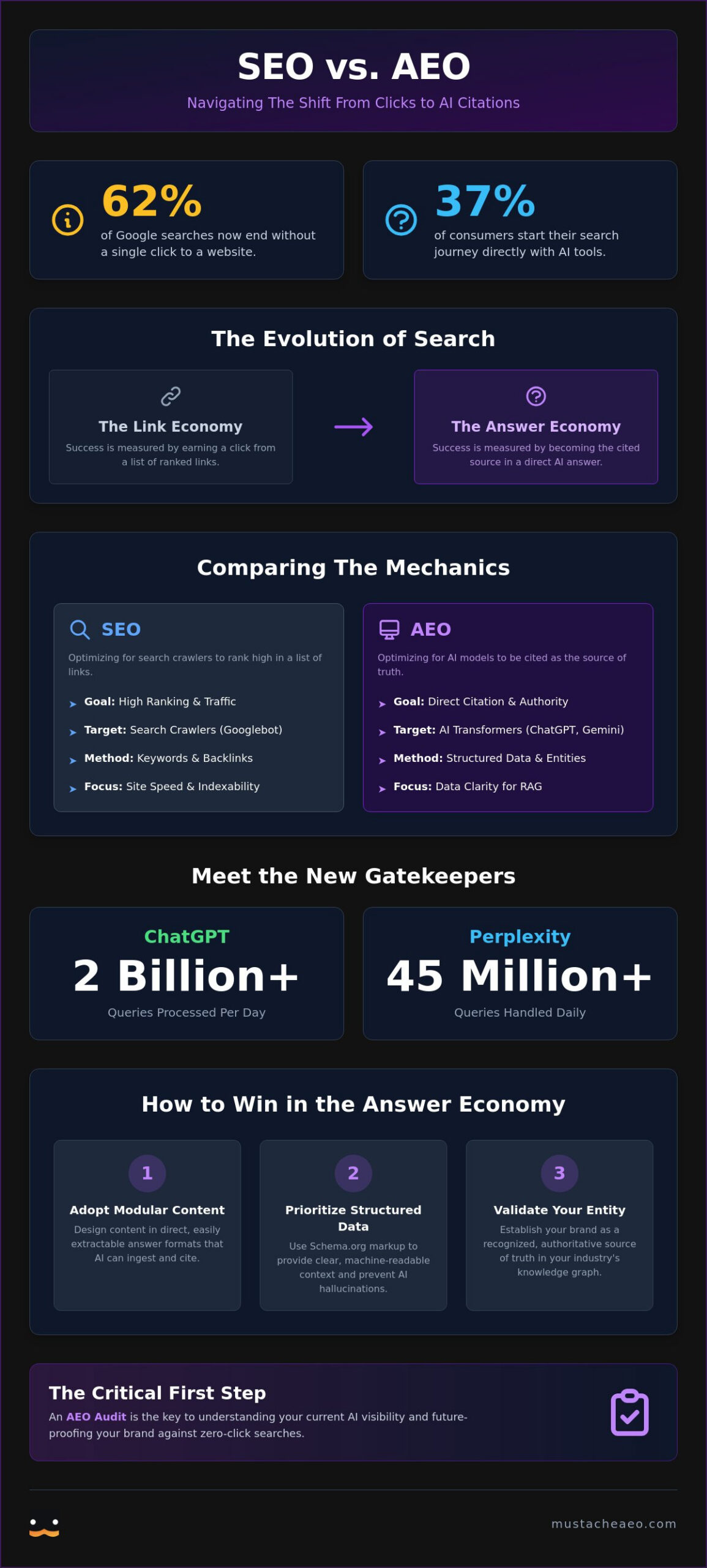
Search has moved beyond the era of browsing. In 2026, the discussion around AEO vs SEO centers on a fundamental change in how users consume information. Traditional search engine optimization (SEO) focuses on optimizing for web crawlers to rank pages in search engine results pages. Answer Engine Optimization (AEO) optimizes for Large Language Models (LLMs) to provide direct, conversational responses. We’re witnessing a paradigm shift where search is moving from finding a list of links to receiving a single, validated answer.
AEO is the strategic process of making brand facts machine-readable and authoritative for AI engines. This isn’t just about keywords anymore. It’s about being the definitive source that an AI agent trusts enough to repeat. While SEO secures your place in the digital library, AEO ensures the librarian recommends you by name. For B2B organizations looking to drive international growth, leveraging the expertise of Cheerway can ensure your site architecture and SEO strategy are aligned with these global AI standards. This shift is agentic. AI agents no longer just provide a path; they perform the evaluation for the user, choosing the most credible data points to present in a synthesized format.
The Evolution of the Search Interface
The interface of search has transformed into a conversational dialogue. With Google AI Overviews appearing in nearly 55% of searches, the zero-click trend is no longer a prediction; it’s the standard. Users now interact with Gemini 3.5 Flash or Perplexity to get immediate solutions without ever visiting a website. This agentic shift means AI isn’t just showing options. It’s performing tasks and making choices for the consumer. If your brand isn’t optimized for these conversational queries, you’re invisible to over 2.5 billion monthly active users who rely on these automated summaries. You must optimize for the “answer” to capture this new wave of conversational intent.
SEO: The Foundation of Digital Findability
Traditional methods remain the bedrock of your visibility. You cannot have effective AEO without a strong foundation in traditional search engine optimization (SEO). Technical SEO, site speed, and mobile responsiveness still dictate how well engines index your data. High-quality backlink profiles continue to serve as essential trust signals. Think of SEO as the process of building and stocking a world-class library. AEO is the layer that summarizes that library for the user. Without the books (your indexed content) and the shelves (your site structure), the AI has nothing to summarize. We treat SEO as the validation engine that proves your brand’s authority to the LLMs that now dominate the search experience. Domain trust remains a primary signal that AI models use to verify the facts they present to users.
Key Differences: How Traditional SEO and AEO Diverge
Strategy dictates success in the 2026 digital ecosystem. While traditional methods hunt for high search volume, AEO targets question frequency. This distinction is vital because users no longer just type keywords; they ask complex, multi-layered questions. Understanding the Core Differences Between AEO and SEO allows your brand to pivot from being a link in a list to being the definitive answer. SEO content is often designed to be comprehensive and long-form to keep users engaged on a page. In contrast, AEO content must be modular and “chunkable” so an LLM can parse and restate it instantly. SEO wins the click, while AEO wins the trust of the AI agent.
Metric Comparison: CTR vs. Citation Share
Ranking #1 on Google no longer guarantees 2026 traffic levels. With AI Overviews appearing in 55% of searches, the traditional click-through rate (CTR) is losing its status as the primary KPI. We now prioritize citation share and brand sentiment within models like Gemini 3.5 Flash, Claude, and ChatGPT. This “Share of Model” is the new market share. It measures how often an AI mentions your brand when a user asks a relevant question. If you aren’t being cited as a source, you’re losing visibility to competitors who have optimized for AI validation. Tracking these mentions across Perplexity and other answer engines is essential for maintaining a modern competitive edge. You can begin this transition by developing a custom AEO Strategy that focuses on these emerging metrics.
Content Structure: Pages vs. Data Fragments
LLMs don’t read like humans. They digest data fragments. You must shift your focus from keyword-heavy headers to direct, intent-based answers. This requires a move toward “LLM Readability,” where content is formatted for machine consumption rather than just visual appeal. Traditional SEO values the holistic page experience, but AEO values the clarity of the individual data point. For brands that need to rebuild their technical foundation for this new era, purplecow.digital offers strategic web design and development that prioritizes machine-readable architecture. Using structured data and clear Q&A formats ensures that an AI agent can extract your information without confusion. If your content is buried in fluff, the AI will bypass you for a more concise source. Modular content allows your brand facts to be easily retrieved and cited, securing your authority in an automated world. This structural shift ensures your brand remains a primary source for the 2.5 billion users interacting with AI search every month.
The Synergy: Why Miami Businesses Need an Integrated Strategy
Integration is the only way to survive the 2026 search shift. You don’t choose between ranking on Google and being cited by Gemini; you do both. Understanding the interplay of AEO vs SEO allows you to capture the 87.63% of search referral traffic still held by Google while simultaneously winning the 55% of queries that trigger AI Overviews. A comprehensive what is an AEO audit is the first step in this journey. It identifies where your brand data is fragmented and where AI models might be losing the trail of your authority. We use this data to align your technical structure with the way modern machines process facts.
Local Entity Optimization for Miami Brands
Miami is a competitive landscape. To win here, your business must exist as a verified entity in the Google Knowledge Graph. AI models don’t just look for keywords. They look for relationships. They need to know that your Miami location, specific services, and professional credentials are linked. In 2026, local citations have evolved. It’s no longer just about having a high star rating on legacy review sites. It’s about how often AI models mention your brand as the most reliable option in South Florida. Using Schema.org to define your business as a unique entity helps LLMs map your presence accurately. This ensures that when a user asks for the best service in Miami, the AI provides your name with confidence.
The “Authority Loop” creates a sustainable cycle of visibility. High SEO rankings act as a massive trust signal for LLMs. If Google considers your page a top resource, AI models are significantly more likely to use your content as a primary citation. We build a What is Answer Engine Optimization? content framework to capitalize on this. This framework ensures your high-ranking SEO pages are structured to be easily digested by machines. It turns your existing authority into a source of truth for automated responses.
The Feedback Loop of Search Authority
Use your existing search traffic to fuel your AI dominance. SEO traffic provides real-world validation of which topics resonate with your audience. You can then repurpose these high-performing blogs into AEO-ready knowledge bases. This involves breaking long articles into modular Q&A sections that AI agents can easily retrieve. Maintaining brand consistency is paramount. Your brand’s voice and factual data must remain identical whether a user finds you through a traditional SERP or a conversational AI interface. This unified approach eliminates brand hallucinations and builds deep consumer trust. By merging these two disciplines, you ensure your brand is seen, heard, and trusted across every digital touchpoint.
Transitioning Your Strategy: From Keyword Ranking to AI Citation
Success in 2026 requires more than just high rankings. You must pivot from a keyword-centric approach to a citation-centric strategy. The fundamental shift in AEO vs SEO is moving from being found to being cited. This transition involves four specific steps that align your brand with the way AI agents process information and perform tasks for users. It’s no longer enough to be on page one; you have to be the source that the AI trusts enough to recommend.
- Step 1: Audit for Chunkability. Analyze your existing content to see if it’s chunkable. This means breaking down long paragraphs into distinct data fragments that an LLM can easily extract and restate in a conversational answer.
- Step 2: Implement Advanced Schema. Use Schema.org markup like Speakable, FAQ, and HowTo. These technical tags act as a direct map for AI models, telling them exactly which parts of your page are the most authoritative answers.
- Step 3: Target Conversational Questions. Stop focusing on broad keywords with high volume but low intent. Instead, optimize for specific, long-tail conversational questions that reflect how people actually talk to their AI assistants.
- Step 4: Monitor Citation Share. Use the best AEO tracking tools to see where your brand appears in AI responses. Tracking these mentions is the only way to measure your “Share of Model” accurately.
Optimizing for the “Zero-Click” Reality
The “Perfect Answer” paragraph is your new secret weapon. This is a concise, 40 to 60 word block of text that directly answers a specific user query. Place these near the top of your pages to make extraction effortless for AI agents. Technical documentation and comprehensive FAQs are no longer just support tools. They are the primary assets that LLMs use to verify your brand’s expertise. When you reduce friction for AI agents, you increase the likelihood of becoming a preferred source. This strategy ensures you remain visible even when users never click through to your actual website.
Tracking Success in an AI-Driven World
Traditional analytics don’t capture the full picture anymore. You need custom alerts for brand mentions within conversational search interfaces. By analyzing Perplexity sources, you can identify which competitors are winning the citation game and adjust your strategy accordingly. This data is critical for justifying your marketing spend in an era where traditional clicks are declining. We provide specialized Tracking & Reporting services to help you visualize your brand’s authority within these automated ecosystems. Understanding your citation share allows you to make proactive decisions rather than reactive ones.
Mustache AEO: Future-Proofing Your Brand’s Digital Authority
General SEO agencies are built for a digital environment that’s rapidly fading. They prioritize legacy rankings while your audience has transitioned to conversational interfaces. At Mustache AEO, we recognize that the debate of AEO vs SEO requires a specialist’s touch to manage correctly. We’ve developed a specialized roadmap that moves your brand from the back of the library to the front of the AI’s mind. Our focus is on achieving AI citation dominance through technical precision and authoritative data structuring. This is especially critical for high-stakes industries where accuracy is non-negotiable. We offer specialized AEO services designed to ensure your brand is the only one the machine trusts.
Our AEO Audit and Strategy Framework
Our process begins by identifying brand hallucinations. We find where AI models provide incorrect or outdated facts about your business. We then clean your digital footprint for LLM consumption, ensuring every data point is consistent and machine-readable. This creates a content roadmap that satisfies the technical requirements of Google while meeting the conversational needs of ChatGPT. We bridge the gap between being a local Miami favorite and having global AI visibility. Our strategy ensures that your brand’s facts are validated across the entire digital ecosystem, from local knowledge panels to global AI responses.
Why Miami Businesses Trust Mustache AEO
Miami businesses trust us because we stay entrenched in cutting-edge trends. We prioritize AI SEO and technical validation over the fluff of traditional methods. You won’t find us pushing PPC or social media management. We focus on what works for the future of information retrieval. Our Tracking & Reporting provides transparent insights into your AI visibility and citation share. You’ll see exactly how your brand’s authority grows within automated ecosystems like Gemini and Perplexity. We help you move beyond the anxiety of declining click-through rates and into a position of proactive authority. Ready to lead your industry into 2026? Book your AEO Audit today and secure your place in the next era of search.
Dominate the Future of Information Retrieval
The transition from a list of links to a single, validated answer is the new standard for digital visibility. You’ve seen how the balance of AEO vs SEO determines whether your brand becomes a trusted citation or remains hidden in the archives of legacy search. Success in 2026 requires a focus on “Share of Model” and brand sentiment across LLMs like Gemini and ChatGPT. By structuring your facts for machine readability, you secure your place as a primary source for billions of users.
We provide the technical expertise to bridge this gap with quiet confidence. Our Miami-based AI SEO experts use a specialized AEO Audit Framework to ensure your brand data is accurate and authoritative. We offer transparent Tracking and Reporting to measure your citation dominance in real-time. It’s time to move beyond the anxiety of declining clicks and embrace the potential of automated responses. Secure Your Brand’s AI Future with a Mustache AEO Audit today. Your brand deserves to be the answer, and we have the roadmap to get you there.
Frequently Asked Questions
Will AEO replace SEO entirely by 2027?
No, AEO is an evolution rather than a total replacement. The relationship between AEO vs SEO is synergistic; SEO provides the indexed library of data while AEO ensures the machine picks your brand as the definitive answer. You need traditional search authority to prove your credibility to the Large Language Models that generate these summaries. Without a strong SEO foundation, your content won’t have the necessary trust signals to be cited by AI agents.
How do I know if my website is currently visible to AI answer engines?
You can identify your visibility by performing manual checks in AI interfaces or using specialized tracking software. Look for your brand name or website URL appearing as a cited source in Google AI Overviews or ChatGPT responses. In 2026, tracking “Share of Model” is the standard way to measure how often your entity is prioritized over competitors. If you aren’t appearing in these summaries, your digital footprint likely lacks the structure required for machine extraction.
Can I use the same content for both SEO and AEO strategies?
You can repurpose the same core information, but the formatting must change to satisfy both audiences. SEO content often focuses on long-form engagement to keep users on the page. To succeed in AEO, you must break that content into modular, “chunkable” fragments that AI agents can easily parse and restate. This dual-layered approach ensures your pages rank well in traditional SERPs while remaining highly readable for automated answer engines.
What is the most important factor for ranking in ChatGPT search?
Factual authority and structured clarity are the primary factors for dominance in conversational search. ChatGPT and other LLMs prioritize information that is easy to verify and formatted for quick retrieval. Implementing Schema.org markup and clear Q&A sections helps the model understand your brand’s expertise without ambiguity. The more direct and validated your data appears, the more likely the AI is to select your content as a primary citation for users.
Does traditional link building still help with AEO?
Yes, traditional link building remains a critical trust signal for modern algorithms. AI models use your backlink profile to determine your domain’s level of authority and reliability. A strong network of high-quality links proves to the machine that your information is vetted by the broader web. This validation is a key differentiator in the AEO vs SEO landscape, as it helps the AI decide which “facts” are trustworthy enough to repeat.
How much does it cost to transition a Miami business from SEO to AEO?
The investment depends on your current digital maturity and the competitive landscape of your industry. While some industry professionals report varied price ranges for optimization, we focus on creating a customized roadmap that aligns with your specific business goals. Transitioning involves technical audits, content restructuring, and entity mapping. We recommend starting with a specialized strategy to ensure your budget is allocated to the most impactful AI visibility improvements.
What are the best tools to check my AEO performance in 2026?
You should use a mix of manual citation tracking and specialized AEO performance suites for the most accurate data. In 2026, tools that monitor brand mentions across Gemini 3.5 Flash, Claude, and Perplexity are essential for understanding your reach. These platforms provide insights into your share of voice within conversational results. Combining these with traditional SEO tools gives you a holistic view of your brand’s authority across both legacy and modern search ecosystems.
Is AEO only for big brands or can small Miami businesses benefit too?
Small businesses can often see the fastest results from these strategies because they can pivot quickly. Local entity optimization allows Miami firms to capture conversational queries by correctly mapping their location and services in the Knowledge Graph. By claiming your entity early, you can outpace larger competitors who are still relying on outdated keyword tactics. AEO provides a level playing field for South Florida brands to win local authority.