
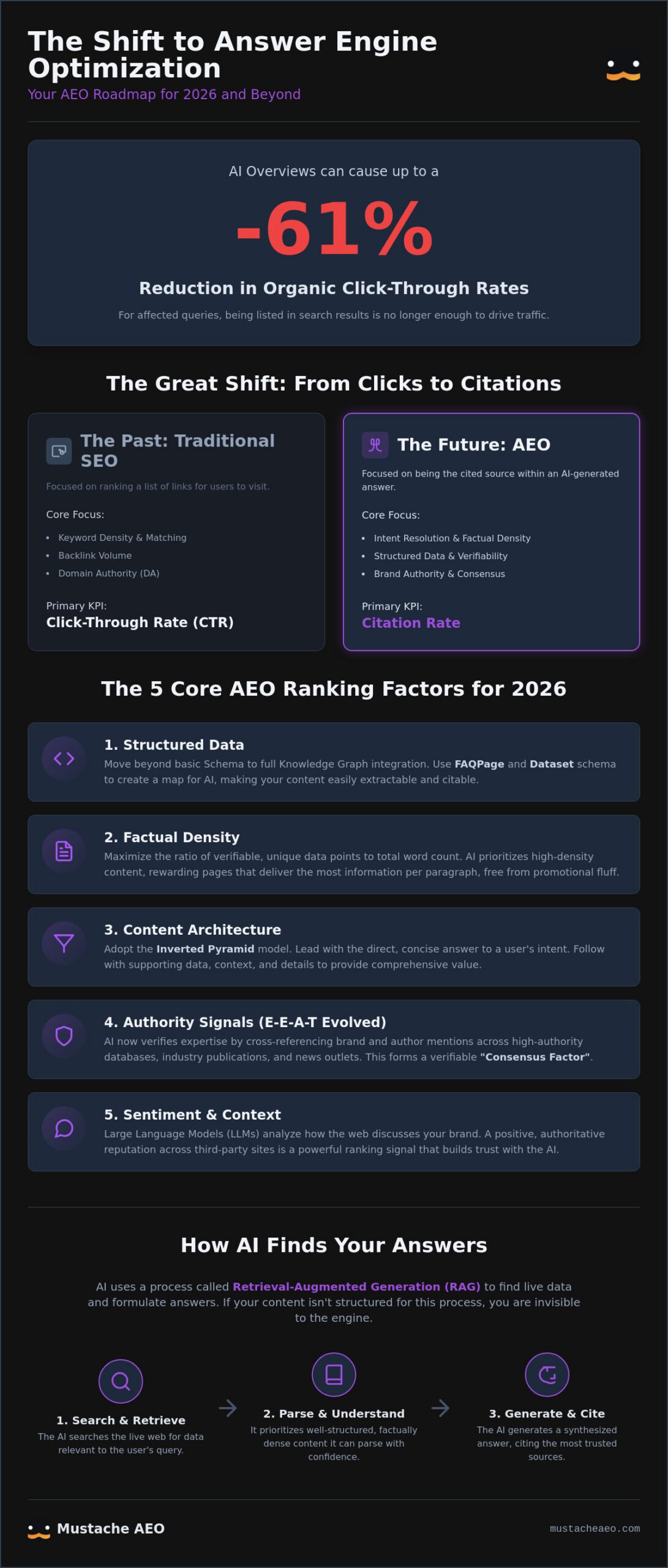
AI Overviews can reduce organic click-through rates by as much as 61 percent for affected queries. This statistic highlights a fundamental shift in how information is retrieved and consumed in 2026. If you feel that your traditional search traffic is evaporating, you are observing a new reality where being listed is no longer enough. Understanding the specific AEO ranking factors is now the only way to ensure your brand remains visible in a world dominated by automated answers.
We recognize the anxiety that comes with declining engagement and the fear of AI hallucinations misrepresenting your expertise. It is a challenge that requires a proactive, technical response. This article promises to help you master the structural requirements that turn your content into the preferred source for engines like ChatGPT and Perplexity. We will provide a clear roadmap of optimization priorities, moving from foundational data structures to the E-E-A-T signals that drive high-value citations and improved brand authority.
Key Takeaways
- Learn how to pivot from keyword matching to intent resolution by understanding the underlying logic of Large Language Models.
- Master technical AEO ranking factors such as factual density and Knowledge Graph integration to ensure your data is prioritized by AI agents.
- Discover the platform-specific nuances that determine whether you are cited by ChatGPT’s conversational engine or Perplexity’s real-time retrieval system.
- Build a robust citation footprint using the Consensus Factor to verify your brand’s authority across the digital ecosystem.
- Identify and eliminate brand hallucinations by conducting a specialized AEO Audit to secure your visibility in automated responses.
The Logic of Answer Engines: Why Traditional SEO Factors Are Shifting
The era of the ten blue links is over. Users no longer want a list of websites to visit; they want a synthesized answer delivered instantly. This shift demands a total reconfiguration of your digital strategy. While traditional SEO focused on keyword density and backlink volume, modern AEO ranking factors prioritize your ability to provide direct, extractable value to a Large Language Model (LLM).
Legacy metrics like Domain Authority (DA) no longer guarantee a spot in the conversation. In 2026, AI models like GPT-5.6 Sol prioritize factual accuracy and structured clarity over historical site power. A boutique brand with high factual density can now outrank a legacy corporation if the AI deems the smaller site more verifiable. This process relies on Retrieval-Augmented Generation (RAG). RAG is the technical bridge that allows an AI to search the live web, retrieve relevant data, and then generate a response that cites its sources. If your content isn’t structured for this retrieval phase, you don’t exist to the engine.
From Link Clicks to Brand Citations
The primary KPI for digital visibility has transitioned from the click-through rate to the Citation Rate. This metric measures how often an AI engine attributes a specific piece of information to your brand. AI models don’t just “find” your site; they verify your claims against a consensus of other trusted sources. Being a source of truth is now more valuable than ranking in the first position. To understand where you stand, conducting an AEO Audit is the essential first step to identifying why engines might be ignoring your expertise in favor of a competitor.
The Role of LLMs in Information Retrieval
LLMs parse website data differently than traditional crawlers. They don’t just index keywords; they map entities and relationships within your content. This evolution in Artificial intelligence optimization means that the “crawl phase” is now an “understanding phase” where the model evaluates your site’s logic. There is a distinct difference between the static training data the model was built on and the real-time search indexing it performs today. LLMs calculate factual density by measuring the ratio of verifiable, unique data points against the total word count of a given passage. High-density content wins the citation every time. Understanding these new AEO ranking factors allows you to move beyond legacy tactics and secure your place in the automated future.
The 5 Core AEO Ranking Factors for 2026
Dominating AI search results requires a precise focus on data verifiability. While traditional SEO often rewards the most popular page, AEO ranking factors reward the most trusted and extractable source. This transition forces brands to move beyond marketing superlatives toward a structure that machines can parse with total confidence. Success depends on these five pillars:
- Structured Data: Moving beyond basic Schema to comprehensive Knowledge Graph integration. This helps AI models understand the relationships between your brand, your products, and your expertise.
- Factual Density: The ratio of verifiable claims to promotional language. AI engines prioritize pages that deliver the highest amount of unique information per paragraph.
- Content Architecture: Using the Inverted Pyramid. Lead with the direct answer to the user’s intent, then follow with supporting data and context.
- Authority Signals: E-E-A-T has evolved. AI now verifies your credentials by cross-referencing your mentions across high-authority databases and news outlets.
- Sentiment and Context: LLMs analyze how the web talks about you. A positive, authoritative reputation across third-party sites is a powerful ranking signal for AI citations.
If you’re unsure where your current technical gaps lie, our AEO Audit methodology is designed to identify exactly where AI engines are losing track of your brand’s authority.
Structural Clarity and Technical Schema
Machines don’t guess; they calculate. To feed AI extractors, you must implement FAQPage and Dataset schema. These technical markers act as a map for the RAG process. Structure your content using H2 and H3 headings as Question-Answer pairs. This makes it easier for an LLM to parse and cite your content as the definitive response. Technical site health remains the baseline, often starting with the best web hosting for business to ensure stability. If a bot can’t crawl your site efficiently, it won’t index your facts.
Factuality and Neutrality: The ‘Hallucination-Proof’ Factor
Neutrality is the new authority. AI engines prefer objective, descriptive language over promotional fluff. Using superlatives like “the best” or “world-class” often triggers a lower trust score in modern AEO ranking factors. Instead, cite primary sources and include specific data points to increase your content’s verifiability. Temporal relevance is also vital. Perplexity, for example, shows an 82 percent citation rate for content less than 30 days old. Use clear date stamps and “last updated” signals to prove your information is fresh and reliable.
Platform-Specific Ranking: ChatGPT vs. Perplexity vs. Google AI
AI engines are not a monolith. Each platform operates with a unique appetite for information, meaning your AEO ranking factors must be tailored to the specific engine you want to dominate. Perplexity AI functions as a real-time researcher, prioritizing news and high-authority publisher data. ChatGPT Search acts as a conversational synthesizer, focusing on multi-source blending and narrative flow. Google AI Overviews remain a hybrid, heavily influenced by traditional Search Essentials and the existing organic index. Mastery requires recognizing these distinct personalities.
Different models prioritize different content depths. Gemini and Claude often excel at parsing long-form technical documentation, making them vital for B2B and SaaS brands. If your content is too brief, these models might skip you in favor of more comprehensive guides. ChatGPT now processes 2.5 billion prompts per day, and its preference for Wikipedia-style authority means your brand must appear as a settled fact rather than a marketing pitch. This is why many global developers of 語音辨識 AI 解決方案 are focusing on data structure to ensure their innovations are correctly cited. Tailoring your content architecture to these specific behaviors ensures your brand remains a constant in the AI ecosystem.
Winning the Perplexity Citation
Perplexity favors speed and freshness. Research indicates an 82 percent citation rate for content less than 30 days old on this platform. To secure your spot in their Source Cards, you must maintain high factual consistency across multiple platforms, including community-driven sites like Reddit. Perplexity uses these diverse signals to verify your claims in real-time. This differs significantly from other models; you can learn more by reviewing our guide on how to rank in ChatGPT for a direct comparison of these distinct retrieval styles.
Google AI Overviews (SGE) and Traditional SERP Synergy
Google’s generative engine relies heavily on its legacy index. Approximately 76.1 percent of URLs cited in Google AI Overviews also rank in the top 10 organic results. This means your traditional SEO foundation is still a critical component of your AI visibility. There is a direct correlation between winning Position 0 Featured Snippets and being selected as a primary source for an AI response. To stay ahead, optimize for People Also Ask queries. These questions serve as a direct feeder for Google’s generative engine, allowing you to capture visibility before the user even clicks a link.
Building a Citation Footprint: Off-Page AEO Factors
AI models do not operate in a vacuum. They verify your claims by cross-referencing your content against a global consensus of trusted sites. This Consensus Factor is one of the most critical AEO ranking factors for 2026. If your website makes a claim that isn’t mirrored by authoritative databases, news outlets, or academic journals, an AI engine is likely to label your information as unreliable. You must build a digital footprint that validates your expertise across the entire web to avoid being ignored.
Digital PR is the new link building. Instead of chasing high-volume backlinks, focus on securing mentions in high-authority databases and industry-specific news outlets. These citations act as a validation layer for LLMs. Community-driven platforms like Reddit and Quora have also become essential human-verified data sources. Perplexity, which handles up to 1.5 billion queries per month, frequently cites these discussions to provide nuanced, real-world answers. Active presence in these conversations ensures your brand is part of the retrieval loop.
Local AEO: Winning Miami-Specific AI Queries
Local visibility in AI is incredibly competitive. Research from 2026 shows that AI platforms recommend only 1.2 percent of local businesses on ChatGPT and 7.4 percent on Perplexity. To win prompts for the best services in Miami, you must optimize your Google Business Profile data and secure mentions in local directories. Local news mentions are particularly powerful. They build geographic authority that signals to the AI that your brand is the definitive local leader. Our AEO Strategy services help Miami businesses navigate these selective recommendation engines to secure their local market share.
Third-Party Validation and Sentiment Analysis
AI models use sophisticated sentiment analysis to gauge brand reliability. They don’t just look for your name; they analyze the context of your mentions across the web. If customer reviews on third-party sites are consistently negative, the AI may append warning labels to its responses or skip your brand entirely. Proactive reputation management is no longer just a PR task; it is a core AEO ranking strategy. High-quality customer reviews and positive sentiment serve as a green light for AI-driven recommendations. Managing how the digital ecosystem perceives your brand is the only way to avoid being filtered out of the automated future.
Securing Your Visibility: The Mustache AEO Roadmap
Securing your visibility in 2026 requires more than just high-quality content. It demands a systematic approach to technical and structural AEO ranking factors. The first step is always a comprehensive AEO Audit. This is the prerequisite for any brand that wants to stop being ignored by AI answer engines. Without a clear baseline, you’re essentially guessing which data points the LLMs are actually indexing and which they are discarding.
We focus on identifying ‘Blind Spots’ where AI engines might be hallucinating about your brand. Hallucinations occur when an engine lacks sufficient verified data and fills in the gaps with inaccuracies. These errors can damage your authority and drive potential clients to competitors who have better-structured data. Our roadmap moves your business from legacy SEO tactics to a future-proof AI search strategy. We combine technical auditing with strategic content roadmaps to ensure your brand is the definitive source of truth across the digital ecosystem.
The Miami AEO Audit: What We Look For
Our audit methodology is designed for the Miami market but built for global reach. We assess structured data integrity and factual density to see how easily an LLM can extract your key claims based on current AEO ranking factors. We also map your brand’s current ‘Share of Model’ across major LLMs like GPT-5.6 Sol and Claude Fable 5. This metric defines how often a model recommends your brand compared to your direct competitors. By analyzing citation gaps, we find the low-hanging fruit where your expertise is already strong but your technical structure is failing you.
Actionable Steps for Immediate AI Visibility
Visibility doesn’t happen by accident. In the short term, we focus on optimizing your existing high-traffic pages for AI extraction. This involves restructuring your content into the ‘Inverted Pyramid’ style discussed earlier. Long-term success requires building a cross-platform citation footprint. We help you secure mentions in high-authority databases and community-driven platforms that AI engines trust. The transition from traditional search to answer engines is a fundamental shift in business logic. Legacy SEO focused on traffic volume; AEO focuses on citation authority. Stop letting AI engines guess who you are. Book your specialized AEO Audit with Mustache AEO today.
Our Miami-based team understands the nuances of emerging search tech and how to apply it to practical business outcomes. We help you move beyond the fear of technology and into a state of quiet confidence. You deserve to be the brand that AI engines trust and cite first. By prioritizing verifiability and structured clarity, you ensure that your brand remains a leader in the automated future of information retrieval.
Master the Evolution of Search Retrieval
The transition from legacy search results to generative answers is a permanent shift in how your brand is discovered. You’ve seen that mastering AEO ranking factors requires a balance of technical precision and verifiable authority. Success in 2026 isn’t about how many keywords you target; it’s about how many AI models cite you as a primary source of truth. By prioritizing factual density and structured clarity, you move from being a mere link to becoming a trusted brand citation.
Mustache AEO provides the specialized expertise needed to navigate this transition. Our Miami-based team uses data-driven tracking and reporting to ensure your brand dominates conversational search results globally. We help you eliminate hallucinations and bridge the gap between your expertise and AI indexing. It’s time to stop reacting to algorithm updates and start leading the conversation. Secure your brand’s future with a comprehensive AEO Audit and claim your authority in the AI ecosystem. The future of information retrieval is automated, but your success is within your control.
Frequently Asked Questions
What are the most important AEO ranking factors in 2026?
Factual density and technical verifiability are the most critical AEO ranking factors today. AI engines prioritize content that provides unique, data-rich information over generic marketing language. You must also focus on Knowledge Graph integration and high-authority brand citations. These elements prove to the model that your information is both accurate and widely trusted across the digital ecosystem, making you a primary candidate for synthesis.
How is AEO ranking different from traditional SEO ranking?
AEO prioritizes being the cited source of a synthesized answer rather than just a link in a list. Traditional SEO focuses on keyword placement and backlink volume to drive site traffic. In contrast, AEO emphasizes semantic understanding and intent resolution. The goal isn’t just to rank high; it’s to be the definitive source of truth that the AI extracts to answer a user’s prompt directly.
Does domain authority still matter for ranking in AI answers?
Domain authority is no longer the primary guarantor of a citation. While a strong backlink profile helps, AI engines like Perplexity often cite newer, smaller sites if they offer higher factual density and real-time relevance. Verifiability and structured clarity now outweigh legacy popularity metrics. A niche expert with precise, structured data can easily outshine a massive corporation that relies on outdated or vague content.
Can I use AI-generated content to rank in AI answer engines?
You can use AI to assist, but purely automated content often fails the factual density test. Google’s May 15, 2026 policy update explicitly classifies manipulated generative responses as spam. To rank, your content must provide original insights, first-hand experience, and verifiable data that an AI cannot simply replicate. Models prefer human-in-the-loop content that adds unique value to the existing information pool.
How do I track my brand’s ranking in ChatGPT or Perplexity?
Tracking requires new KPIs like Share of Model and AI citation rates. Traditional rank trackers don’t work for conversational search because answers are generated dynamically for each user. You need specialized Tracking & Reporting tools that monitor how often your brand is recommended across different LLMs. We measure success by the frequency and accuracy of your brand’s presence in automated responses rather than static positions.
What role does schema markup play in AEO ranking factors?
Schema markup acts as the technical map for Retrieval-Augmented Generation (RAG). By implementing FAQPage and Dataset schema, you make it easier for AI bots to parse and extract your information with total confidence. This structured data reduces the risk of hallucinations. It is a foundational technical requirement that ensures your content is machine-readable and ready for instant synthesis in an AI Overview or chatbot response.
How long does it take to see results from AEO optimization?
Results can appear in as little as 30 days for platforms like Perplexity that favor fresh content. However, building a robust cross-platform citation footprint usually takes three to six months of consistent optimization. The speed of your success depends on your site’s current technical health and how quickly AI models re-crawl your updated content. Starting with a technical audit accelerates this timeline by identifying immediate gaps.
Will AEO eventually replace traditional SEO entirely?
AEO is an evolution of SEO rather than a total replacement. Traditional search engines still drive a significant portion of web traffic, but answer engines are capturing the most direct, high-intent queries. You need a hybrid strategy that maintains your organic search foundation while optimizing for the zero-click future. Balancing both ensures you capture users whether they are browsing a list of links or asking an AI for a specific recommendation.