
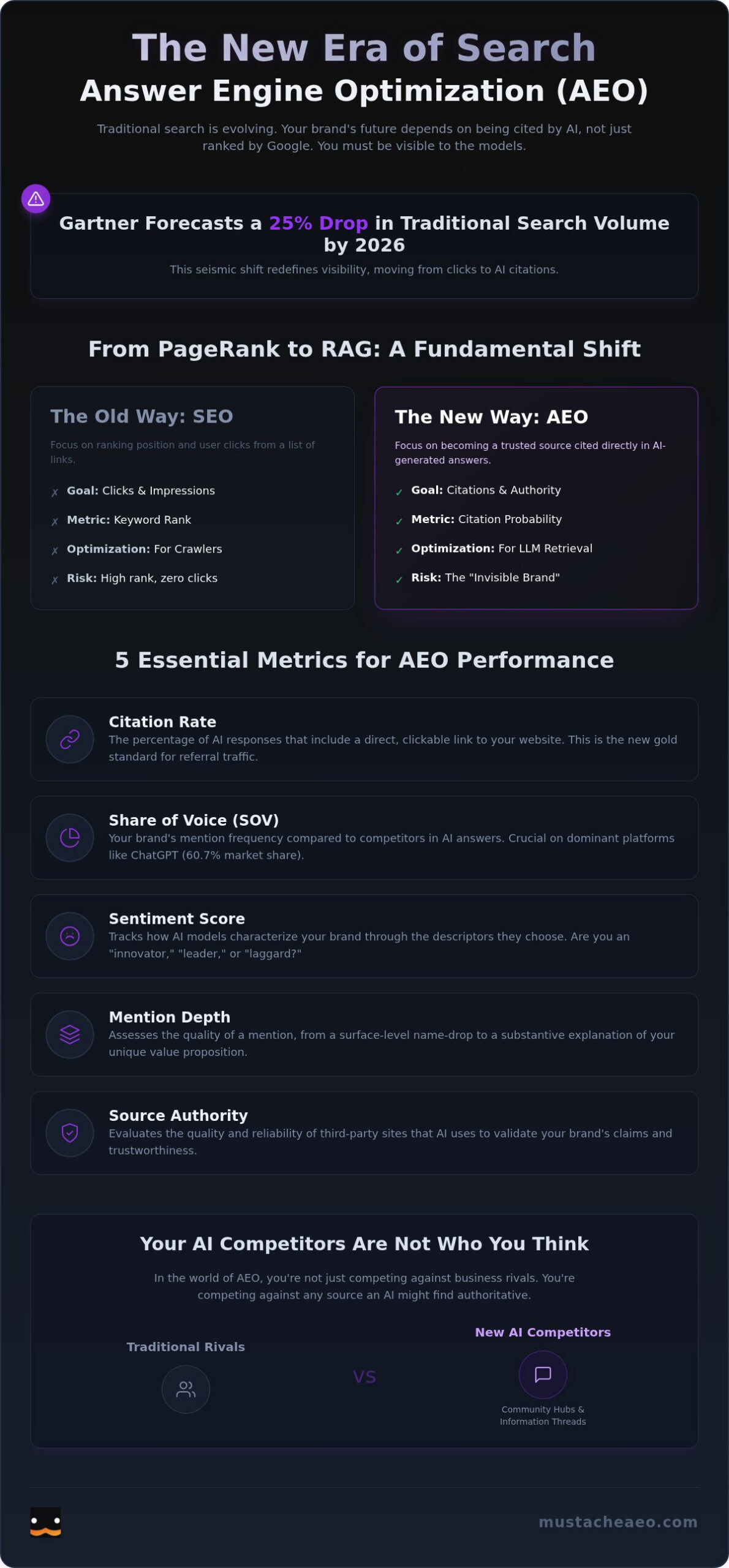
Gartner forecasts that traditional search engine volume will fall by 25% by 2026. This shift means your number one ranking on Google might soon yield zero clicks if AI engines ignore your brand. You’ve likely felt the frustration of seeing traffic dip even as legacy SEO tools report perfect scores. It’s a common anxiety for marketers who realize that being visible to humans is no longer enough. You must be visible to the models. Conducting a rigorous AEO performance analysis is the only way to bridge this gap and secure your share of voice.
We recognize the uncertainty of tracking results in what feels like a black box environment. You need clarity on which metrics actually correlate with AI citations. This article will show you how to master the metrics that matter in AI search to ensure your brand is cited, not ignored, by conversational engines. We’ll provide a clear scorecard for AI visibility, proof of ROI for your AEO efforts, and a strategic roadmap to improve your citations across platforms like ChatGPT and Perplexity. It’s time to move beyond the ten blue links and claim your authority in the era of automated answers.
Key Takeaways
- Understand the shift from traditional PageRank to Retrieval-Augmented Generation (RAG) where citations are the primary currency of authority.
- Master the five essential metrics for AEO performance analysis to track your brand’s citation frequency and share of voice across AI engines.
- Identify your actual AI competitors, which frequently include community hubs and information threads instead of your traditional business rivals.
- Analyze how conversational models categorize your brand perception to ensure you are seen as a modern innovator in your niche.
- Implement a technical AEO Audit to move beyond manual tracking and secure a clear roadmap for enterprise-level visibility.
AEO Performance Analysis vs. Traditional SEO Tracking
AEO performance analysis is the systematic measurement of a brand’s visibility, citation frequency, and sentiment within AI answer engines. It represents a fundamental departure from the legacy framework of tracking clicks and impressions. Gartner predicts a 25% drop in traditional search volume by 2026. This shift marks the transition from PageRank to RAG, or Retrieval-Augmented Generation. In a RAG-driven ecosystem, the engine doesn’t just list links. It retrieves the most relevant data and synthesizes a direct answer for the user.
The primary KPI is no longer the click-through rate. Success is now defined by whether a model chooses to cite your brand as a primary source. This is a binary battle for authority. You could hold a #1 ranking on a legacy search engine and still face the “Invisible Brand” risk. This occurs when an AI engine ignores your site and uses your competitor’s data to answer a query. It happens because their content was more accessible, better structured, or more semantically dense for the LLM to parse. Adopting Answer Engine Optimization (AEO) strategies ensures your data remains the preferred choice for these models.
Traditional SEO tracking focuses on the “where” of ranking. AEO performance analysis focuses on the “how” and “why” of brand perception. Consider these core differences:
- Measurement: SEO tracks position on a results page. AEO tracks citation probability and sentiment.
- Interaction: SEO relies on users clicking a link. AEO focuses on the brand being the definitive answer within the chat interface.
- Data Source: SEO optimizes for crawlers. AEO optimizes for the training sets and retrieval windows of large language models.
The Death of the Keyword Rank
Tracking individual keywords has become a vanity exercise. AI engines prioritize semantically relevant documents over exact-match phrases. They look for topic authority, which measures how comprehensively your brand covers a specific subject area. Traditional SEO tools go quiet in generative search because they cannot track the non-linear way models retrieve information across billions of parameters. You must focus on becoming the definitive source for a concept rather than a specific string of text. The goal is to own the topic, not just the term.
Understanding the AI Feedback Loop
AI models don’t just find your content; they learn from it. This training process creates a permanent brand perception that influences every future response the model generates. LLM benchmarks now determine which sources are deemed trustworthy enough to be cited. Miami businesses must audit their digital footprint before the next model training cycle to prevent outdated or incorrect data from being baked into the AI’s “memory.” If you aren’t validating your presence now, you’re letting the models define your reputation for you. Proactive management is the only way to ensure the feedback loop works in your favor.
5 Essential Metrics for AEO Performance Analysis
Data-driven decisions require a new set of benchmarks. Traditional metrics like bounce rates and time-on-page tell you nothing about how an LLM perceives your brand. A robust AEO performance analysis focuses on how models retrieve, synthesize, and present your information to the end user. Since 77% of U.S. consumers now use at least one AI answer engine, these metrics determine your digital survival. Success in this space is no longer about winning the click; it’s about winning the citation.
Effective measurement requires tracking five distinct pillars of visibility:
- Citation Rate: This is the percentage of AI-generated responses that include a direct, clickable link to your website. It’s the new gold standard for referral traffic.
- Share of Voice (SOV): This measures your brand’s mention frequency compared to direct competitors for high-intent queries. If ChatGPT, which holds a 60.7% market share, mentions a rival more often, your market dominance is at risk.
- Sentiment Score: AI engines characterize your brand through the descriptors they choose. This metric tracks whether you are framed as an industry leader, an innovator, or a laggard.
- Mention Depth: This assesses the quality of the mention. A surface-level mention identifies your existence, while a substantive mention explains your specific services or unique value propositions, such as the enterprise security solutions from OAD Technologies.
- Source Authority: AI models use Retrieval-Augmented Generation to find “truth.” This metric evaluates the quality and reliability of the third-party sites the AI uses to validate your brand’s claims.
Quantifying these factors allows you to move from guesswork to strategy. Executing a technical AEO Audit is the most efficient way to benchmark these variables against your current digital footprint.
Calculating Your Brand’s Citation Rate
Determining your citation rate begins with systematic testing. Run a series of high-intent prompts across ChatGPT, Gemini, and Perplexity to see which URLs the models prioritize. This process reveals “Citation Gaps” where competitors are preferred despite your superior content. In the age of AI, visibility is binary. You are either the cited authority in the answer or you are completely invisible to the user. There is no “page two” in a conversational response.
Measuring AI Sentiment and Perception
AI models don’t just find facts; they interpret them. Analyze the specific adjectives and descriptors that models associate with your brand to understand your synthesized reputation. This analysis also helps identify “hallucination risks” where an AI might misrepresent your product offerings or pricing. Tracking these sentiment shifts over time is essential. It allows you to measure the direct impact of your content optimizations and ensures the models maintain a factual, positive perception of your business.
Benchmarking Your Brand Against AI Competitors
Traditional competitor lists don’t apply to Answer Engine Optimization. Your “AI competitors” are rarely just the businesses selling similar products. They are often information hubs, Reddit threads, or industry forums that the model deems more authoritative. AI engines prioritize the most helpful data, regardless of who published it. This means you might be losing visibility to a community discussion instead of a fellow service provider. Identifying the “Synthesized Leader” in your niche is the first step. This is the source the AI defaults to for industry advice. You must analyze the content structure of these cited competitors to find the technical commonalities that make them readable to large language models.
Local context creates a unique layer of competition. For Miami brands, benchmarking involves geo-specific queries like “best AEO services in Miami.” AI engines look for local validation through specific directories and regional mentions. If a competitor is cited more frequently for local intent, they’ve likely secured a stronger “Entity Clarity” within the regional digital ecosystem. A thorough AEO performance analysis reveals these local gaps. It shows you exactly which regional sources are influencing the AI’s recommendations in your specific market.
The Citation Gap Analysis
Mapping your competitors’ cited pages to your own content inventory reveals exactly where you’re falling short. This process identifies missing “Entity Clarity” that prevents AI from recognizing your brand as the definitive authority. If the model can’t verify who you are or what you do, it won’t cite you. Understanding What is an AEO Audit? is critical for closing these gaps. It provides the technical roadmap needed to align your content with the retrieval patterns of modern engines. This AEO performance analysis ensures your brand is the one being synthesized into the final answer.
Replicating Success: Prompt Fidelity
Consistency is the only way to measure true visibility. You must run the same prompt multiple times to ensure a stable citation pattern across different sessions. AI responses can be fluid. Tracking “Source Volatility” helps you understand how often engines swap out their citations for a given query. This volatility is often influenced by third-party reviews and external directories. If your AI visibility fluctuates, it’s likely because your external validation signals are inconsistent. Strengthening these signals stabilizes your brand’s position as a trusted, permanent source in the AI’s knowledge base.
Analyzing Sentiment and Brand Perception in AI Responses
AI engines act as synthesized critics. They categorize your brand based on the aggregate data they ingest from across the digital ecosystem. Through a technical AEO performance analysis, you can determine if an engine views you as a Market Leader, a Challenger, or a Niche Player. This classification isn’t just a label; it dictates how often you are recommended for high-intent queries. If a model views you as a laggard, it will prioritize competitors who appear more relevant to the user’s current needs.
Perception matters. Models analyze your technical documentation, press releases, and reviews to decide if you are an “Innovator” or a “Traditionalist.” An innovator is cited for future-looking solutions, while a traditionalist is relegated to legacy queries. This distinction impacts the level of trust a conversational engine places in your data. Negative sentiment triggers like “limited features” or “customer complaints” can create a permanent bias in the model’s output. These phrases often originate from the sources the AI cites. Since the tone of your cited sources dictates the AI’s tone, your brand perception is only as strong as the platforms talking about you.
Correcting AI Misconceptions
You can influence the models by updating your “Source of Truth” pages. These are authoritative documents designed to be the definitive reference for AI training data. Using structured data, specifically Schema.org, helps clarify brand entities and significantly reduces the risk of hallucinations. This technical layer ensures the model understands exactly what you offer. If you’re ready to fix your digital reputation, you should explore What is Answer Engine Optimization? to see how we align brand data with AI expectations. Models learn fast; you must provide the right data for them to ingest.
The Power of Mention Depth
Mention depth is a critical metric for authority. A brief mention is a weak performance indicator compared to a detailed feature breakdown. You want the AI to provide a substantive explanation of your unique value propositions. Optimize your content with clear, declarative summaries that conversational engines can easily digest. This encourages the model to explain your services in detail rather than just listing your name. You must also measure “Contextual Sentiment” across different use cases. A brand might have positive sentiment for its pricing but negative sentiment for its customer support. Understanding these nuances through AEO performance analysis allows for targeted content optimizations that improve your overall standing.
If your brand perception needs a technical pivot, contact us for an AEO Strategy to regain control of your narrative.
Executing a Comprehensive AEO Audit with Mustache
Manual tracking is insufficient for enterprise-level AEO performance analysis. You can’t rely on sporadic, manual queries to build a scalable strategy. Our AEO Audit provides a technical deep-dive into how AI engines cite and describe your brand. It uncovers the specific data points that influence model retrieval. This process transforms a “black box” into a transparent, manageable asset for your marketing team. Knowing exactly how ChatGPT or Perplexity views your brand is the first step toward dominance.
Analysis must lead to immediate action. We implement the “Mustache Roadmap” for AI visibility to ensure your content is prioritized during the next model training cycle. In 2026, AEO performance must be tracked monthly. Search behavior is shifting too quickly for quarterly reviews. Continuous Tracking & Reporting ensures your brand stays at the forefront of automated responses as new LLMs enter the market. Staying ahead requires a proactive, technical stance that legacy SEO simply can’t provide.
Our Miami-Focused AEO Strategy
We optimize for Miami brands looking to dominate local AI search results. The Magic City has a distinct digital footprint that requires a specialized approach. Our team integrates your AEO performance data into your broader marketing stack for a cohesive strategy. If you want to own the conversation in South Florida, check out our Miami AEO Services to see how we secure your local authority. We combine high-level technical expertise with an accessible, boutique partnership style.
Ready for the Future of Search?
The urgency is real. Don’t wait for your organic traffic to disappear before you start measuring your AI visibility. Early movers in AEO performance analysis are already claiming the most valuable citations in their industries. This is your opportunity to build a permanent competitive advantage before the market saturates. Get your specialized AEO Audit from Mustache today and ensure your brand is the definitive answer, not just another ignored link.
Own the Future of Conversational Search
The transition from traditional search to AI-driven answers is already here. You’ve learned that citation rates and share of voice are the new benchmarks for digital authority. A rigorous AEO performance analysis is no longer optional; it’s the foundation of your brand’s survival in a world where models synthesize information for millions. By mastering these metrics and correcting AI misconceptions, you ensure your business remains a primary source for the next generation of users.
We are authoritative AEO specialists dedicated to your growth. Our team provides a strategic roadmap for AI search dominance, combining Miami-based expertise with a global reach. Don’t let your competitors define the narrative within conversational engines. Secure your brand’s future with a specialized AEO Audit from Mustache and take control of your digital reputation today.
The shift is significant, but you don’t have to face it alone. We’re here to help you navigate this new era with confidence and clarity. Your brand deserves to be heard, understood, and cited by the models that are shaping the future of information.
Frequently Asked Questions
What is AEO performance analysis?
AEO performance analysis is the systematic measurement of how AI answer engines perceive, categorize, and cite your brand. It moves beyond traditional keyword tracking to evaluate the probability of your brand being synthesized into a conversational response. This process identifies exactly how often you’re cited as a primary source across platforms like ChatGPT and Perplexity. It’s the only way to ensure your brand isn’t ignored by the large language models that now drive search behavior.
How is AEO measured differently from traditional SEO?
Traditional SEO focuses on PageRank and click-through rates from a list of blue links. AEO focuses on citation rates, mention depth, and share of voice within synthesized outputs. Success in AEO means being the definitive answer provided by the model, rather than just one of many options on a results page. It prioritizes the quality of information retrieval over simple link navigation.
What is a “good” citation rate for a business in 2026?
A competitive citation rate in 2026 generally falls between 30% and 50% for high-intent queries within your niche. Since Google AI Overviews now appear on approximately 48% of all search queries, your goal is to be the primary source within that specific window. This ensures you maintain visibility even as organic click-through rates face a projected 38% decline due to AI-generated answers.
Can I track AEO performance for local Miami-based searches?
Yes, tracking local performance is essential for brands looking to dominate regional markets like Miami. You can monitor how conversational engines recommend local services by using geo-specific prompts. This reveals your regional “Entity Clarity” and shows whether the AI considers you a local leader. Monthly tracking helps you adjust your digital footprint to stay ahead of other South Florida competitors.
Which AI engines should I prioritize in my analysis?
Prioritize the engines with the highest user adoption: ChatGPT, Google Gemini, and Microsoft Copilot. As of 2026, ChatGPT leads the market with a 60.7% share, while Gemini and Copilot follow at 15.0% and 13.2% respectively. Focusing your AEO performance analysis on these three platforms ensures you’re reaching the vast majority of consumers who use AI answer engines daily.
How often should I perform an AEO performance audit?
Perform a comprehensive AEO audit at least once a month to keep pace with rapid model updates. AI training data and retrieval algorithms shift frequently, which can lead to “Source Volatility” for your brand. Regular monitoring allows you to detect these shifts early. You can then optimize your content before competitors have a chance to claim your share of voice in the conversational space.
Is there a free tool for AEO performance analysis?
There are currently no professional-grade free tools for comprehensive AEO tracking. Specialized platforms require a subscription to cover the costs of multiple LLM API calls. While you can perform manual tests by prompting individual chatbots, this method lacks the scale and sentiment analysis provided by enterprise-level tools. Professional audits remain the most reliable way to get an accurate scorecard for your AI visibility.
What role does brand sentiment play in AI search rankings?
Sentiment acts as a primary filter for AI recommendations. Models analyze the tone of the sources they ingest to decide if your brand is a leader or a laggard. If the aggregate data shows positive sentiment, the AI is much more likely to recommend your services for high-intent queries. Maintaining a positive perception across third-party sites is critical for securing detailed, authoritative mentions.