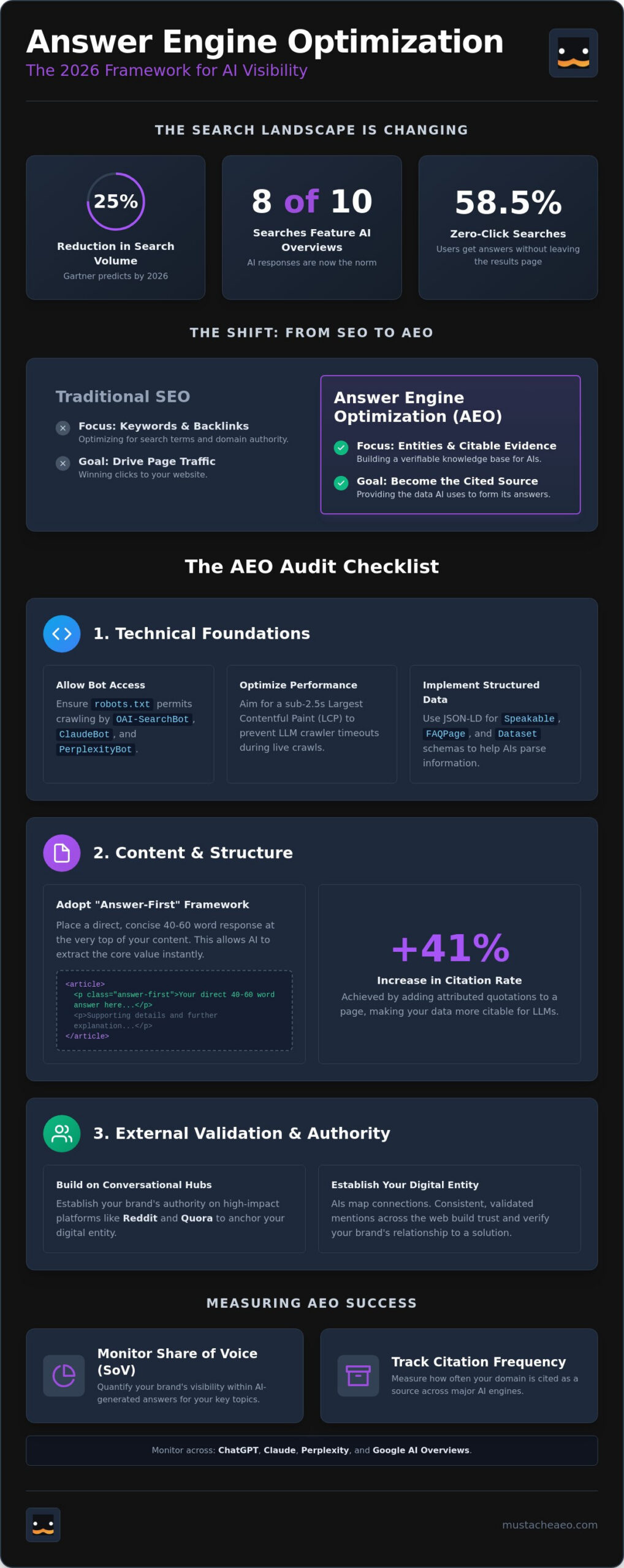
Gartner predicts a 25% reduction in search engine volume by the end of 2026. This shift is already here. You’ve likely watched your organic click-through rates decline as Google AI Overviews now appear in eight out of ten searches. It’s a stressful transition for any brand leader. You understand that legacy tactics are failing, yet finding a concrete way to track AI visibility feels impossible. Our AEO audit checklist bridges this gap by providing a professional-grade framework to secure your brand’s citations in ChatGPT, Claude, and Perplexity.
We secure your presence in the automated response era. This guide helps you master the 2026 Answer Engine Optimization landscape with actionable steps designed for the modern specialist. You’ll learn how to structure answer-first content for immediate extraction and implement the structured data AI engines require. We cover everything from 60-day freshness signals to the provenance markers that build LLM trust. By the end, you’ll have a future-proofed digital authority that doesn’t just rank. It gets cited as the primary source of truth.
Key Takeaways
- Transition from traditional SERPs to conversational interfaces by defining a clear strategy for LLM discovery.
- Use our AEO audit checklist to verify bot access and implement advanced Schema.org markups like ‘Speakable’ and ‘FAQPage’.
- Implement an ‘Answer-First’ content framework that provides direct, 40-60 word responses to conversational queries.
- Build external authority on high-impact conversational hubs like Reddit and Quora to anchor your brand’s digital entity.
- Quantify your success by monitoring your Share of Voice and citation frequency across major AI engines.
The 2026 AEO Audit: Why AI Visibility Requires a New Framework
The digital landscape changed while most marketers were still counting keywords. Traditional search results are becoming secondary to synthesized, conversational responses. Answer Engine Optimization (AEO) is the strategic process of making your brand’s content discoverable and citable by Large Language Models (LLMs). It isn’t just a sub-category of SEO. It’s a fundamental shift in how information is retrieved and consumed. While traditional SEO focuses on driving traffic to a page, AEO focuses on becoming the authoritative data source that the AI uses to build its answer.
You’re facing a zero-click reality where users rarely leave the chat interface. SparkToro data from 2024 showed that 58.5% of U.S. Google searches ended without a click; in 2026, that number has become the baseline. Being the cited source is now more valuable than holding a high-ranking link that no one clicks. Gartner’s projection of a 25% reduction in search engine volume by 2026 underscores this urgency. Success requires auditing your presence across the core engines: OpenAI (SearchGPT), Anthropic (Claude), Google AI Overviews (AIO), and Perplexity. Using a specialized AEO audit checklist ensures no platform overlooks your expertise or misattributes your data.
The Shift from Keywords to Entities
We map brand relationships to establish digital authority. AI engines don’t just read words; they map complex connections between brands, locations, and specific services. This is entity-based search. If an LLM cannot verify your brand’s relationship to a specific solution, it won’t cite you in its response. Brand authority in generative search is built through consistent, validated mentions across the web. Understanding What is an AEO Audit? is the first step for Miami businesses looking to anchor their local entity in AI memory and ensure they’re recognized as the definitive provider in their niche.
Why Traditional SEO Isn’t Enough
We prioritize extractable evidence over simple keyword volume. Legacy SEO focuses on backlinks and metadata. AEO focuses on citable evidence. We’re seeing a democratization effect where smaller, high-authority sites outrank corporate giants because their data is more extractable. For these larger organizations, you can learn more about Syntes AI and how their Enterprise Knowledge Graph unifies complex data into a structured format for better AI ingestion. A 2024 Princeton GEO paper found that adding attributed quotations to a page increased its citation rate by 41%. This requires an “Answer-First” architecture. This involves placing a concise, 40-60 word response at the very top of your content, allowing AI crawlers to identify your value in milliseconds. If your current strategy doesn’t include an AEO audit checklist, you’re optimizing for an older version of the internet that is quickly disappearing.
Technical AEO Checklist: Preparing Your Site for LLM Crawlers
We build the infrastructure that AI agents trust. Your site’s technical health determines whether an LLM can parse your data or if it simply moves on to a competitor. A comprehensive AEO audit checklist begins with your robots.txt file. You must explicitly allow access to the bots that drive conversational search. Ensure your server configuration permits OAI-SearchBot, ClaudeBot, and PerplexityBot to crawl your directories without friction. If these agents are blocked, your brand effectively doesn’t exist in the generative ecosystem.
Performance is a critical signal for automated visitors. Aim for a sub-2.5s Largest Contentful Paint (LCP) to ensure agents don’t time out during ‘live’ crawls. When an AI engine like Perplexity attempts to verify a fact in real-time, it requires a near-instant response. We also focus on topical clustering. Use a logical internal linking structure to facilitate LLM ‘chunking.’ This process helps models group your content into digestible segments of related information, making it easier for them to synthesize your expertise into a final answer.
Schema and Structured Data for AI
JSON-LD acts as a universal translator that helps LLMs map your site’s entities without ambiguity. As highlighted in HubSpot’s guide to AEO, providing structured data is essential for helping AI engines find, understand, and trust your content. We implement advanced markups like ‘Speakable’ for voice-first interactions and ‘FAQPage’ to provide clear question-answer pairs. Use ‘Organization’ entities with ‘SameAs’ properties to link your brand to verified Miami business directories. If you publish proprietary statistics, ‘Dataset’ schema is mandatory to ensure AI agents attribute that data back to your domain. If you’re feeling overwhelmed by these technical requirements, a professional AEO Audit can pinpoint exactly where your schema is lacking.
Bot Accessibility and Crawl Budgets
We prioritize clean, text-heavy HTML for efficient ingestion. While the `/llms.txt` protocol is a trending topic for future-proofing, four independent studies from early 2026 concluded that its current access rate by crawlers is statistically zero. It’s a debated tool, but we include it in our AEO audit checklist as a low-effort, high-reward safeguard for future model updates. Monitor your server logs regularly to identify which AI bots are visiting your site and how frequently. This data allows you to optimize your crawl budget, ensuring that your most authoritative content is always the first thing an AI agent sees.
While optimizing for AI crawlers is essential, maintaining a compliant and inclusive site is just as important for your digital reputation. To ensure your web presence meets ADA and WCAG standards, learn more about 216digital and their specialized compliance services.
Content Structure: The ‘Answer-First’ and Quotation Framework
We refine your narrative for machine ingestion. Answer engines don’t browse; they extract. To facilitate this, your content must align with the foundational AI search technologies that prioritize clear, factual propositions over creative prose. A vital component of any AEO audit checklist is the restructuring of H2 headings into direct, conversational questions. These headings should mirror the natural language patterns users employ when speaking to an AI assistant. Immediately following each question, you must provide a “Direct Answer” paragraph of 40 to 60 words. This concise block serves as the primary target for AI summarization bots.
We leverage specific performance levers to increase your citation probability. A 2024 Princeton paper on Generative Engine Optimization identified that “Quotation Addition” produces a 41% lift in visibility. We solve the common mistake of using generic quotes by implementing a strict expert template. To execute this, integrate unique, named quotations in the following format: “[Expert Name], [Specific Title] at [Organization], states that ‘[Actionable, non-obvious insight].'” This structure provides the verifiable provenance that LLMs require to validate a claim. Similarly, use “Statistics Addition” by isolating proprietary data into bulleted lists. AI crawlers favor these structured fragments because they’re easier to “chunk” into a final response.
The Anatomy of a Citable Paragraph
We utilize a Claim-Evidence-Context structure to ensure your snippets are highly authoritative. Every paragraph should lead with a bold claim, followed by documented evidence or data, and conclude with the business context. You must eliminate fluff phrases like “In today’s digital world” or “It’s important to note.” These terms add zero informational value and can actually decrease an AI’s trust in the content. For practical implementation, see our examples of AEO Content Optimization Miami to see how we transform standard blog posts into AI-ready assets.
Leveraging E-E-A-T for Answer Engines
We differentiate your brand from AI-generated noise through first-person experience. LLMs are increasingly programmed to look for “information gain”—new details that aren’t already in their training data. Use specific case studies and “I” or “we” statements to prove real-world application. Your author bios must be robust, including LinkedIn verification and links to other authoritative publications to establish a verifiable “Entity” in the knowledge graph. Finally, implement “Cite Sources” formatting within your own articles. By citing other high-authority entities, you signal to the AI that your content is part of a verified, trustworthy information ecosystem, which encourages reciprocal citations from the engines themselves.
External Validation: Building Authority Beyond Your Domain
We validate your brand’s authority across the entire digital ecosystem. Answer engines do not rely solely on your website; they look for consensus among high-authority conversational hubs. This is why a comprehensive AEO audit checklist must include a deep dive into platforms like Reddit, Quora, and niche industry forums. These sites act as primary training grounds for LLMs. If your brand is frequently cited as a solution on these hubs, you’re more likely to appear in a synthesized answer. We audit these mentions to ensure your brand sentiment remains positive and authoritative within the datasets that power modern search.
We build a citation strategy that targets industry-specific wikis and AI-curated “Best of” lists. Traditional backlinks are secondary to these high-weight citations. A mention in a reputable trade journal validates your entity in the knowledge graph, providing the social proof that AI agents require. To secure your spot, you must monitor your brand’s presence in historical training sets and address any misinformation that could skew AI responses. If you need help identifying these gaps, you can Request an AEO Strategy Review to align your external presence with AI expectations.
Local AEO for Miami Businesses
We anchor your presence in the Magic City to dominate “Near Me” conversational queries. For Miami businesses, local relevance is about more than just a zip code. You must mention local landmarks like the Wynwood Walls or the Brickell financial district to provide geographic context for LLMs. Consistent NAP (Name, Address, Phone) data across Miami-specific directories is essential for anchoring your local entity. This ensures that when a user asks for the best service in South Florida, the AI has the validated data to cite you. Our findings are often featured in Miami AEO Services reports, which highlight the brands successfully navigating this localized shift.
The Role of Third-Party Authority
We prioritize citable validation over legacy link-building tactics. A single mention in a reputable trade journal like the South Florida Business Journal is worth more than 100 low-quality backlinks. LLMs use these publications to build their internal trust scores for specific entities. Digital PR is the tool we use to influence the knowledge graphs of major LLMs. By securing placements in Miami-specific publications that AI engines frequently cite, we ensure your brand is recognized as an industry leader. This external validation proves to the AI that your content isn’t just self-published noise, but a verified source of truth within your professional niche.
AEO Measurement: Tracking Your AI Share of Voice
We believe you cannot manage what you do not measure. In the AI era, traditional rank tracking is obsolete because search is no longer a linear list of links. We establish a baseline Share of Voice (SoV) across the primary engines: ChatGPT, Gemini, and Perplexity. By focusing on your top 10 high-value queries, you can determine how often your brand is the primary answer versus a secondary mention. An effective AEO audit checklist must include a protocol for automating this monitoring. We utilize the Best AEO Tracking Tools to capture real-time citation data that legacy SEO software simply misses.
We perform monthly Prompt Testing to ensure response accuracy. AI engines are prone to hallucination; you must verify that they are citing your brand correctly rather than inventing attributes or services you don’t provide. We also measure Citation Depth. This metric distinguishes between a Soft Mention, where the AI simply says your name, and a Hard Citation, where the AI provides a functional link back to your domain. Hard citations are the gold standard for driving referral traffic in a zero-click environment. If your brand is mentioned but not linked, your AEO audit checklist should prioritize technical schema updates to encourage better attribution.
Setting Up Your AEO Dashboard
We identify key performance indicators that reflect the current technology. Your dashboard should track total citations, brand sentiment within LLM responses, and direct referral traffic from AI agents. For a DIY approach, you can conduct a manual audit using 50 standardized prompts across different platforms. This helps you understand the nuance between how ChatGPT perceives your brand versus Perplexity. You’ll quickly see the difference between a mention that builds awareness and a citation that builds traffic.
Scaling with a Professional AEO Audit
A manual checklist is a strong start, but it lacks the depth of a professional AEO Agency audit. We provide the technical precision required to monitor Miami brands in real-time. Mustache AEO uses proprietary tracking systems to alert you the moment your citation share drops or a competitor gains ground in the knowledge graph. This proactive approach ensures your brand remains the definitive answer in an increasingly automated world. Don’t leave your AI visibility to chance. Schedule your comprehensive AEO audit with Mustache AEO today.
Anchor Your Brand in the Generative Era
The era of traditional search is receding, replaced by a dynamic, conversational ecosystem. We help you navigate this transition with precision. By implementing an AEO audit checklist, you transform your site from a passive repository into a citable authority for ChatGPT, Claude, and Perplexity. You’ve learned how to restructure content for immediate extraction and how to anchor your brand through external validation on high-authority hubs.
We prioritize your visibility in the responses that matter most. As a specialized AEO agency for Miami businesses, Mustache AEO delivers data-driven strategies based on 2026 LLM behavior. Our methods are featured in leading AI visibility reports, ensuring your brand stays ahead of the curve. Don’t wait for your organic traffic to vanish. Secure Your Brand’s AI Future: Get a Professional AEO Audit. The future of digital authority is citable, and it starts today.
Frequently Asked Questions
What is the difference between an SEO audit and an AEO audit?
An SEO audit focuses on ranking links in a traditional search list. An AEO audit prioritizes making your content citable for Large Language Models (LLMs) that synthesize answers. While SEO looks at keyword density and backlinks, AEO focuses on “extractability” and the provenance of your data.
How often should I perform an AEO audit for my Miami business?
The 2026 standard for content freshness requires updates every 30 to 60 days. Miami businesses should audit their presence at this frequency to maintain local entity anchoring. This ensures your brand remains the primary source of truth as AI training sets evolve.
Can an AEO audit help my brand rank better in ChatGPT?
Yes, an AEO audit checklist targets the specific data structures ChatGPT uses to verify facts. By implementing “Quotation Addition” and proprietary statistics, you increase your position-adjusted word count. This makes it significantly more likely that ChatGPT will cite your brand as a primary source.
Which tools are best for tracking AI search visibility in 2026?
Specialized citation monitors are now the industry standard. We use proprietary tracking to measure Share of Voice (SoV) across Gemini, Perplexity, and ChatGPT. Traditional SEO tools are helpful for technical health, but they don’t capture the conversational citation data that defines AEO success.
Will optimizing for AEO negatively impact my traditional Google rankings?
AEO complements your existing SEO efforts. Google’s AI Overviews (AIO) utilize the same citable data points as other LLMs. Improving your answer-first architecture often results in higher visibility across both legacy search results and modern generative summaries.
How much does a professional AEO audit cost for a local business?
The investment for a professional audit depends on your site’s complexity and the competitive nature of your niche. Each strategy is tailored to the specific technical and content needs of the business. You should consult with a specialist to determine a scope that aligns with your growth goals.
What are the most critical factors in an AEO checklist for 2026?
The most critical factors are answer-first content structures and verifiable expert quotations. You must also ensure your technical infrastructure allows AI bots to crawl your data without friction. These elements ensure your information is the most citable evidence for an AI’s hypothesis.
Is schema markup required for AEO success?
JSON-LD schema is a fundamental requirement. It serves as a translator that helps AI engines parse your site’s entities without ambiguity. Without ‘Organization’, ‘FAQPage’, and ‘Speakable’ markups, your brand won’t be correctly identified by the automated systems used by Claude and Perplexity.