
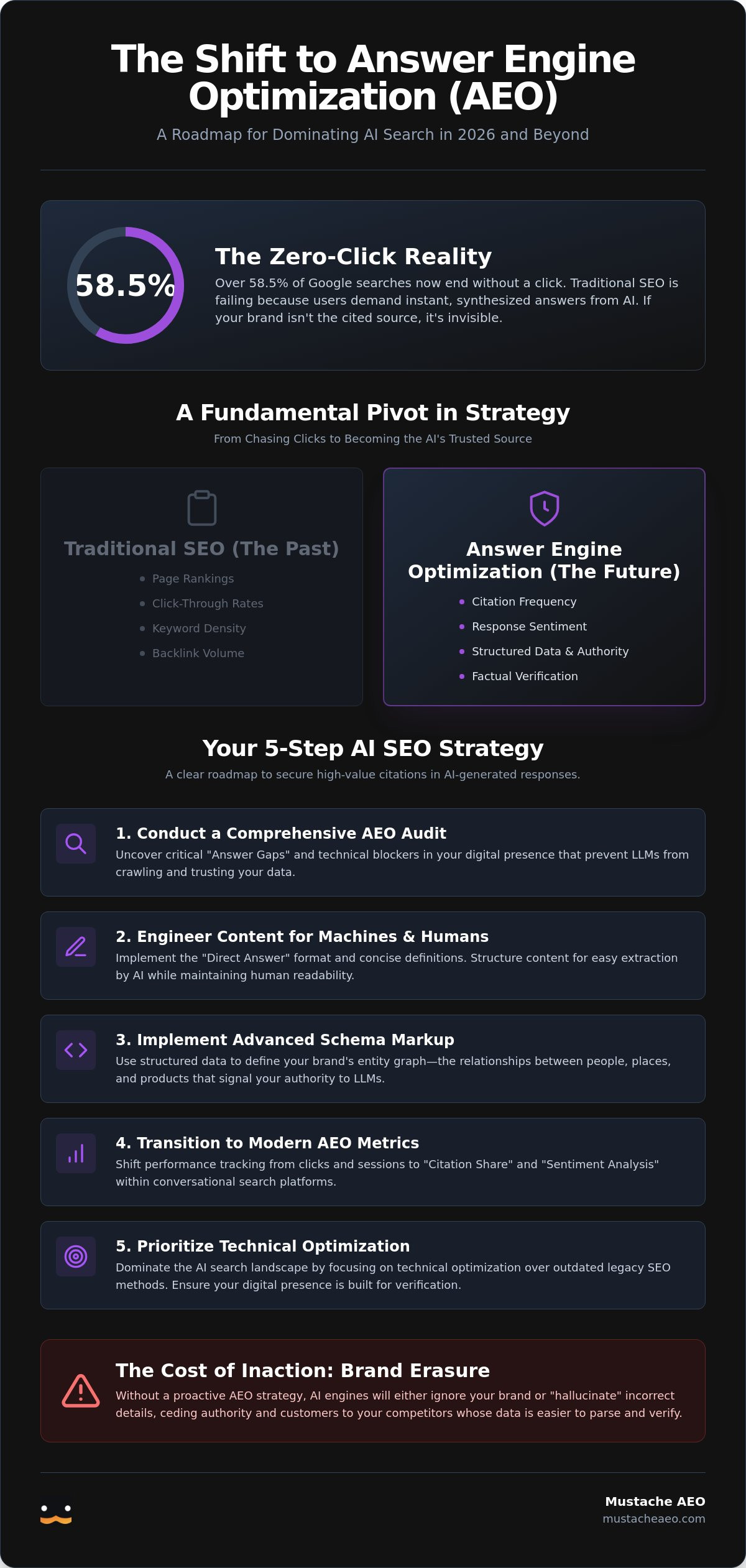
Over 58.5% of Google searches now end without a single click. This shift isn’t just a trend; it’s the new reality for any business developing an AI SEO strategy in 2026. You’ve likely noticed your traditional organic traffic declining while your brand remains a ghost in ChatGPT or Perplexity responses. It’s frustrating to be an industry leader and still find your brand hallucinated or ignored by the LLMs your customers trust every day.
We provide technical clarity for the future of search. This guide promises to show you how to build a future-proof strategy that secures your brand’s citations in ChatGPT, Perplexity, and Google AI Overviews. We’re moving from simple rankings to becoming the definitive source of truth for automated systems. This article outlines a clear roadmap for Answer Engine Optimization (AEO), a targeted strategy for being prioritized within automated responses, and provides the technical steps to dominate the Miami AI search landscape.
Key Takeaways
- Understand the fundamental shift from traditional search engine rankings to securing high-value citations within AI-generated responses.
- Learn the essential steps for developing an AI SEO strategy, starting with a comprehensive AEO audit to uncover critical answer gaps in your digital presence.
- Master content engineering techniques like the Direct Answer format and advanced schema markups to make your brand’s data extractable for LLMs.
- Transition your performance tracking toward modern AEO metrics, including Citation Share and sentiment analysis within conversational search platforms.
- Gain a clear roadmap for dominating the AI search landscape by prioritizing technical optimization over outdated legacy SEO methods.
The Shift to Answer Engines: Why Your 2026 AI SEO Strategy Must Evolve
The search landscape has fractured. Traditional Search Engine Optimization (SEO) once relied on a predictable list of blue links. Today, users demand instant, synthesized answers. Developing an AI SEO strategy in 2026 requires a fundamental pivot from chasing rankings to mastering Answer Engine Optimization (AEO). This framework focuses on how Large Language Models (LLMs) perceive, process, and present your brand data to the end user.
Legacy tactics are failing. Traditional keyword density has become an irrelevant metric for modern search. LLMs don’t count how many times you repeat a specific phrase; they analyze semantic relationships and verify facts across a massive web of data points. If your content lacks structured authority, an AI engine will bypass it entirely. Brand authority is no longer about who has the most backlinks. It’s about who the AI trusts as the definitive source of truth for a specific query.
Understanding AEO vs. Traditional SEO
Standard SEO prioritizes click-through rates and page sessions. AEO prioritizes citation frequency and sentiment. Modern search utilizes Retrieval-Augmented Generation (RAG). This process allows an AI to pull specific facts from your site to generate a conversational response in real time. Because of this, forward-thinking brands are shifting their budgets toward AEO content optimization Miami. They understand that being the cited source in a Perplexity or ChatGPT response is the only way to capture high-intent traffic in a zero-click environment.
The Cost of Inaction: AI Hallucinations and Brand Erasure
Ignoring the shift to answer engines creates a dangerous vacuum. When an AI engine cannot verify your data through clear, structured signals, it faces two choices. It might ignore your brand entirely, effectively erasing you from the conversational search results. Or, it might hallucinate details based on outdated or incorrect third-party information. This leads to brand erasure where your competitors are cited as the primary authority simply because their data was easier for the LLM to parse.
Protect your digital identity. Developing an AI SEO strategy ensures that when a user asks for the “best service in my niche,” the AI has the verified data points necessary to recommend you with confidence. We help you build this technical foundation so you don’t leave your reputation in the hands of an algorithm’s best guess. It is the essential first step to remaining visible in a world where the search bar is being replaced by a chat box.
5 Steps to Developing a Robust AI SEO Strategy
Developing an AI SEO strategy requires more than just installing a plugin or generating bulk articles. It demands a systematic re-engineering of how your brand exists online. Recent data shows that 86% of SEO professionals have integrated AI into their workflows, yet few have a roadmap for being cited by the engines themselves. Success in 2026 depends on high-level technical expertise and a proactive attitude toward these automated systems. You need to move beyond simple keyword matching and start building a digital presence that AI agents can trust and verify.
Step 1: The AEO Audit and Baseline Discovery
You can’t optimize what you haven’t measured. The foundation of your plan must be a rigorous assessment of how platforms like ChatGPT and Perplexity currently perceive your brand. This involves identifying technical blockers in your robots.txt or schema markup that might prevent LLMs from crawling your site effectively. Understanding what is an AEO audit is the essential first step to securing your visibility. It reveals exactly where the AI loses trust in your data and where “Answer Gaps” allow competitors to steal your citations.
Step 2: Mapping Your Entity Graph
Large Language Models don’t think in keywords; they think in entities. These are the relationships between people, places, and things that define your brand’s niche. Research on Enhancing SEO through AI highlights that structuring data to satisfy the reasoning phase of AI engines is critical. You must define your brand’s unique attributes within LLM training sets. This ensures the AI understands your specific authority during its internal reasoning process, making it more likely to recommend you over a generic competitor.
To complete your roadmap, focus on these three final pillars:
- Step 3: Machine Readability. Structure your content for extractability. Use clear headings and concise definitions that an AI can easily parse and use in generated answers.
- Step 4: Digital PR for AI. Build a network of third-party validation. AI engines cross-reference facts across the web, so mentions on authoritative sites are vital for validation and ranking.
- Step 5: Sentiment Tracking. Traditional rank tracking is no longer enough. Implement specialized reporting to measure brand sentiment and citation frequency within conversational search responses.
Executing these steps ensures your brand isn’t left behind as search behavior evolves. If you’re ready to move beyond legacy tactics, a tailored AEO Strategy can help you dominate the conversational search landscape and secure your place in the future of information retrieval.
Content Engineering: Writing for Both Humans and LLMs
Content creation in 2026 is an exercise in engineering. While traditional SEO focused on readability for humans, developing an AI SEO strategy requires you to write for the machines that index your expertise. This dual-audience approach ensures your brand is both relatable to customers and extractable for Large Language Models. The Direct Answer format is your primary tool here. Your H1 and the opening 30 to 50 words of your first paragraph must provide a definitive, factual response to the user’s likely query. If an AI agent can’t verify your answer within seconds, it will simply synthesize a response from a competitor’s site instead.
Precision is the new currency of search. LLMs prioritize data transparency and verifiable claims over marketing fluff. To succeed, you must pair a conversational tone with high-level technical precision. This involves utilizing advanced Schema.org markups to define the specific relationships between your products, services, and locations. When your data is structured correctly, AI engines don’t have to guess at your meaning; they can cite your facts with confidence. We focus on this technical content optimization to ensure your brand’s data is the most reliable source available to the model.
Optimizing for Conversational Search Queries
Conversational search has replaced the fragmented keyword search of the past. Users now ask full questions, which means your H2 headings should directly target Who, What, Where, and Why queries. Structuring your content with clear FAQ sections allows AI agents to parse your site as a series of modular answers. Miami tech firms have already begun using these AEO tactics to dominate local search queries. By providing direct answers to specific regional questions, they ensure their brand is the first one cited when a user asks their AI assistant for a local recommendation.
Authority Signaling and External Citations
AI engines don’t just read your site; they cross-reference it. Building a moat of authoritative mentions across the web is a critical component of developing an AI SEO strategy. LLMs prioritize sources that are validated by high cross-reference counts from other trusted entities. This is where technical whitepapers and deep-dive research become essential. These assets provide the dense, factual data that AI engines crave, serving as a signal of expertise that traditional blog posts cannot match. When multiple authoritative sites cite your research—similar to how Carwa – UAE Online Car Auctions & Marketplace establishes dominance in the automotive sector through in-depth industry guides—the AI views your brand as the definitive leader in your niche.
Measuring Performance: AEO Metrics for the AI Era
Legacy tracking is obsolete. In 2026, counting clicks and keyword rankings no longer reflects your market position. Developing an AI SEO strategy requires a shift toward metrics that capture your brand’s presence within conversational ecosystems. Statistics show that visitors from AI search convert at a rate 4.4 times higher than traditional organic search users. This makes precise measurement the difference between actual revenue and vanity metrics. You can’t rely on 20th-century tools to track 21st-century intelligence, which is why many performance-driven organizations now look to AI-powered data science platforms like nodalmarketing.com to bridge the gap.
Citation Share is the new benchmark for visibility. This metric measures how often your brand is cited as a source compared to your competitors within a specific set of prompts. We also prioritize Sentiment Analysis. It’s not enough for an LLM to mention your brand; the engine must actively recommend your services. A high Source Credibility Score ensures that platforms like ChatGPT, Perplexity, and Claude view your site as a reliable foundation for their responses. If your score drops, the AI will stop citing you in favor of more verifiable sources.
The Share of Model (SoM) Framework
Share of Model (SoM) defines your brand’s footprint across AI training data and real-time retrieval systems. It’s the 2026 equivalent of market share. Calculating SoM involves analyzing thousands of queries across different platforms to see where your authority stands. To monitor this effectively, you must utilize the best aeo tracking tools currently available. These specialized platforms provide the granular data necessary to move beyond guesswork and into strategic dominance within the AI landscape.
Iterative Optimization Based on AI Feedback
AI engines provide a constant stream of feedback if you know how to listen. We use a process of “reverse prompting” to see exactly what an engine knows about your brand at any given moment. If an LLM provides outdated info or hallucinates details, your strategy must adjust immediately to correct the record. This iterative cycle is the core of modern brand management. For Miami executive teams, we establish monthly reporting rituals that translate these technical data points into clear business outcomes. This ensures your leadership understands exactly how your digital authority is growing. Ready to see how your brand performs? Start with our Tracking & Reporting service to get a definitive look at your current AI visibility.
Partnering with a Miami AI SEO Specialist: Mustache AEO
Generalist agencies are falling behind. Most firms still optimize for a version of the internet that no longer exists, focusing on keyword volume and legacy backlink counts while ignoring the underlying logic of Large Language Models. Developing an AI SEO strategy requires a specialized understanding of how machines synthesize information. We don’t just aim for rankings; we aim for citations. Our Miami-based team provides the technical expertise needed to ensure your brand is the preferred answer in the conversational search era.
The Mustache AEO approach combines rigorous technical audits with proactive strategic roadmaps. We recognize that 91% of marketers are now using AI, but few understand the difference between using AI for content and optimizing for AI retrieval. We bridge this gap by focusing on the “extractability” of your data. Our goal is to move your brand from the periphery of search results to the center of the AI conversation, ensuring you remain relevant as traditional SERPs continue to dissolve.
Our Specialized AEO Strategic Roadmap
We provide a clear path to visibility through a three-phase execution model. Each phase is designed to build the authority LLMs require to trust your brand data.
- Phase 1: Technical AEO Audit and LLM Visibility Report. We conduct a deep dive into your current digital footprint. This initial AEO Audit identifies the technical blockers and data gaps that prevent AI engines from citing your brand.
- Phase 2: Content Restructuring and Schema Deployment. We implement precise Content Optimization. This involves re-engineering your existing assets and deploying advanced schema to ensure your information is machine-readable and citable.
- Phase 3: Ongoing Tracking and Citation Management. We provide continuous Tracking & Reporting. Our team monitors your Citation Share across platforms like ChatGPT and Perplexity, adjusting your AI SEO strategy as model weights and search behaviors evolve.
Secure Your Brand’s Future in the AI Ecosystem
Don’t let your brand become a footnote in the AI revolution. As search behavior shifts toward conversational answers, the risk of brand erasure becomes a real threat for those clinging to legacy tactics. Developing an AI SEO strategy with a local partner who understands the Miami tech landscape provides a distinct competitive advantage. We offer the personalized service of a boutique firm paired with the high-level technical capability of a global pioneer. Secure your place in the future of information retrieval. Contact Mustache AEO today for a consultation on your 2026 strategy and ensure your brand is the one the machines recommend.
Dominate the Conversational Search Landscape
The era of chasing blue links has passed. In 2026, your brand’s survival depends on its ability to be synthesized and cited by the world’s most powerful AI models. Developing an AI SEO strategy is no longer an optional experiment; it is the fundamental requirement for digital visibility. By engineering content for extractability and mapping your entity graph, you ensure that AI agents don’t just find your data but prioritize it as the definitive answer.
We provide the technical foundation for this transformation. Our Miami-based technical experts utilize a Specialized AEO Audit Framework to bridge the gap between your current assets and AI-ready authority. With proprietary AI visibility tracking, we move beyond guesswork to deliver measurable results in platforms like Perplexity and ChatGPT. Don’t let your brand become a footnote in the automated revolution. Book Your Specialized AEO Audit with Mustache AEO today to secure your future. The shift to answer engines is here, and we’re ready to lead you through it.
Frequently Asked Questions
How is an AI SEO strategy different from traditional SEO?
Traditional SEO targets rankings and click-through rates on a results page, while Answer Engine Optimization (AEO) targets citations and brand sentiment within generated responses. Legacy methods prioritize keyword density and backlink volume. Developing an AI SEO strategy focuses on semantic relationships and machine-readable data structures. It’s about becoming the trusted source for a model’s reasoning rather than just a result on a list of blue links.
Can I develop an AI SEO strategy for a local Miami business?
Yes, local businesses benefit significantly from AI search because LLMs prioritize regional relevance for specific conversational queries. We help Miami brands optimize for “near me” prompts and local entity recognition. This ensures that when a user asks for a top-rated service in the city, your business is the first one the AI recommends based on verified local data points and geographic authority.
Which AI search engines should I prioritize for my brand?
Prioritize ChatGPT, Perplexity, and Claude, as these platforms currently lead the conversational search market. Each engine uses different retrieval methods, so your strategy should account for these technical nuances. Google AI Overviews also remains a critical target due to its integration with legacy search. A balanced approach ensures your brand is visible across the most influential training sets and real-time retrieval systems used today.
How long does it take to see results from AEO optimization?
Most brands see initial citation shifts within three to six months of implementing technical optimizations. Unlike traditional SEO, which relies on slow crawl cycles, AI engines update their understanding as they ingest new, verified data points across the web. The timeline depends on the frequency of model updates and how quickly you resolve the technical blockers identified in your initial AEO Audit and strategic roadmap.
Do I need to rewrite all my existing content for AI engines?
You don’t need a total rewrite, but you must restructure your content for extractability. We focus on Content Optimization that layers “Direct Answer” formats over your current assets. This involves adding clear H2 headings and concise definitions that machines can easily parse. It’s about making your existing expertise more accessible to the algorithms that synthesize search responses without losing the human touch your readers expect.
What are the best tools for tracking AI search visibility in 2026?
Use specialized platforms like Semrush’s AI Visibility Index and Ahrefs’ Brand Radar to monitor your footprint. Traditional rank trackers are insufficient because they can’t measure citation share or sentiment within a chat interface. We utilize proprietary Tracking & Reporting systems to provide a granular view of how often your brand is mentioned across various LLMs compared to your direct competitors in the Miami market.
Does a ‘Miami AEO audit’ cover global AI visibility?
Our audit provides a comprehensive view that includes both local authority and global visibility. While we highlight our Miami roots for regional authority, the technical blockers we identify affect how LLMs perceive your brand worldwide. Correcting your schema and data transparency improves your citation rates across all geographic markets, as AI models generally apply the same reasoning logic regardless of the user’s specific physical location.
Will AI SEO replace traditional search engine optimization entirely?
AI SEO won’t replace traditional methods, but it will become the dominant framework for digital visibility. Traditional SEO will evolve into a foundational layer that supports Answer Engine Optimization. You’ll still need a healthy website with high-quality content, but the goal will shift from driving page clicks to securing brand citations within the conversational interfaces that 83% of users now find more efficient.