
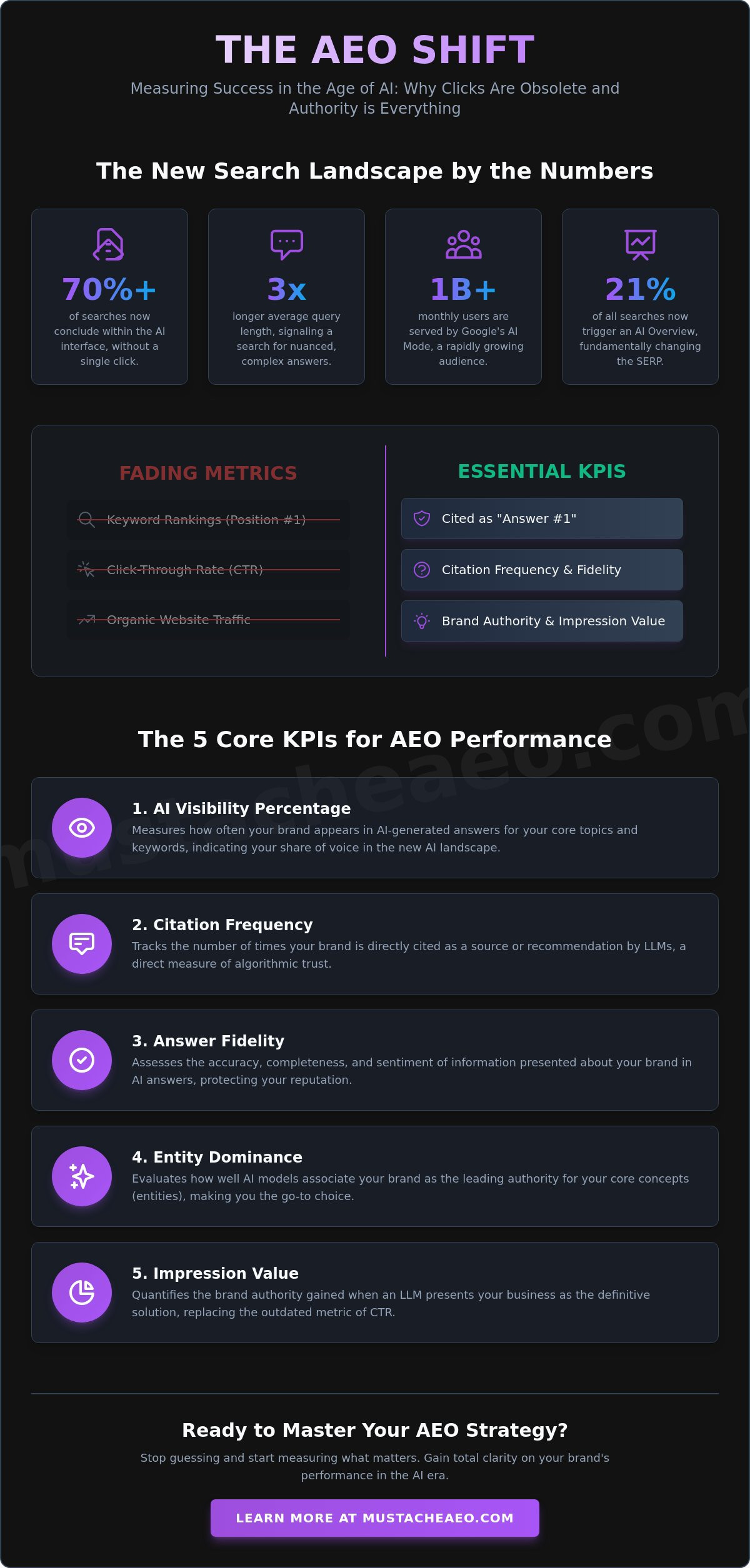
What if your brand’s biggest win this month didn’t result in a single click to your website? It’s a jarring shift for any digital marketer. With AI Overviews appearing in 21% of searches and the average query length tripling, the old rules of engagement have changed. You aren’t just fighting for a spot on page one anymore; you’re fighting to be the definitive source that an LLM trusts and cites. Learning how to measure AEO success is no longer a luxury for the future. It’s a requirement for survival in an environment where Google’s AI Mode now serves over 1 billion monthly users.
We understand the pressure of explaining declining click-through rates to a CEO who still values outdated metrics. This guide bridges that gap. You’ll master the new KPIs of the AI era and learn exactly how to track your brand’s authority across answer engines like ChatGPT and Perplexity. We provide a clear framework for a monthly AEO performance report that proves your brand is the top-of-mind choice for modern algorithms. From utilizing the June 2026 Search Generative AI reports in Google Search Console to monitoring AI Visibility Percentage, you’re about to gain total clarity on your digital footprint.
Key Takeaways
- Abandon legacy metrics that prioritize website clicks over brand visibility. You’ll learn why “Answer 1” is the new “Position 1” in an environment where most searches now end within the AI interface.
- Master the five essential KPIs for the AI era. This guide provides a clear framework for how to measure AEO success using metrics like Citation Frequency and Answer Fidelity across major LLMs.
- Identify the right tools for monitoring your presence in automated responses. We cover how to combine specialized tracking software with manual “secret shopper” audits to verify your brand’s accuracy in ChatGPT and Perplexity.
- Build a reporting dashboard that speaks to leadership. You’ll learn to define your core entities and track them through a continuous optimization loop that proves your brand’s authority.
Why Traditional SEO Metrics Fail in the Answer Engine Era
Traditional SEO metrics are dying. For decades, digital marketers obsessed over “Position 1” and click-through rates, but in 2026, those numbers represent a fading era of search. Search has evolved into a conversational exchange where Large Language Models (LLMs) act as the primary filter for information. If you’re still trying to figure out how to measure AEO success by looking at organic traffic in Google Search Console, you’re missing most of the picture. The reality is that over 70% of searches now conclude within the AI interface. Users get the answer they need without ever clicking a link. Google’s AI Mode now serves over 1 billion monthly users, and the average query is three times longer than a traditional search. This complexity means users are looking for nuanced advice, not just a list of links.
This shift marks the end of the traditional keyword rank as a primary success indicator. Being at the top of a list of blue links doesn’t matter if an AI agent provides a comprehensive summary above those results. Success is now defined by being “Answer 1.” This requires a deep commitment to Answer Engine Optimization (AEO), where the goal is to become the cited source that the AI trusts. You aren’t just ranking; you’re being validated by an intelligent system.
Google Search Console only tells half the story. It tracks clicks from Google’s ecosystem, but it remains blind to the millions of queries happening on ChatGPT, Claude, and Perplexity. You can’t manage what you don’t see. The psychological shift required here is massive. You must value brand influence over mere website sessions. It’s about being the top-of-mind choice for the algorithm. When an LLM recommends your brand, the conversion often starts before the user even reaches your site.
The Obsolescence of Click-Through Rate (CTR)
Click-through rate is no longer the gold standard for digital health. When Google’s AI Overviews or Perplexity satisfy a user’s intent immediately, the “click” becomes redundant. We now focus on “Impression Value.” This metric quantifies the brand authority gained when an LLM presents your business as the definitive solution. Miami brands must pivot from traffic-chasing to authority-building. Utilizing specialized Miami AEO services ensures your business remains visible as search behavior continues to shift. High-value impressions in an AI answer often carry more weight than a thousand low-intent clicks.
From Blue Links to Conversational Citations
The gatekeepers have changed. In the past, Google served as a directory; today, LLMs serve as consultants. For local Miami services, being “baked into the weights” of the model is the ultimate competitive advantage. This means your brand information is so pervasive and verified that the model considers it a fundamental fact. We’ve moved from a “10 blue links” model to a single definitive answer model. Understanding how to measure AEO success means tracking how often your specific brand name appears in these conversational citations. It’s about presence, not just position.
The 5 Core KPIs for Measuring AEO Performance
We define performance by visibility and validation within automated ecosystems. Relying on traditional traffic metrics leaves your brand vulnerable to the “Zero-Click” shift where users find everything they need inside the chat interface. To gain a competitive edge, you must adopt a new set of metrics that reflect how Large Language Models (LLMs) perceive and present your brand. Learning how to measure AEO success requires a move toward entity-based tracking and citation analysis. This transition ensures your brand remains the primary choice for algorithms that prioritize trust over simple keyword matching.
Our methodology focuses on five specific indicators that determine your standing in the modern search landscape. These metrics provide a holistic view of your digital authority. You can find a deeper dive into these technical benchmarks in The Complete AEO Measurement Framework. These core KPIs include:
- Citation Frequency: This tracks how often your brand is named as a source across top LLMs like ChatGPT and Perplexity. High frequency correlates with high authority.
- Answer Fidelity: This measures the accuracy of the information provided about your brand or services. It ensures the AI doesn’t misrepresent your offerings.
- Entity Sentiment: LLMs categorize brands as leaders or secondary options. This KPI evaluates whether the AI describes your brand with a positive, authoritative bias.
- Recommendation Share: This identifies how often you appear in “best of” or “top-rated” conversational queries. It’s the AI equivalent of market share.
- Structured Data Coverage: This is the percentage of your content correctly mapped to the Knowledge Graph via schema markup. It’s the technical foundation for all AI visibility.
Measuring Answer Fidelity and Accuracy
Accuracy is the primary currency of the AI era. We actively identify the risk of “AI hallucinations” where an engine might invent brand facts, incorrect pricing, or non-existent services. It’s also critical to track if AI engines are misattributing your intellectual property to competitors. Answer Fidelity is the metric of factual alignment between your site and AI responses. If the AI isn’t grounded in your verified data, your how to measure AEO success strategy is failing. We use manual audits and specialized tools to ensure every citation is a true reflection of your brand.
Calculating Your Recommendation Share
Recommendation Share determines your dominance in competitive “near me” or “best” searches. There is a fundamental difference between being a “cited source” and a “recommended solution.” A citation simply mentions you; a recommendation positions you as the best choice for the user. We track recommendation trends for Miami-specific professional services to ensure our clients remain the top suggestion. If you’re ready to secure your spot as the definitive answer, consider starting with a comprehensive AEO Audit to see where you stand today.
Tools and Techniques for Tracking AI Visibility
Monitoring your brand in the AI era requires a departure from traditional dashboarding. You cannot rely solely on tools built for the “blue link” era because they often miss the conversational context of modern answers. We use a combination of API-driven monitoring and manual “Secret Shopper” audits to verify how LLMs represent our clients. This hybrid strategy is essential because many AI interactions happen in private threads that standard crawlers cannot reach. Understanding Why Measuring AEO Is Different From SEO helps clarify why standard keyword trackers often fail to capture the nuance of a conversational response. Learning how to measure AEO success starts with looking past the click and focusing on the citation.
Performance baseline starts with data. Specialized AEO audits are the first step in identifying where your brand currently lives within the Knowledge Graph. Once we establish this baseline, we deploy the best AEO tracking tools to monitor mentions in real-time. These tools track entity mentions across ChatGPT, Perplexity, and Gemini, providing a level of visibility that traditional rank trackers simply don’t offer. By using API-based tools, we can monitor brand mentions in real-time within AI interfaces. This allows us to react quickly to hallucinations or misattributions before they become part of the model’s “permanent” understanding of your business. Discovering how to measure AEO success is a process of constant validation.
Automated vs. Manual AEO Monitoring
Software provides the scale needed to track thousands of potential queries across multiple platforms simultaneously. However, human-led prompt audits are necessary to understand the context of a recommendation. We suggest a recurring “AI Pulse Check” for your brand’s core entities. This involves manually prompting LLMs to describe your services, ensuring the narrative remains accurate and authoritative. While automation identifies the “where,” manual audits explain the “how.” It’s the only way to navigate the current limitations of trackers that struggle to capture the sentiment of private, non-indexed AI conversations.
Tracking Citations in Perplexity and Google AI Overviews
We look for “Source Leakage” where competitors might be cited for your original research or data. Seeing which specific pages are being crawled for AI citations allows us to double down on high-value content that models clearly prefer. You can identify these pages by looking at the reference links provided in Perplexity or the “Sources” dropdown in Google AI Overviews. Citation tracking identifies the specific URLs fueling AI answers, giving you a roadmap for future optimization. If a low-value page is being cited over your primary service page, it’s a clear signal that your content structure needs adjustment to better serve AI extractors.
Building Your AEO Dashboard: A Step-by-Step Framework
A centralized reporting system is the only way to reclaim control over your brand’s digital narrative. You need a data-driven structure that translates complex LLM interactions into actionable insights. Knowing how to measure AEO success requires moving beyond the flat data of a standard spreadsheet. Our framework prioritizes entity health and citation depth, ensuring your dashboard reflects the reality of a conversational search environment. This structured approach allows you to move from reactive guessing to proactive optimization.
- Step 1: Define your core entities. Identify your Brand, Key Personnel, and Primary Services. These are the fundamental units that AI models use to categorize your business.
- Step 2: Establish a baseline. Audit your current visibility across five major LLMs, including ChatGPT, Gemini, and Perplexity. This provides the starting point for your authority growth.
- Step 3: Categorize queries. Segment your tracking into Informational, Commercial, and Local-Intent buckets. This helps you see where the AI considers you a primary authority versus a secondary source.
- Step 4: Map citations to outcomes. Connect AI mentions to specific business results like brand lift or indirect lead generation. Even without a click, a recommendation carries measurable commercial weight.
- Step 5: Set a monthly cadence. Establish a recurring reporting cycle to track authority growth. Regular updates ensure you catch hallucinations or source leakage before they impact your reputation.
Defining Local Entity Signals for Miami Brands
Local context is the new battleground for Miami businesses. We measure your “Miami Authority” by tracking how often local publications and directories appear as citations alongside your brand in AI answers. It’s not enough to just exist; your Miami office must be a verified entity in the Knowledge Graph. This verification ensures that when a user asks for the best service in the Magic City, the AI pulls from a foundation of localized trust. We focus on securing mentions in regional databases that LLMs prioritize for geographical accuracy.
Reporting AEO Success to Executive Stakeholders
C-suite leaders demand clarity on marketing spend. We translate “Citation Share” into “Market Share” to show the true impact of your how to measure AEO success strategy. Visualizing the transition from traditional organic traffic to AI visibility helps stakeholders understand the changing landscape of 2026. We introduce “Cost per Citation” as a new efficiency metric for marketing spend. This provides a clear benchmark for how effectively your budget is building long-term brand authority. If you’re ready to modernize your reporting, our Tracking & Reporting services provide the granular data you need to prove ROI.
The Future of Measurement: Why Specialized AEO Audits are Essential
AEO is not a destination. It’s a continuous optimization loop. Large Language Models are constantly retraining on new data; this means your visibility today doesn’t guarantee your authority tomorrow. We see many brands treat this as a “set and forget” project, only to find their citations disappearing after a model update. Mustache AEO provides the technical oversight needed to navigate these shifts in the 2026 search environment. Specialized audits are the only way to identify the invisible gaps in your AI authority. These gaps often exist in the training data or the Knowledge Graph, where your brand might be mentioned but not validated as a leader.
A comprehensive audit reveals why an AI might hallucinate about your services or ignore your most profitable entities. We analyze the relationship between your structured data and the way LLMs synthesize that information. This process ensures your brand becomes the logical conclusion of every AI-driven inquiry. Understanding how to measure AEO success means recognizing that your digital presence is now a living conversation. You must stay present in that conversation to remain relevant. We move your brand from being a data point to becoming a trusted partner for the algorithm.
Beyond SEO: The Strategic Advantage of AEO
Generalist agencies often fail to track conversational performance accurately because they still rely on legacy metrics. They look for clicks while the world moves toward citations. We prioritize AEO content optimization to ensure your information is structured for extraction. This specialized focus provides a roadmap for Miami brands to lead their industry. It’s the difference between being a background link and a foreground recommendation. We help you own the niche by defining how you are prioritized within automated responses. Our approach replaces guesswork with technical precision.
Take the First Step: Audit Your AI Presence
The window for early adoption is closing. Proactive brands are already securing their share of voice in AI interfaces, leaving reactive firms to fight for the remaining traffic. High-stakes Miami firms require a tailored AEO strategy that protects their reputation and drives authority. You can’t fix what you haven’t measured. We provide the clarity needed to dominate the next era of search. Learning how to measure AEO success starts with a deep dive into your current LLM standing. Don’t wait for your competitors to become the definitive answer. Get your specialized AEO Audit from Mustache AEO today.
Own Your Brand Narrative in the AI Era
The transition from traditional search to answer engines is complete. You’ve learned that success isn’t about the quantity of blue links anymore; it’s about the quality and accuracy of your conversational citations. By focusing on modern KPIs like Answer Fidelity and Recommendation Share, you move from chasing low-intent traffic to building genuine authority. Mastering how to measure AEO success gives your business a strategic advantage that legacy SEO tactics simply can’t match. It’s about being the definitive source that LLMs trust and recommend.
We are pioneers in Answer Engine Optimization and specialized Miami AI search experts. Our team provides the data-driven AEO tracking and reporting required to navigate the complexities of 2026. We don’t just track clicks; we validate your brand’s standing within the global Knowledge Graph. Don’t let your competitors define your narrative in this shifting landscape. Take control of your digital footprint and ensure you’re the top-of-mind choice for every algorithm.
Secure your brand’s future with a comprehensive AEO Audit from Mustache AEO
The future of information retrieval is conversational. We’re here to ensure your brand is the one leading the discussion with confidence and clarity.
Common Questions About AEO Measurement
What is the most important metric for AEO success in 2026?
Citation Frequency is the most critical metric in the current landscape. This measures how often your brand is cited as a trusted source across major LLMs like ChatGPT and Perplexity. While traditional SEO focused on clicks, your standing now depends on being the “Answer 1” that the AI presents to the user. It validates your brand as a primary authority within the model’s weights.
How do I track if my brand is being mentioned in ChatGPT?
You can track ChatGPT mentions through a combination of manual “Secret Shopper” prompts and API-driven monitoring tools. Since ChatGPT doesn’t provide a public search console, you must use specialized software to simulate user queries and record when your brand appears in the output. This provides a real-time view of your AI visibility that standard search tools cannot capture.
Can I still use Google Analytics to measure AEO results?
Google Analytics remains useful for tracking referral traffic from AI citations, but it doesn’t capture the full scope of your influence. Because 70% of AI searches result in zero clicks, you need a specialized strategy for how to measure AEO success that looks beyond website sessions. Relying solely on legacy analytics will leave you blind to your brand’s actual reach within conversational interfaces.
What is an Answer Visibility Score (AVS)?
Answer Visibility Score is a metric that quantifies your brand’s presence within AI-generated responses. It evaluates three specific factors: the frequency of your citation, the sentiment of the recommendation, and the accuracy of the facts provided. A high AVS indicates that your brand is a primary, trusted entity in the AI’s knowledge base, making you the logical choice for the algorithm.
How do I stop an AI from providing incorrect information about my business?
You correct AI misinformation by grounding the model in verified, structured data on your own digital properties. AI engines pull from the Knowledge Graph, so you must use schema markup and authoritative citations to provide a single source of truth. Regular audits help you identify hallucinations early so you can adjust your content strategy to overwrite the AI’s incorrect assumptions.
Is it possible to track AEO success for a local Miami business?
Yes, tracking local AEO success involves monitoring “near me” conversational queries and local entity signals. We track how often your Miami business is recommended for location-specific services in the Magic City. This requires a focus on local directories and regional publications that LLMs use to verify geographical authority and provide accurate local recommendations.
How often should I audit my brand’s visibility in answer engines?
We recommend auditing your brand’s visibility at least once per month. AI models and their underlying training data are in a state of constant flux as they ingest new information. A monthly reporting cadence ensures you stay ahead of algorithmic shifts and maintain your top-of-mind status for the engines. It turns optimization into a proactive, continuous loop of validation.
Does structured data still matter for AEO measurement?
Structured data is essential because it serves as the technical bridge between your content and the AI’s understanding. Schema markup helps AI crawlers map your brand to the Knowledge Graph with high precision. Without this foundation, the engine might struggle to extract the correct facts, making it difficult for you to understand how to measure AEO success accurately across different platforms.