
In 2026, visibility isn’t about ranking #1 on a search results page; it’s about being the most trusted citation in an AI’s latent space. You’ve likely noticed that traditional click-through rates are plummeting as users get their answers directly from platforms like ChatGPT and Perplexity. It’s frustrating to watch your brand become invisible in conversational search despite years of SEO effort. If you’re confused by the shift from legacy search to answer engines, you aren’t alone. This definitive AEO audit checklist allows you to assess your content for AI search engines and secure your place in the citations of Claude and Gemini.
We’re here to provide a clear roadmap for this new era. We’ll examine the 48 critical factors across technical access, content structure, and E-E-A-T signals that determine whether an LLM recommends your brand or ignores it. This article breaks down the technical requirements for crawlability and the “answer-first” formatting needed for extractability. You’ll gain a measurable strategy to turn your site into a primary data source for the world’s most powerful AI models, ensuring your brand remains authoritative and visible in every conversation.
Key Takeaways
- Transitioning from legacy SEO to LLM-readability is essential for capturing traffic in an era of zero-click conversational search.
- Our AEO audit checklist provides a step-by-step guide to opening your technical infrastructure to critical crawlers like GPTBot and PerplexityBot.
- Mastering “Answer-First” formatting ensures your content is easily extractable for AI systems through targeted H2 questions and precise definition boxes.
- Building authority in high-value datasets like Wikidata allows AI models to validate your brand and cite your expertise with higher confidence.
- Implementing a specialized AI visibility roadmap positions your business as a leader in the shifting digital landscape of 2026.
The Shift from SEO to AEO: Why You Need a New Audit
Visibility is the new currency in the digital economy. For over two decades, businesses focused on climbing the ranks of Google’s blue links, but the rules of the game changed. By 2026, the traditional search engine results page (SERP) has evolved into a conversational interface where AI provides the final answer. This transition has birthed Answer Engine Optimization (AEO), a specialized framework designed to make your brand’s data readable and trustworthy for Large Language Models (LLMs). If your content isn’t formatted for these systems, your brand simply doesn’t exist in the eyes of the AI.
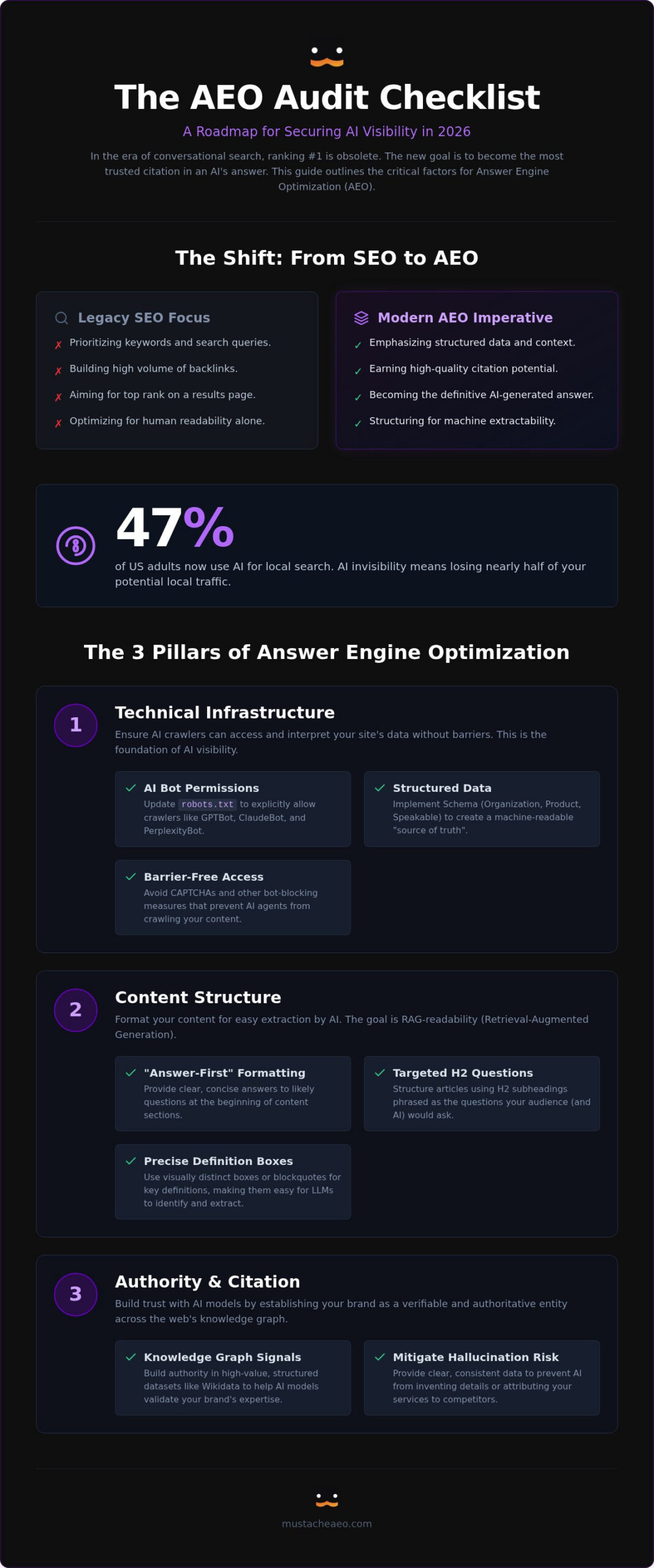
Legacy search tactics are no longer sufficient. While traditional SEO prioritized keywords and backlink volume, AEO prioritizes structured data, contextual relevance, and citation potential. We’ve entered the era of “Zero-Click” search, where users get everything they need from an AI-generated summary without ever visiting your website. For Miami businesses, this shift is critical. With nearly 47% of US adults now using AI for local search, failing to appear in a ChatGPT or Perplexity response means losing nearly half of your potential local traffic. You need a comprehensive AEO audit checklist to bridge the gap between being a search result and being the definitive answer.
Understanding the AI Search Landscape in 2026
The dominance of Perplexity, ChatGPT Search, and Google AI Overviews has redefined how information is retrieved. These platforms don’t just “rank” content; they synthesize it. Traditional SEO audits often miss the citation layer entirely because they focus on human readability rather than machine extractability. Technically, AEO is the optimization of content for retrieval-augmented generation (RAG), ensuring that LLMs can accurately pull and cite your specific brand data. By focusing on RAG-readability, you ensure your brand is the primary source the AI trusts when a user asks a high-intent question.
The Cost of AI Invisibility for Miami Brands
Invisibility is dangerous, but misinformation is worse. When AI engines lack clear, structured data about your brand, they face a “hallucination risk” where they may invent details or attribute your services to a competitor. AEO protects your brand’s reputation by providing a “source of truth” that AI agents can validate. This is why modern specialists emphasize a proactive approach to AI visibility. If you’re unsure where to start, you should understand What is an AEO Audit? Securing Your Brand’s AI Visibility in 2026. Utilizing an AEO audit checklist is the first step in ensuring your brand is spoken about accurately in the conversational AI ecosystem.
Technical Infrastructure: The AI Crawler Access Checklist
Technical accessibility is the bedrock of AI visibility. If an LLM cannot crawl your site, your brand remains a ghost in the conversational search landscape. This phase of the AEO audit checklist focuses on the invisible handshakes between your server and the world’s most powerful AI models. Traditional SEO often ignores these specific bot permissions; however, in 2026, managing these entry points is non-negotiable for any brand seeking citations.
AI engines often look for clean data streams rather than just rendered HTML. To gain a deeper understanding of these requirements, you should explore What is Answer Engine Optimization? to see how AEO differs from legacy technical checks. Ensuring your site’s API accessibility allows for real-time AI data retrieval, which is essential for brands with frequently changing inventory or news updates.
Managing AI Bot Permissions
Your robots.txt file needs a 2026 upgrade. Add a User-agent line for GPTBot, ClaudeBot, and PerplexityBot followed by an Allow directive for your content. Distinguish between search crawlers and training crawlers to control data usage. Open access doesn’t mean compromising security; it creates a pathway for verified AI agents. Avoid CAPTCHAs that block bots, as they will simply pivot to a competitor’s more accessible site.
Structured Data for AI Interpretation
Structured data is the bridge between raw text and machine understanding. Use Organization and Product schema to provide a definitive source of truth about your brand. This prevents AI from guessing your location or offerings. Include Speakable Schema to capture the voice-driven answer market. By mapping your knowledge graph through JSON-LD, you help LLMs validate your authority. If you need help refining these layers, a specialized AEO audit can identify hidden blocks.
AI “lite” browsers prioritize speed and clean code. Audit your site for mobile-first indexing and remove bloated scripts that slow down bot rendering. Finally, check for rogue no-index tags in your header. These tags might have been intended for staging sites but could be blocking AI training sets on your live domain. A clean, fast, and open technical infrastructure ensures your brand is ready for the next generation of digital retrieval. This is a core component of any effective AEO audit checklist.
Content Structure: The Answer-First Formatting Checklist
LLMs don’t read content like humans; they extract data like machines. To secure citations in 2026, your content must prioritize modularity and immediate value. This section of our AEO audit checklist focuses on “Answer-First” formatting, a structural methodology that ensures semantic analyzers can identify your brand as the definitive source. When your information is buried under paragraphs of introductory filler, AI crawlers often abandon the page in favor of more efficient competitors.
Every H2 heading on your site should function as a direct question based on conversational intent. Immediately following that heading, place a 45-65 word “Definition Box.” This paragraph serves as a concise, objective answer that an LLM can easily pull for a featured snippet or a verbal response. Use bulleted lists for technical specifications and data points. This clear formatting facilitates easy AI extraction, allowing models to map your offerings without processing unnecessary fluff. Precise language is the key to validation in the AI ecosystem.
Optimizing for Conversational Intent
The shift from legacy keywords to natural language queries is complete. Users no longer type “Miami SEO”; they ask, “How do I optimize my content for AI search engines?” Your content strategy must pivot to address these long-tail, high-intent prompts. Focus on “How-to” and “What is” structures that mirror real-world dialogue. For a deeper dive into local optimization, see our guide on How to Rank in ChatGPT: The Miami Business Guide to AI Visibility (2026). Aligning your content with conversational patterns is a core pillar of a modern AEO audit checklist.
Creating Comparison and Verdict Content
AI engines prioritize content that provides a clear recommendation. They aim to close the loop for the user by offering a “Verdict” rather than a list of options. To win this placement, create high-value comparison tables that contrast your features with industry standards. LLMs prioritize verdict sentences because they provide the closure conversational users expect. Ensure your articles conclude with a definitive statement of value. This approach helps the AI synthesize your data into a confident response, positioning your brand as the logical choice in any comparison prompt.
Authority and Citation: Winning the AI Trust Factor
Trust is the filter through which every AI response passes. In a conversational ecosystem, the algorithm doesn’t just look for relevant keywords; it looks for a verified entity. This stage of your AEO audit checklist requires a deep dive into how external datasets perceive your brand. If the AI cannot validate your existence through high-authority sources, it will default to a better-documented competitor. Establishing this “Trust Factor” is what separates cited leaders from ignored background noise.
Begin by auditing your brand’s presence in foundational datasets like Wikipedia and Wikidata. These platforms serve as primary sources for many LLM training sets. If your brand data is missing or inconsistent across these nodes, the AI’s confidence score for your brand will drop. We also recommend assessing the sentiment of current AI responses using a specialized AEO grader. AI doesn’t just repeat facts; it interprets sentiment. A negative or neutral bias in training data can lead to a “reputation gap” in conversational answers. Consistency in your brand story across all digital touchpoints ensures the AI has a clear, unified narrative to retrieve.
Building E-E-A-T for AI Algorithms
Experience, Expertise, Authoritativeness, and Trustworthiness (E-E-A-T) remain critical, but the signals have shifted. AI models now prioritize expert bylines and verified credentials that are cross-referenced across the web. For local brands, identifying missing citations from niche-specific authority sites in Miami is a high-priority task. Third-party reviews also play a massive role in AI sentiment scoring. To measure these signals accurately, you need the right stack. See our guide on Best AEO Tracking Tools in 2026: The Definitive Guide for AI Search Visibility to see how we quantify authority.
Monitoring Brand Citations
Citation frequency is the ultimate KPI for AEO success. You must track how often your brand is cited as a source in platforms like Perplexity and ChatGPT. If the AI is hallucinating facts about your business, it’s often due to conflicting data found during its training phase. Correcting these hallucinations requires a strategic injection of verified data into the ecosystem. Use this manual AI sentiment testing checklist to evaluate your standing:
- Test 20-30 high-intent queries across Perplexity, Claude, and ChatGPT.
- Identify if your brand is the primary, secondary, or omitted citation.
- Score the sentiment of the response: Positive, Neutral, or Negative.
- Check for factual accuracy in the AI’s summary of your services.
Securing your brand’s authority requires a specialized eye for technical validation. If you’re ready to move beyond guesswork, schedule a professional AEO Audit to solidify your trust factor in the AI landscape. This proactive step ensures your brand isn’t just seen, but trusted as a primary source of information in every relevant AI conversation.
Executing Your Miami AEO Roadmap with Mustache AEO
Mustache AEO operates as a modern specialist agency. We’ve moved beyond the limitations of legacy search firms to address the specific demands of 2026. While traditional agencies focus on keyword density and backlink profiles, we prioritize the technical and semantic requirements of conversational search. Our AEO audit checklist serves as the foundational tool for this transition. We provide a definitive roadmap that ensures your brand is not just indexed, but actively prioritized by the world’s most advanced answer engines.
Our Miami AEO Audit differs significantly from a standard technical SEO check. A typical audit might identify broken links or missing meta descriptions; however, our process evaluates how effectively your site functions as a data source for retrieval-augmented generation. We analyze your “answer-first” infrastructure and your authority within LLM training sets. This proactive approach turns your digital presence into a validated asset that AI models can trust and cite without hesitation. We replace technical confusion with a clear, strategic path to visibility.
Specialized Tracking & Reporting is a core component of our partnership. You can’t optimize what you don’t measure. We track your brand’s citation frequency and sentiment across platforms like ChatGPT, Perplexity, and Gemini. This data allows us to refine your content strategy in real-time, ensuring you remain the primary answer for high-intent queries. We focus on practical business outcomes, moving your brand from being a hidden search result to a dominant conversational authority.
Why Miami Brands Choose Mustache AEO
Being based in the Miami tech hub allows us to understand the unique competitive pressures of the Magic City. We don’t sell PPC or social media management. Instead, we specialize in the intersection of marketing and emerging technology. Our focus remains strictly on AI SEO and Content Optimization. This dedication allows us to offer superior insights into local conversational search trends that generalist agencies miss. For firms ready to lead, our Miami AEO Services: Dominating AI Search in the Magic City (2026) provide the edge needed to capture traffic from AI-driven queries.
Start Your AEO Journey Today
Your transition from “Searchable” to “Citable” begins with a technical deep dive. When you partner with us, you receive an AEO Strategy that prioritizes long-term authority over short-term hacks. We help you build a brand that AI engines recognize and recommend. This process alleviates the anxiety of shifting technologies by providing clear, actionable results. If you’re ready to secure your brand’s future, it’s time to implement a professional AEO audit checklist. Get your specialized Miami AEO Audit from Mustache AEO and take the first step toward dominating the AI search revolution.
Own the Answer Engine Era
The transition to AI-driven search is no longer a future prediction; it’s your current reality. To remain relevant in 2026, you must move beyond the blue links of the past and embrace a digital structure that LLMs can instantly validate. By implementing a comprehensive AEO audit checklist, you ensure your technical infrastructure and content strategy align with the extraction needs of platforms like ChatGPT and Perplexity. This shift from being searchable to being citable is the most critical move your business will make this year.
As Miami’s leading AI SEO specialists, we provide the authoritative brand citation strategies necessary to secure your place in the conversational landscape. Our specialized AEO tracking and reporting give you the measurable data needed to stay ahead of the curve while others fall behind. It’s time to stop guessing about your visibility and start owning your authority. Secure your brand’s AI future with a professional Mustache AEO Audit. Take control of your visibility and lead the conversation in the Magic City and beyond. Your brand deserves to be the answer.
Frequently Asked Questions
What is an AEO audit checklist?
An AEO audit checklist is a technical and strategic framework used to evaluate how well AI-powered answer engines can find, extract, and cite your brand’s content. An effective AEO audit checklist covers 48 critical factors including crawler permissions, schema validation, and answer-first content structure. It moves your digital presence from being a simple search result to a trusted primary source for Large Language Models. This process ensures your data is readable for the systems that power modern conversational search.
How does AEO differ from traditional SEO in 2026?
AEO prioritizes citation and extraction over simple page ranking. While traditional SEO focuses on keyword placement to satisfy legacy search algorithms, AEO focuses on structured data and semantic relevance to satisfy generative AI models. The goal in 2026 is to provide the “source of truth” that AI agents use to construct their answers. You aren’t just trying to appear in a list of blue links; you’re trying to be the voice of the answer itself.
Can I perform an AEO audit myself for my Miami business?
You can perform basic checks like verifying your robots.txt file or checking for schema errors using standard validation tools. However, a comprehensive audit requires specialized Tracking & Reporting to measure sentiment and citation frequency across different LLMs. Professional audits provide the strategic roadmap needed to correct hallucinations and secure authority in competitive markets like Miami. Most business owners find that the technical complexity of LLM indexing requires a specialized partner to ensure accuracy.
Which AI search engines should I optimize for first?
Focus your initial efforts on ChatGPT Search, Perplexity, and Google AI Overviews. These platforms currently dominate the conversational search landscape and serve as the primary gateways for zero-click queries. Optimizing for these engines first ensures you capture the largest share of AI-driven traffic while building a foundation for niche-specific bots like ClaudeBot. This targeted approach allows you to build authority where the highest volume of conversational queries occurs.
How often should I audit my brand’s AI visibility?
Run a full audit every 90 days to keep pace with rapid model updates and training set refreshes. AI systems evolve much faster than legacy search algorithms, making frequent technical validation essential. Regular testing of 20 to 30 high-intent queries ensures your brand sentiment remains positive and your citations stay accurate. Frequent auditing prevents your brand from falling victim to data decay or new crawler restrictions that could lead to AI invisibility.
What are the most important technical factors for AEO?
Technical crawlability and structured data are the most critical foundations for any AEO audit checklist. You must explicitly allow agents like GPTBot and PerplexityBot in your robots.txt file and implement comprehensive JSON-LD schema. Without these entry points, AI models cannot access or validate your content, rendering any other optimization efforts ineffective. Speed and API accessibility also play significant roles in how real-time answer engines retrieve your data during a live query.
Does social media impact my AEO audit results?
Social media platforms serve as vital signals for brand sentiment and entity validation. AI models often scrape high-authority social profiles to understand public perception and verify your brand story across different digital touchpoints. While social media isn’t a direct ranking factor in the traditional sense, a consistent presence strengthens your authority within the broader digital ecosystem LLMs analyze. This external validation helps the AI confirm that your business is a legitimate and trusted entity.
How long does it take to see results from an AEO strategy?
Initial technical improvements can show results within 30 to 60 days as crawlers re-index your site and recognize new permissions. Full authority building and citation dominance typically require a 90-day roadmap to account for model training cycles and external validation. Consistency is key; AI engines reward brands that provide reliable, well-structured information over long periods. You’ll see measurable growth in citation frequency as the models begin to trust your content as a primary source.