
Gartner projected that 25% of traditional search volume would vanish by 2026 as users shifted toward AI assistants. If you’re seeing a steady decline in legacy organic traffic, you aren’t failing. You’re witnessing the migration of your audience to conversational platforms. Identifying the key aeo metrics to track is now the only way to prove your marketing impact to stakeholders who demand hard numbers.
It’s unsettling to see GA4 dashboards trend downward while your brand awareness remains stable. You need a new lens to view performance. This guide will help you master the essential metrics needed to quantify your brand’s authority and visibility within AI answer engines. We’ll provide a clear list of monthly KPIs, a reliable method to attribute leads to AI platforms, and a framework to improve your brand citations. It’s time to stop fearing hallucinations and start owning the conversation.
Key Takeaways
- Shift your focus from legacy click-through rates to brand synthesis and inclusion within conversational AI responses.
- Identify the key aeo metrics to track to bridge the reporting gap between traditional GA4 traffic and modern AI visibility.
- Quantify your brand’s authority by measuring citation frequency and mention rates across major Large Language Models.
- Attribute actual revenue to AI discovery by monitoring sessions from AI user agents and tracking assisted conversions.
- Establish a data-driven foundation with a specialized AEO Audit to monitor sentiment and eliminate harmful AI hallucinations.
Beyond Clicks: Why Traditional SEO KPIs Fail in the AI Era
The era of the click is ending. For decades, digital success was measured by how many people landed on your website. Today, AI engines like ChatGPT and Perplexity provide the answer directly on the user interface. This shift creates a “zero-click” reality where users get exactly what they need without ever clicking a link. If you rely solely on traditional click-through rates (CTR), your reports will look like a failure even if your brand is the primary recommendation. You aren’t losing traffic because your content is bad; you’re losing it because the AI is doing its job too well.
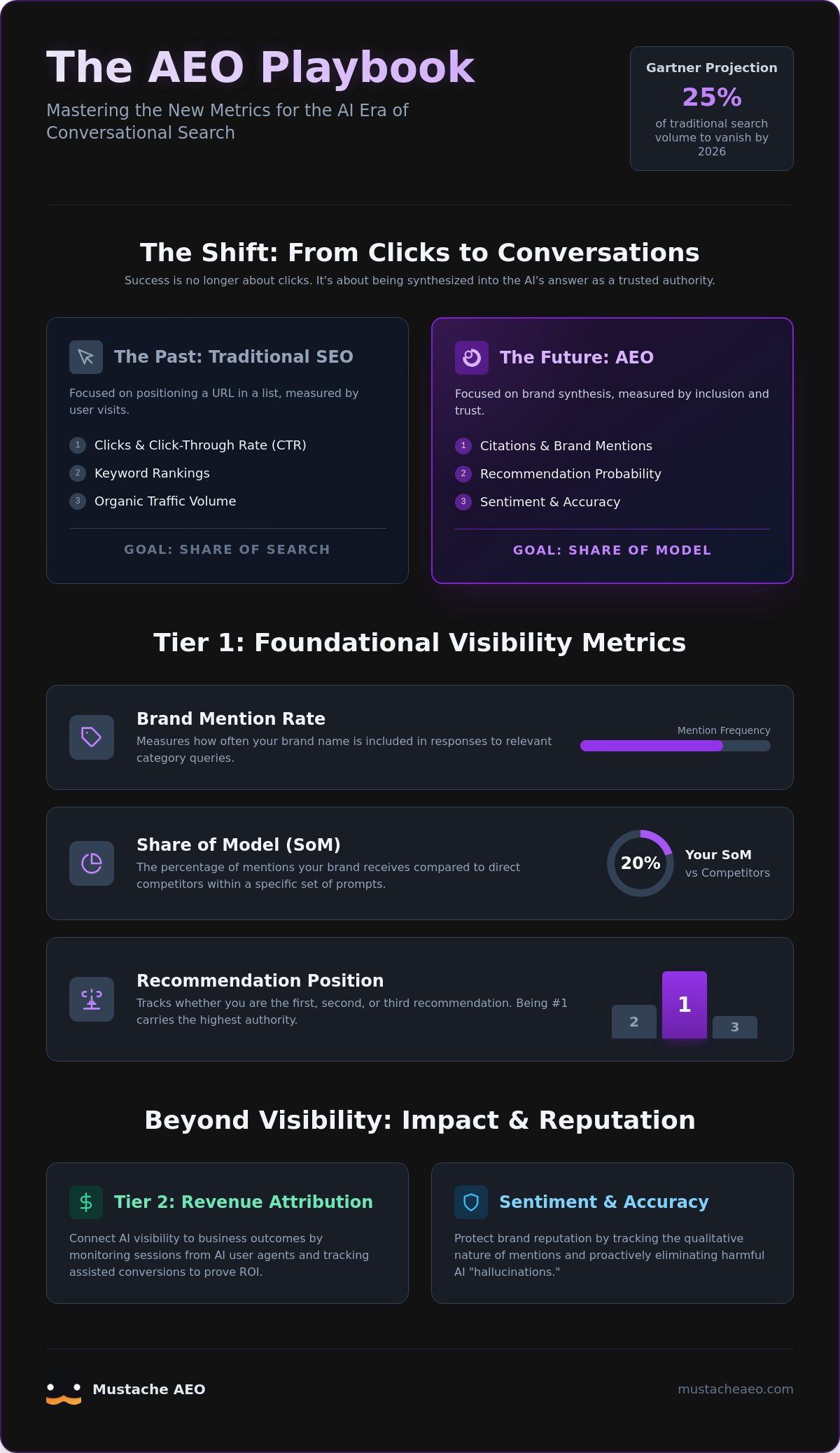
We must pivot from “Share of Search” to “Share of Model.” Traditional SEO focuses on positioning a URL in a list. In contrast, Answer Engine Optimization (AEO) focuses on brand synthesis. This means the AI model has ingested your data, verified your authority, and included your brand as a trusted solution within its generated response. Identifying the key aeo metrics to track is now essential because impressions are becoming less relevant than citation frequency. Success in 2026 is defined by how many models “know” your brand and recommend it as the definitive answer.
- Synthesis over Ranking: AI doesn’t just list you; it summarizes you.
- Citations over Clicks: Being the source of truth matters more than the visit.
- Authority over Volume: High-value mentions beat high-volume impressions.
The Definition of AEO Metrics
AEO metrics are specific data points that track your brand’s presence and sentiment within Large Language Models (LLMs). Unlike a standard ranking, which is a static position on a search results page, a citation is a verified mention of your brand as a source or solution. We track “Probability of Recommendation” instead of keyword rank. This metric measures how likely an AI is to suggest your brand when a user asks for a specific service. It’s a fundamental shift from being “visible” to being “validated” by the algorithm.
Why Miami Brands Face Unique Tracking Challenges
Local discovery is transforming for Miami businesses. When a user asks an AI for the “best tech consultant in Brickell,” the engine doesn’t just look at a map. It synthesizes local news, reviews, and industry citations to form a conversational response. Miami’s unique status as a growing tech hub means the competition for “Answer Prominence” is exceptionally high. Local brands must track how AI models interpret their local authority. You need to ensure your data is structured so AI models can easily verify your physical presence and community impact in the South Florida market.
Tier 1 Visibility Metrics: Tracking Brand Citations and Mentions
Visibility in the AI era isn’t about appearing on a list. It’s about being the answer. To understand your standing, you must identify the key aeo metrics to track that define your presence within an LLM’s logic. These are your foundational KPIs. They reveal if the AI recognizes your brand and if it trusts your expertise enough to recommend you. Without these numbers, you’re flying blind in a conversational world.
Brand Mention Rate measures how often the AI includes your name in responses to relevant category queries. If a user asks about luxury real estate in Miami, does the AI mention your agency? This leads directly to Share of Model (SoM). SoM is the percentage of mentions your brand receives compared to your direct competitors within a specific set of prompts. If there are 100 mentions of “Miami SEO agencies” and you receive 20, your SoM is 20%. This provides a clear picture of your dominance or your need for better optimization.
Measuring Share of Voice in Conversational Search
AI Share of Voice (AI SoV) varies significantly across different platforms. You might dominate in Perplexity AI due to its reliance on real-time web citations but struggle in Google AI Overviews if your structured data is lacking. You need to calculate this platform-specific visibility to know where your strategy is winning. Using Mustache AEO Audits allows you to baseline these metrics and identify which platforms require more aggressive content optimization. It’s the first step toward a data-driven strategy.
Recommendation Position is another critical visibility marker. AI engines often provide a numbered list of suggestions. This metric tracks whether you are the first, second, or third recommendation. Being the primary suggestion carries significantly higher authority and typically results in higher user trust. If you aren’t in the top three, you’re essentially invisible to the user.
Citation Source Attribution
AI models use specific pages as “ground truth” to generate their answers. You must identify which of your pages the AI prefers to cite as a source. Tracking the “Citation-to-Click” ratio helps you understand if users are following the link or if the AI’s summary satisfies their intent. Citation Frequency is the rate at which an LLM explicitly credits a domain for a specific fact or recommendation. Identifying these sources allows you to double down on the content that the models find most useful.
Miami brands face a unique challenge in AI discovery. The South Florida market is dense and competitive. If an AI doesn’t see strong local citations and geo-specific authority, it won’t mention you for Miami-based queries. You need to monitor your local brand inclusion rate specifically for the region. If you’re ready to move beyond guesswork, our Tracking & Reporting services can provide the hard data you need to scale.
Tier 2 Conversion Metrics: Attributing Revenue to AI Discovery
Visibility is the baseline, but revenue is the benchmark. You can’t pay the rent with citations alone. While Tier 1 metrics prove you’re present, Tier 2 metrics prove you’re profitable. Identifying the key aeo metrics to track for conversion allows you to justify your AI budget with hard ROI data. This starts with monitoring AI referral traffic. According to research from June 2025, AI platforms generated 1.13 billion referral visits, a 357% increase year-over-year. More importantly, traffic from ChatGPT has been shown to convert at a rate of 15.9%, which significantly outperforms the 1.76% conversion rate of traditional Google organic search.
Not every AI interaction results in an immediate click. Many users receive a recommendation from an LLM and later visit your site directly. These are assisted conversions. To capture this “dark” discovery, firms should integrate “How did you hear about us?” fields in their lead forms. This qualitative data bridges the gap between AI visibility and CRM records. When a user says they found you through “an AI search,” you’re seeing the direct impact of your AEO strategy on your pipeline.
Setting Up AI Attribution in GA4
Attribution doesn’t have to be a technical nightmare. You can set up custom channel groupings in GA4 to isolate traffic from engines like Claude, Gemini, and Perplexity. First, identify your referral sources in the traffic acquisition report. Second, build a custom segment for these AI user agents. Third, monitor the conversion paths to see how many touchpoints started with an AI answer. Linking AEO efforts to CRM data is vital for high-stakes sectors. When a lead enters your system, you need to know if their journey began with a ChatGPT prompt to value that mention correctly.
The Role of Content Optimization in Conversion
Conversion often depends on how the AI presents your brand. Structured data and FAQ schemas are vital here. They don’t just help you get cited; they ensure the citation is conversion-ready by providing the AI with clear, punchy facts. For a deeper dive into tactical improvements, check out our AEO content optimization Miami guide. FAQ schemas allow you to control the narrative. When an AI pulls an answer from your FAQ, it uses your exact wording to satisfy the user. This reduces the risk of hallucinations and ensures the brand voice remains consistent from the AI interface to your landing page.
Comparing lead quality is the final step in this tier. AI-referred leads often come with a higher level of intent because the AI has already “vetted” your brand as a solution. Monitor the close rate of these leads compared to your traditional organic search traffic. You’ll likely find that while the volume is lower, the value of each session is substantially higher. This shift in perspective turns key aeo metrics to track into a blueprint for sustainable growth.
Sentiment and Accuracy: The Qualitative Side of AEO Tracking
Numbers tell only half the story. You might have a high citation rate, but if the AI describes your brand as a “budget alternative” when you provide luxury services, your visibility is working against you. Qualitative data is the missing link in most reporting frameworks, and agencies like Omedia Paris offer the expert brand strategy needed to protect a luxury house’s reputation in this new landscape. Identifying the key aeo metrics to track must include a deep dive into Brand Sentiment Scores and Framing Analysis. These metrics reveal how an engine positions your brand relative to specific customer pain points. Does the AI suggest you as the primary solution to a complex problem or merely a secondary option? Framing analysis tracks this positioning to ensure you aren’t just seen, but respected.
The Authority Gap is another vital qualitative metric. It identifies the specific topics where competitors are cited as experts while your brand is ignored. This isn’t just a content problem; it’s an authority problem. By tracking where you’re losing the “expert” label, you can adjust your strategy to reclaim those high-value mentions. This gap analysis tells you exactly which pillars of your brand authority are crumbling in the eyes of the LLM. It’s a roadmap for your next round of content optimization. You need to know where your voice is missing to stay relevant in a conversational market.
Monitoring for AI Hallucinations
Hallucinations are a significant risk for any Miami business. AI models sometimes invent fake services, non-existent locations, or incorrect pricing structures. This is your Hallucination Rate. It’s a qualitative metric that requires constant vigilance. We use a specialized AEO audit to identify these errors before they damage your reputation. The solution is creating a “Ground Truth” content library. This is a centralized, highly structured set of data that feeds the AI engines exactly what they need to stay accurate. It’s your first line of defense against algorithmic misinformation. Without a verified source of truth, you’re leaving your brand’s reputation to the whims of a probabilistic model.
Sentiment Benchmarking Against Competitors
Adjectives are the new rankings. We analyze the descriptive language AI models use to compare you with your Miami rivals. Does the AI call your competitor “innovative” while calling you “traditional”? We turn these qualitative AI responses into quantitative sentiment scores. This allows you to track your brand’s emotional impact over time. Forward-looking brands aim for a “reassuring” sentiment. In a world of automated answers, a sense of quiet confidence builds the most trust with potential clients. If you want to know exactly how the machines see you, it’s time to start an AEO Strategy that prioritizes accuracy. We help you move from being a data point to being a trusted authority.
Implementing an AEO Tracking Strategy with Mustache AEO
A baseline is non-negotiable. You cannot measure growth without a clear starting point. Implementing a robust strategy begins with identifying the key aeo metrics to track for your specific industry. We move beyond general data to provide actionable insights that drive revenue. Mustache AEO specializes in transforming technical AI signals into clear business outcomes. We ensure your brand isn’t just present in the training data but prioritized in the live response. Our approach bridges the gap between technical complexity and practical marketing goals.
The shift from legacy search to AI discovery requires a partner who understands the nuances of LLM interpretation. We don’t just optimize for keywords; we optimize for authority. By focusing on the key aeo metrics to track, we help you build a resilient digital presence that survives algorithmic shifts. Our goal is to provide transparency in a landscape that often feels like a black box. We provide the tools you need to validate your brand’s influence across every major conversational platform.
Starting with a Miami AEO Audit
A specialized Mustache AEO audit is the foundational step for any local brand. This deep dive reveals your current AI footprint across multiple engines like ChatGPT and Perplexity. We identify “low-hanging fruit” metrics like missing structured data or unoptimized FAQ sections that provide immediate ROI. For Miami businesses, this means analyzing how your local authority translates into conversational recommendations. We customize your tracking dashboard to reflect the unique competitive dynamics of the South Florida market. You get a clear view of where you stand today so we can map where you need to be tomorrow.
Ongoing AEO Management and Reporting
Static strategies fail in dynamic environments. AI models update their weights and retrieval methods constantly. Partnering with a specialized AEO agency ensures your tracking remains accurate as the technology evolves. Our Tracking & Reporting service provides the monthly visibility busy marketing teams need to justify their budget. We provide quarterly roadmap adjustments based on shifting LLM algorithms. This proactive approach prevents your brand from becoming obsolete as new models enter the market. We handle the technical monitoring so you can focus on running your business.
The transition from tracking data to executing strategy is where the real value lies. We don’t just hand you a spreadsheet; we provide a blueprint for dominance. By monitoring these metrics monthly, Miami firms can scale their visibility and outpace competitors who are still stuck in the legacy search era. It’s time to stop reacting to the decline of traditional search and start leading the AI revolution. Secure your brand’s future today by embracing the next generation of digital visibility.
Own the Future of Conversational Discovery
The transition from traditional search to AI synthesis is a permanent evolution in digital marketing. You’ve learned how to move beyond legacy clicks to track brand citations, attribute revenue to AI referral traffic, and eliminate harmful hallucinations. These data points provide the transparency needed to thrive in a landscape where search volume continues to migrate toward AI assistants. Success in 2026 requires a shift from passive visibility to active authority within the models that drive user decisions.
Identifying the key aeo metrics to track is the first step toward reclaiming your digital authority. We provide specialized AI SEO reporting for Miami brands and offer deep expertise in Perplexity, ChatGPT, and Google AI Overview optimization. Our team builds authoritative AEO roadmaps that prioritize your business revenue over empty impressions. We ensure your brand is the “ground truth” that AI engines rely on for every relevant query. This focus on validation ensures your brand remains the primary recommendation in a conversational world.
Stop guessing and start measuring with hard data. Get Your Comprehensive AEO Audit from Mustache AEO Today to secure your visibility. The era of automated answers is here, and your brand is ready to lead the conversation with confidence.
Frequently Asked Questions
What is the most important AEO metric for a local Miami business?
Answer Prominence is the most critical metric for any Miami-based entity. It measures how frequently an AI engine names your brand as the primary recommendation for local prompts. For example, if a user asks for the best boutique hotel in Wynwood, your prominence score reflects your standing in that specific response. High prominence ensures you aren’t just one of many options but the definitive choice for the user.
How do I track referrals from ChatGPT in Google Analytics 4?
You can track these referrals by creating custom channel groupings in GA4. Navigate to your traffic acquisition reports and look for referral paths from known AI domains like chatgpt.com or perplexity.ai. By setting up a dedicated segment for AI traffic, you can see exactly how these users interact with your landing pages. This data allows you to attribute site engagement directly to conversational search discovery.
What is a good Brand Mention Rate for a mid-sized company?
A strong Brand Mention Rate for mid-sized firms usually ranges between 15% and 25% within a specific niche. This percentage indicates how often you appear in relevant topic-based prompts compared to your competitors. Tracking this is one of the key aeo metrics to track to ensure your brand remains top-of-mind for the algorithms. If your rate drops below this range, it’s often a sign that your authority needs reinforcement.
Can I track AEO metrics for free or do I need specialized software?
Basic tracking can be done manually through consistent prompting, but it’s time-consuming and lacks scale. Professional tools like Semrush or Ahrefs provide automated visibility tracking across multiple models. However, these tools often miss the qualitative nuances of your brand’s sentiment. For a comprehensive view, we recommend a specialized audit that combines automated data with expert analysis to reveal the true health of your AI footprint.
How often should I report on AEO metrics to my leadership team?
Monthly reporting is essential to keep pace with the rapid updates of AI models. Large Language Models frequently refresh their weights and retrieval systems, which can cause sudden shifts in your visibility. A monthly report allows your leadership team to see these trends in real-time and adjust budgets accordingly. It transforms AEO from a technical experiment into a predictable, measurable marketing channel for your business.
What happens if an AI engine is hallucinating facts about my brand?
You must immediately update your source data to stop hallucinations. AI engines often hallucinate because they ingest conflicting or outdated data from third-party sites. By strengthening your own structured data and FAQ schemas, you provide the engine with a verified source to reference. Our specialized audits identify these inaccuracies and provide a tactical plan to overwrite the AI’s incorrect assumptions with factual brand data.
Is Share of Model (SoM) the same as Share of Search?
Share of Model (SoM) is distinct from Share of Search because it focuses on synthesis. Share of Search tells you how many people are looking for you. SoM tells you how often the AI includes you in its own generated answers. While search volume is a measure of user intent, SoM is a measure of algorithmic trust. It’s the ultimate indicator of your brand’s authority within the AI ecosystem.
How do AEO metrics differ from traditional SEO rankings?
Traditional SEO tracks your position in a list of URLs, whereas AEO metrics track your inclusion in a conversational answer. SEO is about being found; AEO is about being recommended. Success in SEO is a blue link on page one. Success in AEO is being the cited source that the AI uses to solve a user’s problem. This shift requires a focus on citable facts rather than just keyword density.