
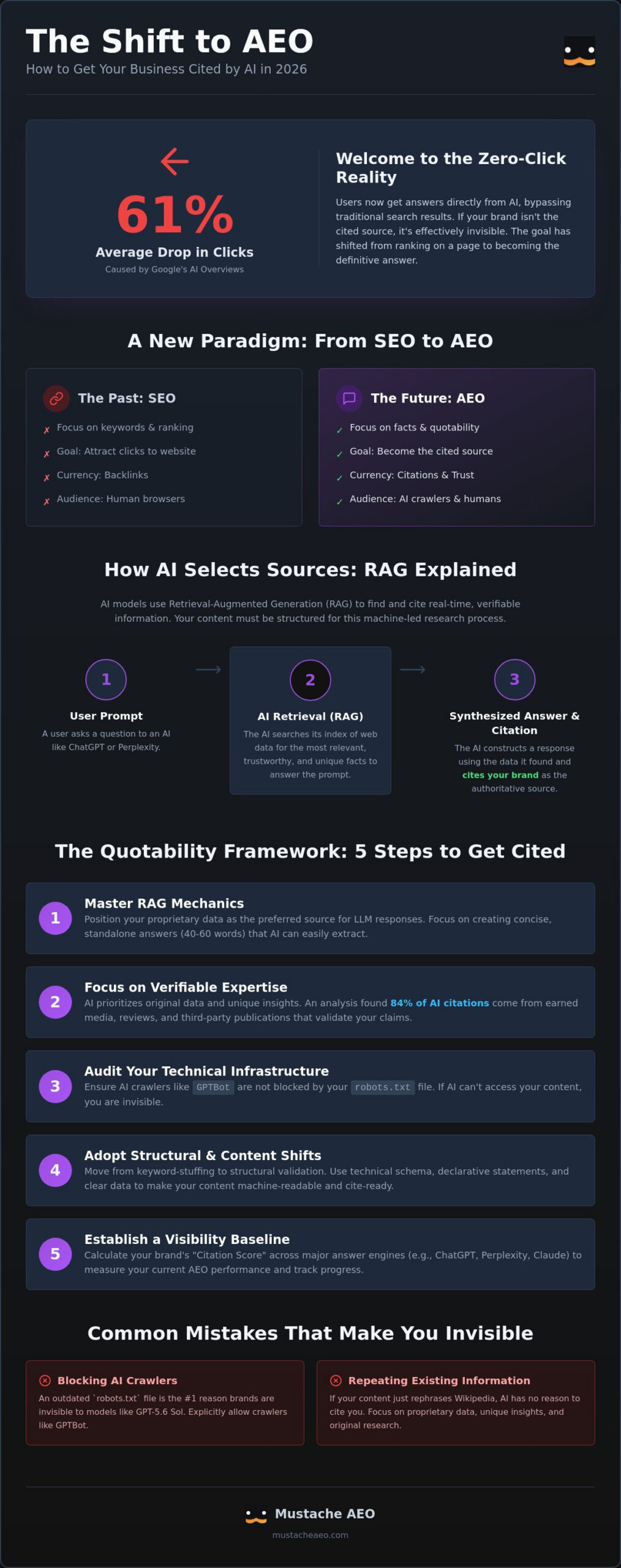
Google’s AI Overviews have triggered an average 61% drop in organic click-through rates, forcing brands to face the reality of digital erasure. You’ve likely felt the anxiety of declining traffic and the confusion of watching ChatGPT cite your competitors while your brand remains invisible. It’s a common pain point in this new zero-click environment. Learning how to get your business cited by ChatGPT is no longer an optional experiment; it’s a critical survival strategy for 2026.
We’ve entered the era of Answer Engine Optimization. You’ll learn the exact structural and content shifts required to turn your brand into a trusted source for flagship models like GPT-5.6 Sol. This guide provides a clear roadmap for AI visibility, focusing on technical schema and “quotability” to ensure your authority is recognized. We’ll move beyond legacy search tactics to give you the technical definitions and pragmatic strategies needed to protect your brand’s future in the automated ecosystem.
Key Takeaways
- Transition from legacy SEO to Answer Engine Optimization (AEO) to thrive in a zero-click environment where citations are the new currency.
- Master the mechanics of Retrieval-Augmented Generation (RAG) to position your proprietary data as the preferred source for LLM responses.
- Use our five-step Quotability Framework to learn how to get your business cited by ChatGPT through specific structural and content shifts.
- Audit your technical infrastructure to ensure AI crawlers can access your content without being blocked by outdated robots.txt configurations.
- Establish a baseline for your brand’s visibility by calculating your Citation Score across major answer engines like Perplexity and Claude.
The Shift from SEO to AEO: Why ChatGPT Citations Matter in 2026
Traditional SEO is no longer the primary driver of digital authority. In 2026, the goal has shifted from appearing on a list to being the definitive answer provided by an artificial intelligence. Answer Engine Optimization (AEO) is the strategic process of making your brand’s content cite-ready for a large language model (LLM). This shift is essential because users are moving away from browsing multiple websites to find information. They want immediate, conversational results. For companies wondering how to get your business cited by ChatGPT, the answer lies in transitioning from keyword-stuffing to structural validation.
Miami’s tech landscape has embraced this evolution rapidly. Our local ecosystem thrives on efficiency, and conversational search provides exactly that. We’ve moved beyond the era of getting clicks. The new objective is to become the trusted source that AI models rely on to build their responses. If you aren’t cited, you don’t exist in the eyes of the modern consumer. This emotional shift from visibility to trust is the hallmark of the 2026 marketing strategy.
The Death of the Blue Link
The traditional search engine results page is fading into the background. As of early 2026, ChatGPT has surpassed 900 million weekly active users, while Google’s AI Mode has reached 1 billion monthly users. These platforms function as Answer Engines rather than search engines. Instead of providing ten blue links, they synthesize data into a single, cohesive paragraph. This has created a Zero-Click reality. When an AI Overview appears, it causes an average 61% drop in organic click-through rates. You can’t rely on users clicking your link anymore; you need the AI to speak your brand’s name directly.
What is AEO Content Optimization?
AEO is a technical discipline that prioritizes machine consumption over traditional browsing habits. While you still write for people, you must also write for retrieval-augmented generation. This involves a specific type of content optimization that makes facts easy for an AI to extract. Understanding What is Answer Engine Optimization? is the first step in protecting your brand from erasure. It requires a move toward declarative statements and technical schema that validates your expertise. This isn’t about tricking an algorithm. It’s about providing the highest quality data to the systems that now gatekeep information. Learning how to get your business cited by ChatGPT requires this foundational shift in how you produce and present every piece of content you own.
How ChatGPT Selects Sources: The Mechanics of AI Citations
AI models follow a rigorous retrieval process to determine which brands to mention. ChatGPT uses a mechanism called Retrieval-Augmented Generation (RAG) to pull real-time data from the web. Instead of relying solely on static training data, the model acts like a researcher looking for the most relevant and verifiable facts. Understanding this process is the foundation for learning how to get your business cited by ChatGPT in 2026. The system doesn’t just look for keywords; it looks for the most reliable piece of information available to satisfy a user’s prompt.
LLMs prioritize original data over traditional keyword density. If your content repeats what’s already on Wikipedia, the AI won’t cite you. It looks for proprietary knowledge or unique insights that provide a missing piece of the puzzle. Verifiable expertise is the new currency. The model cross-references your claims against other trusted sources to build a Trust Score. A May 2026 analysis found that 84% of AI citations come from earned media, such as third-party reviews and publications. This means the AI isn’t just looking at your website; it’s looking at who else validates your claims across the digital ecosystem.
Understanding RAG: How AI “Reads” Your Site
RAG bridges the gap between what a model learned during its initial training and what is happening right now. For your business to be part of that current retrieval, your site must be accessible to AI crawlers like GPTBot. If you’ve unintentionally blocked these in your robots.txt file, you’re invisible to the flagship GPT-5.6 Sol model. Focus on creating standalone answers. These are concise blocks of information, typically 40 to 60 words, that the AI can extract and present to a user without needing the surrounding context of your entire page. This structural clarity is essential for anyone researching how to get your business cited by ChatGPT.
The Authority Loop: Citations as the New Backlinks
In the AEO landscape, citations function like the backlinks of the past. When one model cites you, it signals to other engines that your data is reliable. This creates an authority loop that compounds over time. For our partners in the Miami tech scene, local authority signals are vital. If you want to win regional queries, your brand must be anchored in local directories and regional news mentions. Brand Authority in an AI context is the mathematical probability that an LLM will select your content as the most accurate answer for a specific query. You can begin building this probability today with a tailored AEO Strategy designed for the 2026 landscape.
The Quotability Framework: 5 Steps to Get Cited
Visibility in AI search isn’t accidental. It requires a specific architecture we call the Quotability Framework. This system moves beyond traditional content creation to focus on data extraction and validation. Learning how to get your business cited by ChatGPT involves a five-step process that aligns your brand with the way LLMs retrieve and synthesize information. By following this roadmap, you transform your digital footprint into a series of verifiable facts that AI engines can easily digest.
Step 1: Original Data and Proprietary Insights
AI models crave unique facts they can’t find elsewhere. If you publish a study showing that “30% of Miami firms” have adopted a specific technology, you’ve created a cite-worthy asset. Generic statements like “many firms use this tech” provide zero value to an AI looking for precision. Original research directly boosts your visibility scores by making your site the primary source for a specific statistic. Turn your internal business data into public-facing reports to become the definitive authority that LLMs reference when users ask for industry trends.
This approach is effective across all markets; for example, Marhaba Auctions secures its authority in the Middle East by publishing transparent data on used car market trends, ensuring it remains a primary source for AI-driven automotive queries.
Step 2: Technical Structure and Schema
You must speak the machine’s language to be recognized. Implementing advanced Schema Markup, specifically JSON-LD, provides the context AI engines need to categorize your business accurately. This includes defining your business type, specific location coordinates, and service offerings. FAQ schema is particularly powerful for conversational search because it mirrors the question-and-answer format used by LLMs. For a deeper dive into these tactical executions, explore our comprehensive guide on How to Rank in ChatGPT.
Beyond data and code, your brand must demonstrate Experience, Expertise, Authoritativeness, and Trustworthiness (E-E-A-T). In niche markets where heritage defines authority, you can learn more about Mike Nekta New York to see how a third-generation diamond expert validates their expertise for AI retrieval. AI models prioritize content from verified experts, and your site needs clear expert bios and visible credentials to validate your claims. If the model can’t verify who wrote the content, it won’t cite it as a trusted source. Use declarative headings that answer specific user questions directly. Instead of a vague heading like “Our Process,” use “How Our AEO Audit Identifies AI Visibility Gaps.” This makes it easier for RAG systems to parse your page and extract the exact information a user requested.
Finally, you must monitor your brand sentiment. AI doesn’t just cite; it evaluates. If third-party reviews or news mentions are consistently negative, your Trust Score will drop. This makes you less likely to appear in responses from flagship models like GPT-5.6 Sol. Consistency across the web ensures the AI sees your brand as a stable and reliable source of information. Learning how to get your business cited by ChatGPT is a continuous process of maintaining this technical and reputational excellence.
Common Mistakes That Make Your Business Invisible to AI
Many brands fail in the new digital ecosystem because they treat AI like a traditional search engine. Learning how to get your business cited by ChatGPT requires avoiding the pitfalls of legacy marketing that now act as barriers to visibility. If your content is generic or technically inaccessible, you’re effectively invisible to the systems that control modern consumer attention. You can’t rely on the same tactics that worked three years ago to win in a conversational environment.
Over-reliance on generic AI-generated content is a major hurdle. If you use basic prompts to generate 500-word fluff pieces without adding original data, you’re competing with millions of identical pages. LLMs prioritize unique value and proprietary insights. They won’t cite a source that merely paraphrases their own training data. You must provide a direct, quotable answer that offers fresh insight or verifiable facts. Vague writing that dances around a topic without providing a specific conclusion is ignored by retrieval systems looking for the “best” answer.
Legacy content is another silent killer. AI models cross-reference information across multiple platforms to ensure accuracy. If your site contains outdated facts or conflicting brand details, the model may flag your brand as unreliable. Failing to update your digital footprint allows old data to contaminate your current authority. This inconsistency forces the AI to look elsewhere for a more stable source of information.
The “Hallucination” Trap
Inconsistent brand information across the web creates a fragmented identity. If your pricing, service descriptions, or core facts vary between your site and third-party directories, AI models struggle to validate your existence. This confusion leads to AI hallucinations or, more commonly, your brand being excluded from the response entirely. Thin content is also a liability. Short, low-value pieces are invisible in 2026 because they lack the depth required to satisfy complex user prompts. Legacy SEO tactics like keyword stuffing also backfire now. Models prioritize semantic meaning and structural clarity. Stuffing terms into your text makes your content harder for RAG systems to parse, not easier.
Technical Barriers to Entry
Technical friction is a primary cause of AI erasure. Slow site speeds or complex JavaScript renders prevent AI crawlers from indexing your data in real-time. If you’ve unintentionally blocked bots like GPTBot in your robots.txt file, you’ve locked the door to your brand’s future. Gated content presents a similar risk. AI cannot cite what it cannot see. While lead magnets have their place, hiding your most authoritative data behind a form ensures it will never be used as a source in a conversational answer. Conducting a comprehensive AEO Audit is the only way to identify and remove these invisible barriers to your brand’s growth.
Securing Your Brand Authority with a Mustache AEO Audit
The Mustache AEO Audit is the technical standard for AI visibility in 2026. It’s a comprehensive diagnostic tool that identifies why your brand is missing from conversational answers. We move beyond general observations to provide a deep technical analysis of your brand’s presence in the AI ecosystem. This process is essential for anyone trying to understand how to get your business cited by ChatGPT effectively. We assess your brand’s “Citation Score” across major platforms like ChatGPT, Perplexity, and Claude to establish a clear baseline for your current authority. This score reflects the mathematical probability of your brand being selected as a primary source for relevant queries.
Miami’s competitive market requires more than just a digital presence; it requires a strategic advantage. We develop an AEO roadmap tailored to your specific industry and local competition. This roadmap outlines the necessary structural shifts and content optimizations required to win citations in a crowded field. Our ongoing tracking and reporting ensure that you can measure your authority growth in real-time. We provide the data you need to see exactly where your brand stands in the conversational search landscape. You’ll receive actionable insights that translate technical data into practical business outcomes.
Why an Audit is Your First Step
You cannot optimize what you cannot measure. AI visibility tracking is the foundation of any successful 2026 marketing strategy. Our audit identifies the specific “Gaps” where your competitors are currently stealing your citations. By pinpointing these missed opportunities, we create customized roadmaps that prioritize high-impact content changes. This ensures that your resources are focused on the tactics that will move the needle for your Citation Score. It provides the clarity needed to stop guessing and start winning in AI-generated responses. Understanding how to get your business cited by ChatGPT starts with identifying the technical barriers currently holding you back.
The Mustache AEO Advantage
We are specialists in the future of information retrieval. Mustache AEO focuses exclusively on specialized AEO strategy and AI SEO, moving beyond legacy services like PPC or Social Media. Our mission is to help Miami brands transition from being merely “Searchable” to being “Cited.” We understand the technical nuances of how LLMs select their sources and we apply that expertise to your unique business needs. This specialized focus ensures that your brand remains authoritative and visible as the digital landscape continues to shift toward automated answers. Schedule your AEO Audit with Mustache AEO today.
Own Your Authority in the Age of AI Search
The era of the ten blue links is over. To remain relevant in 2026, your brand must transition from being searchable to being cited. We’ve explored the mechanical shifts of RAG, the importance of proprietary data, and the technical schema required to satisfy flagship models like GPT-5.6 Sol. Mastering how to get your business cited by ChatGPT isn’t just about visibility; it’s about securing your status as a trusted authority in an automated world. If your data isn’t structured for retrieval, you are effectively invisible to the millions of users relying on conversational answers every day.
You don’t have to navigate this technical shift alone. As Miami-based AI visibility experts, we provide a Specialized AEO Audit Framework and proprietary citation tracking tools designed to measure your growth with precision. We identify the gaps where your brand is currently overlooked and turn them into opportunities for citation dominance. Don’t let your business disappear in the zero-click landscape while your competitors take the lead. Get Your Brand Cited: Book Your AEO Audit Today. Your future in conversational search starts with a single strategic choice, and we’re ready to help you lead the way.
Frequently Asked Questions
How long does it take to get cited by ChatGPT?
Citations can appear in as little as 60 minutes if the model uses live web retrieval to answer a query. However, achieving consistent citation frequency usually takes several weeks of structural optimization and authority building. The AI needs time to crawl your updated content and validate it against other trusted sources across the digital ecosystem to confirm your brand’s reliability.
Does my business need a specific AEO strategy if I already do SEO?
Yes, because traditional SEO targets page rankings while AEO targets direct answer extraction. You need a distinct strategy to learn how to get your business cited by ChatGPT because LLMs prioritize cite-ready answer blocks over standard keyword-optimized landing pages. AEO focuses on technical validation and structural data that legacy SEO often ignores, making it essential for the 2026 landscape.
Can ChatGPT cite local Miami businesses for geographic queries?
ChatGPT frequently cites local Miami businesses by pulling data from regional directories, news outlets, and localized schema. When a user asks for specific services in South Florida, the AI retrieves entities with the strongest local authority signals. Ensuring your business type and location are clearly defined via JSON-LD is critical for winning these geographic queries and appearing in conversational local results.
Is there a tool to check my brand citation frequency in AI?
Specific tools for tracking AI citations are emerging, and we utilize proprietary Tracking & Reporting systems to measure brand visibility. These tools monitor how often your brand appears in responses across ChatGPT, Perplexity, and Claude. This data allows you to calculate a Citation Score and adjust your strategy based on real-time performance rather than relying on outdated keyword rankings.
What is the difference between AEO and traditional SEO in 2026?
The primary difference lies in the end goal: SEO seeks a website click, while AEO seeks a brand citation within an AI response. Traditional SEO relies on backlinks and keywords to rank on a results page. In contrast, AEO uses structural data and original authority to ensure an LLM selects your content as the definitive answer for the user’s specific prompt.
Will AI cite my content if it is behind a paywall or login?
AI models generally cannot cite content that is hidden behind a paywall or login screen. If a crawler like GPTBot cannot access the text, the model cannot retrieve it to answer a prompt. To maximize your citation potential, you must ensure your most authoritative and proprietary data is available in a machine-readable, public format that allows for easy extraction by automated systems.
How do I prevent ChatGPT from hallucinating facts about my business?
You prevent hallucinations by maintaining absolute consistency across your website, social profiles, and third-party directories. When an AI finds conflicting facts about your brand, it may synthesize incorrect information or ignore your brand entirely. Providing clear, declarative statements and regularly updated content reduces the risk of the model guessing your business details or presenting obsolete data to users.