
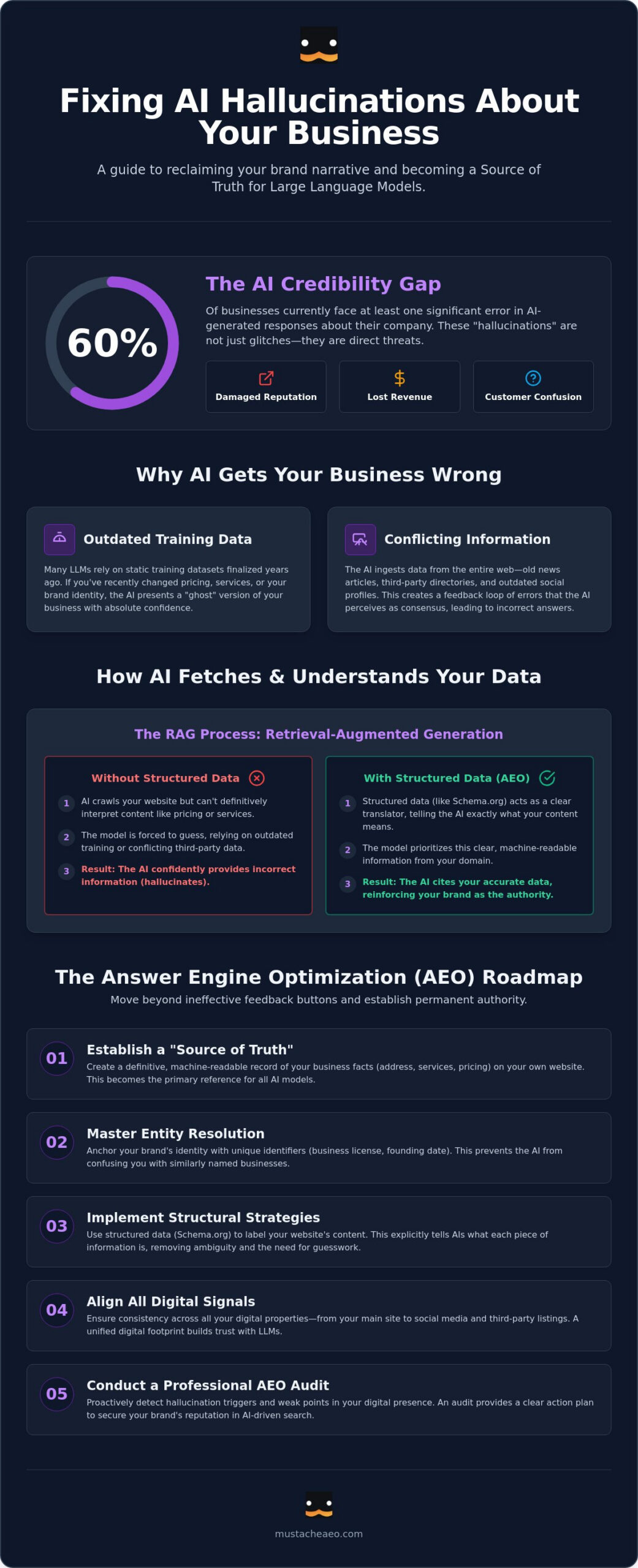
Sixty percent of businesses currently face at least one significant error in AI-generated responses about their company. It’s frustrating to watch ChatGPT or Perplexity quote your 2022 pricing or cite a competitor as your owner. You know these hallucinations aren’t just technical glitches. They’re direct threats to your brand authority and your bottom line.
We provide the structural strategies needed to reclaim your narrative. To fix incorrect business information in AI chat, you must move beyond simple prompting and establish verifiable authority. This guide outlines a clear roadmap to becoming a Source of Truth for Large Language Models. You’ll learn how to correct AI citations permanently through Answer Engine Optimization. AEO is the specialized process of structuring data so AI models prioritize your brand’s facts. This targeted strategy ensures ChatGPT, Claude, and Perplexity cite you accurately. We’re here to help you secure improved visibility in the evolving world of AI-driven answer engines.
Key Takeaways
- Identify the root causes of AI hallucinations and why 2026 models still struggle with outdated knowledge cutoffs.
- Master entity resolution to anchor your brand identity within a stable Knowledge Graph that LLMs can trust.
- Implement structural strategies to fix incorrect business information in AI chat instead of relying on ineffective feedback buttons.
- Establish a definitive “Source of Truth” on your digital properties to guide AI models toward your current pricing and services.
- Leverage a professional AEO Audit to detect hallucination triggers and proactively manage your brand’s reputation in automated responses.
Why AI Chatbots Hallucinate Your Business Data in 2026
AI chatbots are not encyclopedias. They operate as sophisticated predictive engines that prioritize probability over factual precision. When a Large Language Model (LLM) generates plausible but false information about your brand, it’s called an AI hallucination. This isn’t just a technical quirk; it’s a direct threat to your bottom line. Sixty percent of businesses now face at least one significant error in AI-generated responses. Understanding How LLMs Build Your Brand Identity is the first step in diagnosing why these errors occur. If you want to fix incorrect business information in AI chat, you must understand the underlying mechanics of the mistake.
Misinformation costs you leads. It damages your reputation. It creates customer confusion that your sales team has to clean up every single day. By 2026, the conversational AI market has reached $17.97 billion, meaning more customers than ever are getting their first impression of you from a bot. You need a proactive solution. Answer Engine Optimization (AEO) is that solution. It moves your brand from being a victim of bad data to being the definitive source of truth for every major model. Reclaiming your narrative is the only way to fix incorrect business information in AI chat and protect your authority.
The Knowledge Cutoff vs. Live Retrieval
Static training data often creates “ghost” versions of your business. Even in 2026, many models rely on datasets finalized years ago. If you rebranded, changed your service menu, or updated your pricing in the last twelve months, the AI doesn’t automatically see those changes. “Search” modes in AI can still fail if your website isn’t structured for machine-readability. LLMs prioritize older, high-authority data because their training weights favor established historical patterns over recent, unverified updates. This creates a gap where outdated facts are presented with absolute confidence.
Conflicting Sources: The War of Information
AI models ingest data from every corner of the web. An outdated LinkedIn profile or an old news article can easily confuse an LLM. Third-party aggregators often spread incorrect brand data, creating a feedback loop of errors that the AI perceives as consensus. Miami businesses with multiple locations face higher hallucination risks because AI struggles to distinguish between specific regional offerings and closed offices. For example, a Miami firm might find an AI quoting the address of a satellite office that hasn’t existed since 2025. You can’t just hope the AI gets it right. You need a targeted AEO Strategy to align every digital signal with your current reality.
How LLMs Build Your Brand Identity: Training vs. Retrieval
AI models don’t think like humans. They process information through a lens of probability and mathematical relationships. To fix incorrect business information in AI chat, you must first understand entity resolution. This is the process where an AI connects your specific brand name to a distinct “thing” in the world. Without clear signals, an LLM might merge your data with a similarly named business across the country. It’s a common failure point for brands that lack a unified digital footprint.
The Knowledge Graph acts as a stable anchor for these facts. It’s a structured database of entities and their relationships that helps AI understand who you are. When your brand is correctly mapped within this graph, AI models cite you with higher confidence. Following The 2026 Roadmap to Correcting AI Misinformation requires a shift toward structured authority. You aren’t just writing for people anymore. You’re writing for the engines that summarize your existence for your customers.
Entity Resolution and Brand Anchoring
Why does ChatGPT confuse your Miami firm with one in NYC? It’s often a lack of unique identifiers. AI looks for “anchors” like your Miami business license, specific local address, or a unique founding date. If these details are inconsistent across the web, the AI’s confidence score drops. You must maintain a “Source of Truth” document on your own domain. This document should serve as the definitive record for all AI bots to crawl. A professional AEO Strategy ensures these identifiers are prominent and machine-readable, preventing identity confusion before it starts.
The RAG Process: How AI Fetches Your Data
Retrieval-Augmented Generation (RAG) is how modern AI fetches live data. When a user asks about your pricing, ChatGPT doesn’t just rely on its training. It “searches” the web in real-time. If your site lacks structured data like Schema.org, the AI has to guess what your services actually cost. Structured data acts as a translator. It turns your visual website into a format LLMs understand instantly.
There is a clear hierarchy of trust in the RAG process. Wikipedia usually sits at the top, followed by your official brand site, and then third-party platforms like Yelp or LinkedIn. If you want to fix incorrect business information in AI chat, you need to dominate these high-authority nodes. Local Miami citations are particularly powerful for businesses with physical footprints. They provide the geographic validation AI needs to distinguish your entity from the global noise. When your local signals match your website’s data, the AI’s confidence in your information skyrockets.
Prompting vs. Answer Engine Optimization: Why Feedback Buttons Fail
Clicking a “thumbs down” icon on ChatGPT or Claude feels like a direct correction. It rarely is. This action typically alerts developers to safety issues or stylistic errors rather than updating the model’s factual database. If you want to fix incorrect business information in AI chat, you must understand that the interface is not the engine. You are interacting with a display layer, not the core knowledge base. Relying on feedback buttons is a reactive strategy that leaves your brand’s reputation to chance.
Session-based corrections are temporary. While a “thumbs down” might change the current response, it doesn’t alter the underlying training data or retrieval sources. Researchers at Stanford HAI are currently exploring various approaches to editing large language models, but these methods remain complex and automated. AI companies simply cannot manually edit every business listing across the globe. You need a strategy that targets the data the model consumes before it ever reaches the chat window.
The Limits of Direct Feedback
Safety training dominates the feedback loop. When you report a hallucination, you are contributing to Reinforcement Learning from Human Feedback (RLHF). This helps the bot learn how to sound more human, not how to be more factual about your specific firm. The “Black Box” reality means there is no customer support line to call for a factual correction. To truly understand why these models are failing your brand, you must first determine what is an AEO audit and how it exposes the gaps in your digital presence. Feedback buttons are a placebo; you need a structural fix.
Structural AEO: The Long-Term Solution
Structural authority is the new currency of the generative web. You must build a moat around your facts through consistent, machine-readable data. AEO content optimization in Miami focuses on establishing this authority by aligning your website, social profiles, and local citations. We move the needle from simple keyword density to deep entity clarity. By defining your brand as a unique entity with verifiable attributes, you make it easier for LLMs to retrieve the correct data. This is the only way to permanently fix incorrect business information in AI chat and secure your brand’s future in an AI-first world.
The 2026 Roadmap to Correcting AI Misinformation
Correcting AI errors is a systematic process, not a one-time request. If you want to fix incorrect business information in AI chat, you must follow a structured roadmap that addresses both the training data and the retrieval systems. Start by auditing your current citations across ChatGPT, Claude, and Perplexity to identify exactly where the hallucinations begin. Once you have a clear picture of the misinformation, you can begin the work of structural correction.
Consistency is your greatest asset in this landscape. You must consolidate your brand’s data on a dedicated “Source of Truth” page and implement advanced Schema.org markup. This technical foundation ensures that when an AI bot crawls your site, it finds unambiguous facts. Cleaning up your third-party ecosystem citations on LinkedIn, Crunchbase, and local Miami directories reinforces this authority. Finally, you must use the best AEO tracking tools to monitor how these changes influence AI responses over time.
Consolidating Your Source of Truth
Establish a machine-readable “About Us” page that AI bots prioritize during the RAG process. This page should be the definitive record of your company’s history, leadership, and core offerings. Clear, tabular data for pricing and services is significantly better than flowery prose because it allows LLMs to extract specific values with higher mathematical certainty. You should also host official PDFs and whitepapers on your domain; for instance, you can discover UAE POA Online to see how specialized legal documentation is presented to provide the high-density information that retrieval engines often weigh more heavily than standard blog posts.
Schema.org: The Language of AI
Schema.org acts as the primary bridge between your website and an AI’s Knowledge Graph. You must use specific Schema types like Organization, LocalBusiness, and Product to fix entity confusion. The “sameAs” property is essential here. It allows you to explicitly link your website to your social profiles and official business listings, telling the AI that these disparate pages all belong to the same entity. Your Miami physical address must match exactly across all JSON-LD scripts to ensure local relevance. If you’re ready to secure your brand’s future, a comprehensive AEO Strategy can help you implement these technical requirements correctly.
Securing Your AI Authority with a Professional AEO Audit
Manual checking is no longer enough for enterprise brand management. With 78% of organizations now using AI in at least one business function, the volume of automated interactions is too high for human oversight alone. To fix incorrect business information in AI chat, you need a professional diagnostic that identifies “hallucination triggers.” These triggers are the specific, often invisible, data conflicts in your digital footprint that cause LLMs to generate false claims. We look for the gaps where your legacy search presence contradicts your modern brand identity.
Our AEO Audit analyzes the structural signals that matter to 2026 models. We evaluate how your entity is resolved across the web and pinpoint exactly where the Knowledge Graph is breaking down. This provides a strategic roadmap for your 2026 visibility. By securing these signals, you position your Miami business as the definitive leader in your niche. This makes your brand the only logical choice for an AI to recommend when a user asks for an expert in your field. You don’t just want to be mentioned; you want to be the primary citation.
What to Expect from a Mustache AEO Audit
We map your brand citations across the top five Large Language Models. This audit identifies the exact conflicting data sources that confuse answer engines during live retrieval. You won’t just get a list of errors. You’ll receive a prioritized fix-list for your technical and content teams to implement immediately. This ensures your AI SEO efforts are targeted where they will have the most impact. We provide the clarity needed to turn a fragmented digital presence into a unified source of truth that bots can trust without hesitation.
Future-Proofing Your Brand for Generative Search
Answer Engine Optimization is the necessary evolution of Miami SEO. As conversational interfaces replace traditional search result pages, your brand authority depends on machine-readability. You must maintain this authority even as next-generation models like GPT-5 are released. New regulations, such as the California AI Transparency Act, are also changing how AI systems disclose their sources and data provenance. Staying compliant and visible requires a proactive stance on data governance and entity clarity. Get your specialized AEO Audit from Mustache AEO and take control of your brand’s digital future today.
Reclaim Your Brand Authority in the Generative Era
The shift from traditional search to AI-driven answer engines is now a business reality. You’ve learned that hallucinations aren’t random glitches; they are the result of fragmented digital signals and outdated knowledge cutoffs. To fix incorrect business information in AI chat, you must transition from reactive feedback to proactive structural optimization. Consolidating your brand identity and implementing precise Schema.org markup ensures that LLMs prioritize your current reality over historical noise.
Mustache AEO is your partner in this technical evolution. Our specialized experts focus exclusively on LLM optimization, providing the global AI search insights and proven tracking systems you need to dominate conversational results. We are a Miami-based agency that understands the complexities of entity resolution in a high-stakes digital ecosystem, helping global brands like EdNex Automation maintain factual accuracy in their automated citations. We help you move beyond simple visibility and establish absolute authority across all major models.
Don’t let automated systems define your reputation. Secure Your Brand’s AI Visibility with a Professional AEO Audit today. You have the tools and the roadmap to become the definitive source of truth for the future of search. Your brand’s accuracy is within your control.
Frequently Asked Questions
How long does it take for ChatGPT to update its information about my business?
Updates depend on whether the model uses live retrieval or static training data. Live retrieval engines like Perplexity can reflect changes in days if your site is machine-readable. Static models like base ChatGPT may take months or until the next major training cycle. Implementing a structured AEO Strategy helps accelerate this process by making your data easier to ingest during real-time web searches.
Can I sue an AI company for providing incorrect information about my company?
Legal recourse is currently limited and complex. While new regulations like the California AI Transparency Act increase accountability, suing for hallucinations is difficult due to safe harbor protections. Most businesses find that using AEO to fix incorrect business information in AI chat is faster and more cost-effective than litigation. Focus on technical correction rather than legal confrontation to protect your brand authority.
Does updating my website automatically fix what AI says about me?
Updating your website is a critical first step, but it isn’t an automatic fix. AI models look for consensus across multiple authoritative sources to verify facts. If old data persists on LinkedIn, Yelp, or industry directories, the AI may continue to prioritize that consensus over your new site content. You must align your entire digital footprint to ensure the AI resolves your entity correctly.
What is the most important site for AI to trust my business data?
Your official brand domain is the most important site for establishing a Source of Truth. AI models prioritize your own site when they can easily parse your data through Schema.org markup. Beyond your domain, high-authority nodes like Wikipedia, LinkedIn, and major industry-specific directories carry the most weight in the RAG process. Consistency across these platforms is what builds AI confidence in your business facts.
How do I know if Perplexity AI is citing my website or a competitor?
You can verify Perplexity’s sources by clicking the citation numbers or footnotes included in its response. These links show exactly which websites the model used to generate its answer. If you see a competitor’s URL cited for your brand’s services, it means the AI perceives them as a more authoritative or clearer source of information. This is a clear signal that your own content needs optimization.
Is there a “Google Business Profile” equivalent for AI chat engines?
There is no single AI Business Profile dashboard yet. Instead, AI engines rely on the global Knowledge Graph and structured data across the web. To manage your presence, you must optimize your website’s JSON-LD scripts and maintain consistent profiles on high-authority platforms. This decentralized approach replaces the old model of managing a single portal like Google Business Profile.
Can I pay to have my business information corrected in AI models?
You cannot pay AI developers like OpenAI or Anthropic to manually edit your business listing. There is no sponsored correction service in the generative AI world. Instead, you invest in AEO services to influence the data the models naturally retrieve. This involves technical audits and content restructuring to ensure your brand is the most plausible and verifiable answer for the engine’s query.
What should I do if an AI says my business is permanently closed?
You must immediately synchronize your active status across all major directories and your own website. AI often hallucinates a closure if it finds conflicting data on old social media pages or abandoned local listings. To fix incorrect business information in AI chat regarding your status, use LocalBusiness Schema to explicitly state your hours. This provides the machine-readable proof the AI needs to update its response.