
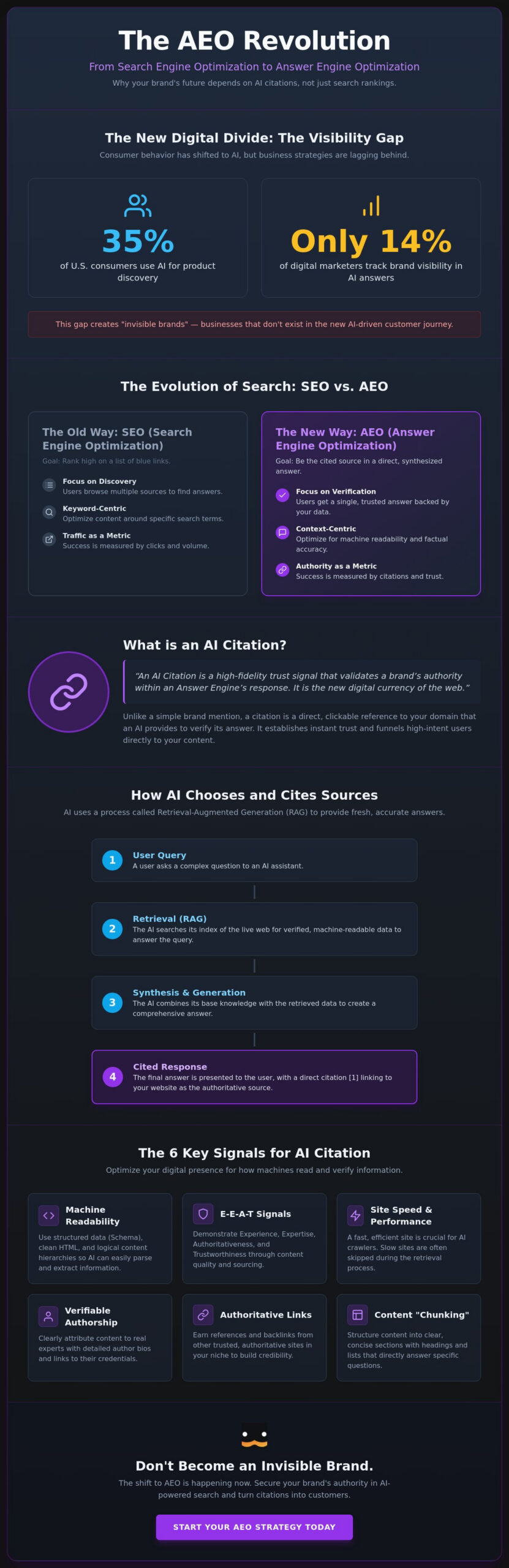
35% of U.S. consumers now use AI tools for product discovery, yet only 14% of digital marketing leaders are actually tracking their brand’s visibility in these answers. It’s a jarring reality for any business owner watching traditional organic traffic decline as Google AI Overviews and ChatGPT take center stage. You’ve likely felt the anxiety of your brand being ignored or, worse, hallucinated by models that don’t recognize your expertise. We understand that the shift from SEO to AEO feels like moving targets in the dark. We’re here to provide the light.
This article provides the exact technical and content signals required for getting my brand cited by AI across platforms like Perplexity and the new GPT-5.5 Instant. You’ll learn how to move beyond legacy search tactics to become a verified authority that AI models prioritize. We’ll outline a clear list of citation signals, show you how to verify your current AI visibility, and provide a 2026 roadmap to ensure your brand isn’t just found, but cited as the definitive answer. We’ll also explore how the EU AI Act and Google’s June 2026 spam update are reshaping the way your content must be structured to remain retrievable and relevant.
Key Takeaways
- Discover why AI citations are the new digital currency for building instant trust and driving high-intent traffic.
- Learn how Retrieval-Augmented Generation (RAG) selects information and how to optimize your site for machine readability.
- Master the exact technical signals and content structures required for getting my brand cited by AI across major platforms.
- Transition from traditional SEO to Answer Engine Optimization (AEO) to avoid being an “invisible brand” in automated search.
- Implement a localized strategy to ensure your business captures authority in regional AI knowledge graphs.
The New Digital Currency: Understanding AI Citations and Brand Mentions
Visibility in 2026 is no longer defined by your position on a list of blue links. It is defined by your presence as a footnote in a synthesized answer. Traditional search results are becoming secondary to the immediate, conversational responses provided by Large Language Models (LLMs). An AI citation is a direct reference or link provided by an LLM to validate its response. These citations are the new digital currency of the web. An AI Citation is a high-fidelity trust signal that validates a brand’s authority within an Answer Engine’s response.
The search landscape has shifted from discovery to verification. Users no longer want to browse; they want to know. Getting my brand cited by AI ensures that when a user asks a complex question, your business provides the evidence. This shift creates a higher level of intent. When an AI cites your brand, it isn’t just showing a result. It’s providing a recommendation backed by data. This establishes instant brand trust that traditional SEO often struggles to replicate. Understanding the Relationship between SEO and large language models is now the baseline for any serious digital strategy.
Citations vs. Mentions: Why Both Matter
A citation is a clickable path to your domain. A mention is a conceptual association within the model’s training data. You need both to thrive. AI platforms like Perplexity and GPT-5.5 use citations to mitigate hallucination risks. They ground their responses in verified, real-time data retrieved from the web. If an AI mentions your brand but cannot find a source to cite, it may categorize your information as unreliable. Brand sentiment also plays a critical role. LLMs analyze how your brand is discussed across the web to determine if you are a safe recommendation for the user. Positive mentions build the foundation, but citations provide the proof.
The Impact on the Customer Journey
The customer journey has collapsed. In the past, a user might visit five websites before making a decision. Today, an AI agent synthesizes those five sources into one answer. This shortens the funnel from awareness to conversion significantly. However, this creates the risk of AI Exclusion. If your brand is invisible to LLMs, you effectively do not exist for the 35% of consumers using AI for product discovery. Getting my brand cited by AI is the only way to remain in the consideration set.
Miami businesses face a specific set of challenges. As a growing hub for AI search and innovation, regional knowledge graphs in Miami are becoming increasingly competitive. Local brands must secure their spot in these graphs to ensure they appear in “near me” and regional queries. If you aren’t cited in the local AI overview, your competitor will be. The risk of being left behind is absolute. We focus on ensuring your brand is not just a name in a database, but a cited authority in every relevant conversation.
Whether you are operating in South Florida or looking to check out Shepherd HomeOwners’ Association in Dubai, the core strategy remains the same: define your entity clearly so that AI agents can cite you as a trusted authority.
How AI Search Engines Choose Sources: From Training Data to RAG
AI models operate on two distinct timelines. The first is the training cutoff, which contains the historical data the model learned during its development. The second is the live retrieval layer. For most businesses, getting my brand cited by AI happens within this second layer. This process is known as Retrieval-Augmented Generation (RAG). It allows an LLM to pull current facts from the web to supplement its internal logic. It acts as a real-time fact-checker that ensures answers are grounded in reality rather than just probability.
AI agents prioritize sources structured for high machine readability. They don’t read pages like humans do. They look for specific “chunks” of information that can be easily synthesized into a conversational response. In 2026, AI models evaluate source credibility using advanced E-E-A-T signals. They weigh your brand’s historical accuracy, the verifiable expertise of your authors, and the frequency with which other authoritative sites reference your data. If the model cannot verify your authority, it will skip your content to avoid the risk of hallucination.
The Mechanics of Retrieval-Augmented Generation (RAG)
Traditional search bots indexed keywords to build a library. AI bots index context to build a knowledge base. These agents crawl the web with a focus on extraction efficiency. Site speed and structured data are the primary drivers of retrieval success. If your site structure is chaotic, the RAG process will fail to extract the necessary context. This leaves your brand in the shadows. Thin content remains the most common reason brands are skipped. If an article doesn’t provide enough semantic depth for the model to synthesize a response, you lose the citation opportunity. We recommend performing a technical AEO Audit to ensure your site is fully retrievable by these modern agents.
Topical Authority as a Citation Signal
You must build a Knowledge Hub to win the citation war. AI models favor domains that demonstrate a deep, interconnected understanding of a specific subject. This is known as semantic density. You should move beyond repeating a single keyword. Instead, use the entire vocabulary associated with your topic. This proves to the model that your brand is the definitive source of truth. When you establish this level of authority, AI engines are more likely to pull your data for high-intent queries. A robust strategy focuses on being the most “retrievable” expert in your niche. This ensures your brand is the one chosen when the LLM needs to validate its answer with a real-world source.
If you want to learn more about Timescape Tours, you can see how a luxury travel brand uses these principles to become the definitive citation for private tours and day trips from London.
Why Your Current SEO Strategy is Missing AI Citations
Traditional SEO focuses on where you rank. Answer Engine Optimization (AEO) focuses on how you are understood. This distinction is critical for any business owner wondering why their top-ranking pages aren’t appearing as footnotes in ChatGPT responses. You can hold the #1 spot on a Google search results page and still suffer from the “Invisible Brand” problem. This happens when your content is optimized for keyword matching rather than machine synthesis. If an AI agent cannot easily extract a direct, declarative answer from your page, it will move on to a competitor who has prioritized retrievability over mere ranking.
A common objection is the belief that existing SEO retainers cover these new requirements. They don’t. Legacy SEO was built for a world of discovery via browsing. AEO is built for a world of verification via synthesis. Over-optimizing for specific keywords while neglecting entity relationships is a frequent mistake that prevents getting my brand cited by AI. You need to define your brand as a distinct entity in the knowledge graph, not just a collection of meta tags. Transitioning to an AEO-first mindset ensures your brand is a participant in the AI-driven conversation rather than a spectator.
The Gap Between Search Results and Answer Engines
High-ranking pages often fail to provide the direct answer an AI seeks. Traditional search engines reward comprehensive guides that keep users on the page. Answer engines reward concise, declarative data that can be pulled into a summary. This is the difference between keyword-matching and intent-resolution. If your content is being read by AI but not cited, it’s likely because your information lacks the structure necessary for attribution. AI agents need to know exactly which entity provided which fact to mitigate hallucination risks. Without clear attribution signals, your expertise becomes anonymous training data rather than a cited recommendation.
Legacy SEO vs. Modern AEO Audit Requirements
The metrics for success have evolved. We moved from tracking backlink quantity to prioritizing citation quality and brand authority. Legacy technical debt, such as slow server response times or outdated JavaScript, often prevents AI from indexing your brand correctly. You need to understand what is an AEO audit to identify these hidden visibility gaps. An audit of this nature evaluates your site through the lens of a machine reader rather than a human browser. It uncovers the structural flaws that keep you out of the RAG process. Securing your future visibility requires a technical foundation that speaks the language of the models you want to influence.
5 Actionable Steps for Getting Your Brand Cited by AI Platforms
Execution is the bridge between being understood by AI and being cited by it. While understanding the theory of RAG is essential, your visibility depends on specific technical and structural adjustments. You must transform your digital presence into a series of verifiable facts that an LLM can retrieve with confidence. Getting my brand cited by AI requires a shift from writing for clicks to writing for attribution. Follow these five steps to secure your authority in the 2026 search landscape:
- Structure content with declarative headings: Use H2 and H3 tags that mirror the exact questions your audience asks.
- Implement advanced Schema Markup: Define your brand as a distinct entity using Organization and Person schema to remove ambiguity.
- Establish Niche Dominance: Focus on being the absolute authority on a specific sub-topic before expanding your reach.
- Secure third-party validation: Earn mentions and citations from high-authority press and industry journals to build external trust.
- Monitor your footprint: Track your performance using specialized best aeo tracking tools to identify which queries are currently citing your brand.
Step 1: Implementing “Answer-First” Content Architecture
AI models prioritize efficiency. You should place the direct answer to a user’s query within the first 100 words of your content. This “Answer-First” approach allows agents to quickly identify your page as a relevant source for retrieval. Use bulleted lists and tables to organize complex data, as these structures are highly “retrievable” for LLMs. Craft self-contained sentences that act as quotable nuggets. These short, punchy statements are easier for an AI to lift and place directly into a synthesized response. If your content is buried under fluff, the model will likely skip you for a more direct source.
Step 2: Entity-Based Optimization and Schema
Your brand needs a clear identity in the global knowledge graph. We use Organization and Person schema to link your business to recognized experts and established entities. This technical layer connects your content to entries in Wikipedia or Wikidata, proving your legitimacy to the AI. These AEO content optimization Miami tactics differ from standard on-page SEO because they focus on relationships rather than just keywords. You aren’t just trying to rank for a term; you’re trying to be recognized as the definitive entity behind the term. This level of clarity is the primary driver for getting my brand cited by AI consistently. To ensure your technical foundation is ready for these models, consider starting with a professional AEO Strategy session.
Securing Your AI Authority with a Miami-Based AEO Strategy
Miami businesses operate in a uniquely competitive digital ecosystem. The city’s rapid evolution as a global tech hub means that generic, national strategies often fall short. Getting my brand cited by AI in a local context requires a precise integration of regional signals. AI models prioritize proximity and local authority when answering “near me” or city-specific queries. If your business isn’t anchored in the Miami knowledge graph with verified local data, you’re ceding high-intent traffic to competitors who are. We bridge this gap by ensuring your brand’s physical and digital presence is unmistakable to LLM retrievers.
Static content is a liability in the age of generative search. LLMs update their training sets and retrieval patterns constantly. This is why ongoing aeo services are essential for maintaining your citations. We ensure your brand remains a primary source as models like GPT-5.5 Instant and Gemini 3.5 Flash continue to refine their source selection. Consistency in your structured data output prevents the “Invisible Brand” problem from resurfacing after a model update. We provide the roadmap from invisibility to becoming a cited authority in the Magic City.
Why a Specialized AEO Audit is Your First Step
You cannot optimize what you don’t measure. A specialized AEO Audit identifies exactly which platforms recognize your brand and which are currently ignoring your expertise. We uncover hallucination risks where AI might be misrepresenting your services or providing outdated information to potential clients. This audit creates a prioritized roadmap for your business. It tells you which technical fixes and content restructures will yield the fastest results for getting my brand cited by AI. We turn technical uncertainty into a clear, actionable plan for growth.
Partnering with Mustache AEO for Future-Proof Growth
We are Modern Specialists deeply entrenched in the mechanics of information retrieval. Our approach balances high-level technical expertise with pragmatic business outcomes. We don’t just hope for visibility; we track brand citations across ChatGPT, Claude, and Perplexity using real-time data. This transparency builds trust and ensures your investment leads to documented authority within digital ecosystems. Stop letting AI models define your brand’s narrative or ignore your existence. Schedule your AEO Audit with Mustache AEO today and secure your place in the future of search.
Own the Future of Information Retrieval
The transition from blue links to verified answers is a permanent shift in digital discovery. Success in 2026 requires moving beyond traditional keywords to embrace entity-based optimization and structured machine readability. By implementing an answer-first architecture and securing third-party validation, you ensure your expertise is not just indexed, but actively recommended by LLMs. Mastering the technical signals for getting my brand cited by AI is the only way to protect your brand from digital invisibility. It’s about being the most retrievable authority in your niche.
We are Pioneers in Answer Engine Optimization, providing specialized AEO Tracking and Reporting to keep you ahead of every model update. As Miami-based experts focused on AI visibility, we understand the high-stakes landscape of the Magic City and beyond. It’s time to stop reacting to technology and start commanding it. Trust our modern specialist approach to bridge the gap between your current SEO and the future of AEO. Get your comprehensive AEO Audit and AI Strategy Roadmap today to verify your authority. The new era of search is here, and your brand is ready to lead the conversation.
Frequently Asked Questions
How long does it take to see my brand cited in AI search results?
Most businesses see initial citation results within 4 to 12 weeks after implementing a full AEO strategy. AI models need this time to crawl your updated site structure and integrate your new “Answer-First” content into their retrieval layers. While real-time engines like Perplexity may update faster, larger models like GPT-5.5 Instant require a full index refresh to recognize your brand as a primary authority.
Does getting cited in ChatGPT require a different strategy than Perplexity?
Yes, these platforms prioritize different data signals. ChatGPT relies heavily on conceptual authority and its massive internal knowledge graph, while Perplexity functions as a real-time retrieval engine that favors structured data and news-like accuracy. A comprehensive plan for getting my brand cited by AI must address both by balancing deep topical authority with the technical precision required for live web retrieval.
Can I pay AI platforms like Google or OpenAI for citations?
No, you cannot purchase organic AI citations. These models are designed to provide the most accurate and “retrievable” answer to maintain user trust. Attempting to buy visibility through manipulative tactics will likely trigger penalties under Google’s June 2026 spam update. You must earn your spot by becoming the definitive source of truth through verified expertise and superior technical site architecture.
Will traditional SEO still help my brand get cited by AI?
Traditional SEO is the essential foundation for all Answer Engine Optimization. Elements like site speed, mobile-friendliness, and high-quality backlinks provide the crawlability that AI agents need to find your content. However, SEO is only the starting point. You need the specialized AEO layer to transform your existing rankings into the declarative, machine-readable formats that LLMs require for direct attribution.
What is the most important factor for getting an AI citation in 2026?
Machine retrievability is the single most important factor this year. An AI agent must be able to extract a specific fact and attribute it to your brand entity without any ambiguity. This requires a combination of advanced Schema Markup and clear, declarative content that answers a user’s query in the first 100 words. If the model can’t parse your data easily, it will skip you.
How do I know if my brand is currently being cited by AI?
You can verify your visibility by using specialized AEO tracking tools or conducting manual “footprint” queries across different LLMs. Ask specific, high-intent questions related to your niche and check the footnotes or link icons in the generated response. Tracking these citations requires a different set of metrics than traditional rank tracking, focusing on “share of model” rather than just search position.
What should I do if an AI platform is providing incorrect information about my brand?
Correcting hallucinations requires a data-cleansing strategy across the entire knowledge graph. You must update your website’s Schema, verify your Wikidata entries, and ensure all third-party mentions are accurate. AI models often hallucinate when they find conflicting data. By providing a single, authoritative “source of truth” on your domain, you help the models self-correct during their next retrieval cycle.
Is AEO only for large enterprises or can local Miami businesses benefit too?
Local Miami businesses often have a significant advantage in getting my brand cited by AI for regional queries. AI models prioritize proximity and local relevance when answering “near me” or city-specific questions. By dominating a specific geographic niche and integrating local knowledge graph signals, small businesses can often outpace national competitors who lack a focused, authoritative presence in the South Florida market.