
Did you know that 73% of B2B buyers now use AI tools like ChatGPT or Perplexity to conduct their vendor research? This shift makes generative engine optimization for B2B a requirement rather than an experiment. You’ve likely felt the anxiety of watching traditional organic traffic dip while wondering if AI models are accurately citing your expertise or hallucinating your competitors instead. Uncertainty about how LLM recommendations work is the new bottleneck for growth.
We understand that the transition to AI-first search feels like unmapped territory. At Mustache AEO, we provide a clear roadmap for visibility, presenting a proven framework for mastering generative engine optimization. You’ll master the mechanics of GEO and learn why it’s the technical evolution of reputation management. We’ll define the critical differences between GEO and AEO while providing actionable steps to dominate the “Day One List” in 2026. It’s time to move beyond legacy tactics and secure your brand’s authority in the era of retrieval-augmented generation.
Key Takeaways
- Learn how generative engine optimization for B2B secures citations within conversational AI responses instead of traditional search rankings.
- Implement the six strategic pillars of the First Page Sage framework to influence how Large Language Models retrieve and synthesize your brand data.
- Transition your tracking from “Share of Voice” to “Share of Model” to accurately measure brand authority within AI ecosystems.
- Optimize content for Retrieval-Augmented Generation (RAG) systems using advanced Schema.org markup and SameAs properties.
- Establish your baseline AI visibility and identify brand perception gaps by starting with a professional AEO Audit.
What is Generative Engine Optimization (GEO) for B2B?
Generative Engine Optimization (GEO) is a specialized marketing discipline designed to influence Large Language Models (LLMs). It represents the technical evolution of digital visibility. Instead of competing for a position in a list of blue links, brands now strive to be the cited source in conversational AI responses. This strategy shifts the goal from simply ranking to becoming the definitive recommendation. Success in 2026 requires influencing both the training data and the real-time retrieval layers. You must ensure your brand’s historical data is accurate while maintaining a strong presence in the live web sources AI tools pull from today.
Generative engine optimization for B2B is the strategic process of optimizing digital content for Retrieval-Augmented Generation (RAG) systems. What is Generative Engine Optimization (GEO) at its core? It is the process of making your expertise machine-readable and authoritative enough for an AI to trust and reference.
The Shift from SERPs to Answer Engines
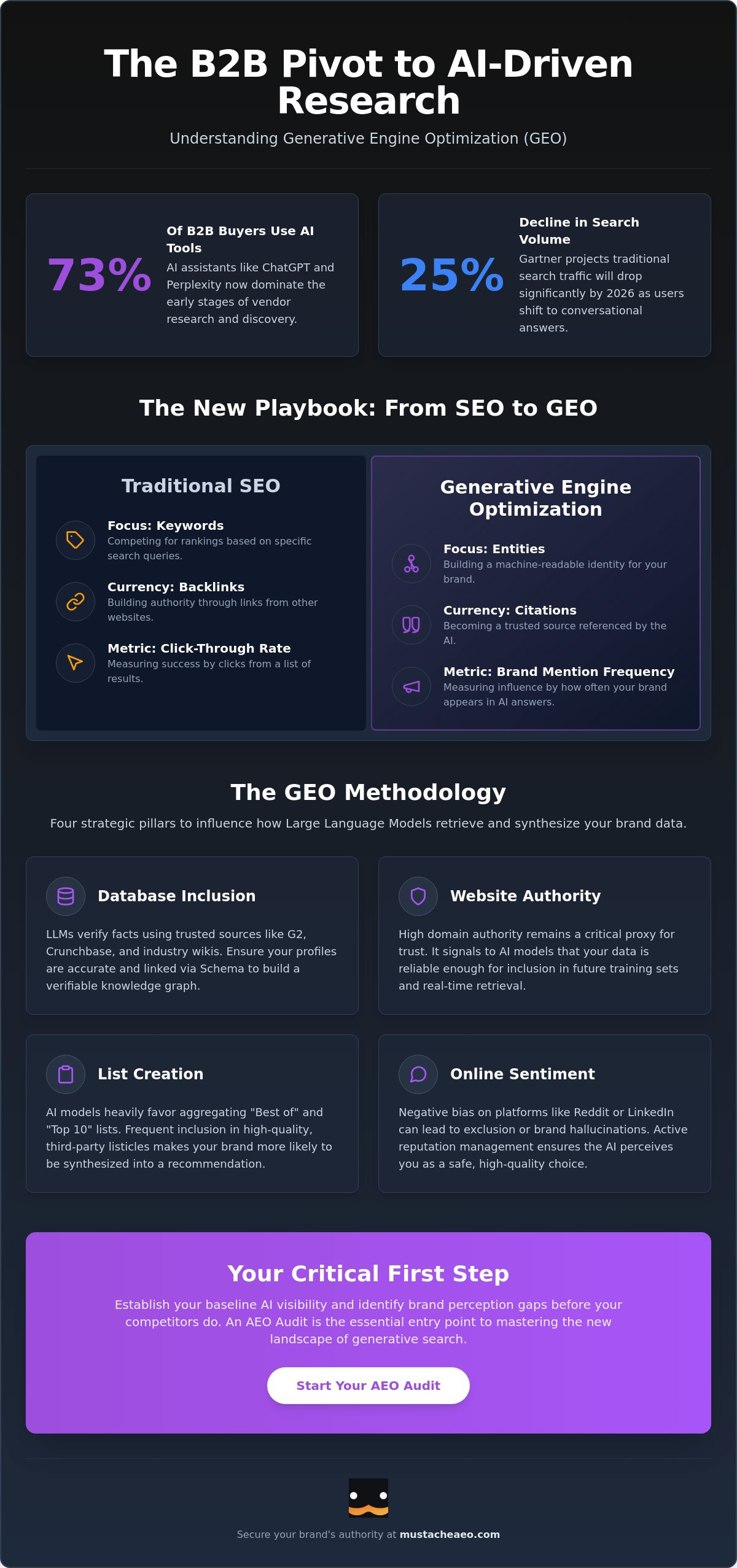
Traditional organic traffic is being cannibalized by AI Overviews and conversational interfaces. Gartner projects that traditional search volume will decline by 25% by 2026. This isn’t just a trend; it’s a fundamental change in how buyers find solutions. Platforms like Perplexity, Claude, and ChatGPT now dominate the early stages of the B2B buyer journey. Research indicates that 73% of B2B buyers use AI tools during vendor research. Conversational search streamlines the research phase for high-ticket services, allowing buyers to bypass lists and get direct, synthesized answers quickly.
GEO vs. Traditional SEO: The Core Differences
The mechanics of visibility have diverged. Traditional SEO is built on keywords; however, GEO is built on entities. AI models care more about the “who” and “what” of your brand than the specific strings of text you target. Citations have become the new currency of digital authority, replacing the simple backlink. While links provide a path, citations provide the validation an LLM needs to reference your brand as a leader. We’ve also seen a shift in performance tracking. Moving from click-through rates (CTR) to brand mention frequency (BMF) allows brands to measure their actual influence within an AI’s output. You’re no longer just looking for a click; you’re looking for a definitive endorsement.
This is why a B2B consultancy like Lotus Lane Trading must focus on building authority within its niche; when an AI cites them as an expert in China-Brazil trade, it serves as a powerful endorsement that traditional search results cannot match.
The 6 Pillars of the First Page Sage GEO Methodology
First Page Sage identifies six critical factors that drive AI recommendation rates. Each pillar targets a specific stage of the AI data retrieval and synthesis process. Success requires a holistic approach rather than treating these as isolated tactics. Aligning your digital footprint with a comprehensive AEO Strategy ensures every pillar works in tandem to build brand authority. AI models prioritize data from “trusted seeds” like industry databases and high-authority news sites. B2B brands must optimize for all six to stay visible in complex procurement queries.
Database Inclusion and Website Authority
LLMs don’t just guess; they verify. They use established databases like G2, Crunchbase, or industry wikis to confirm facts about your business. Domain authority remains a critical proxy for trust in the eyes of generative models. High authority suggests that your data is reliable enough to be included in the training sets of future LLM iterations. To master this, implement SameAs schema properties that explicitly link your domain to your profiles on Crunchbase or G2. This creates a verified knowledge graph that LLMs can traverse to confirm your brand’s existence and expertise. Without this technical verification, your brand risks being ignored during the retrieval phase.
List Creation and Online Sentiment Management
AI loves to aggregate existing industry listicles. This is known as the “Top 10” effect. If your brand appears frequently in third-party “Best of” lists, you’re more likely to be synthesized into the AI’s final answer. Online sentiment management is equally vital for success. Negative bias on platforms like Reddit or LinkedIn can lead to brand hallucinations or exclusion from recommendations. Review signals feed directly into the RAG process for B2B comparisons. This makes active reputation management a core part of your generative engine optimization for B2B strategy. You must proactively monitor how your brand is discussed in professional communities to ensure the AI perceives you as a safe, high-quality recommendation.
Measuring Impact: Key GEO Metrics for B2B Brands
Standard SEO metrics like “position” are becoming obsolete in a conversational world. Tracking a ranking on a page that few buyers actually see is a wasted effort. B2B brands must transition to tracking Share of Model rather than just Share of Voice. Share of Model is the percentage of times your brand is cited for a specific category query across major LLMs. This metric provides a clear picture of your actual authority within the AI ecosystem. Mustache AEO provides specialized Tracking & Reporting to monitor these brand citations in real-time. We help you move beyond vanity metrics to focus on data that directly influences your revenue pipeline.
Effective generative engine optimization for B2B requires a shift in how you value digital interactions. Measurement must connect AI exposure to measurable pipeline impact and lead quality. It isn’t enough to know that an AI mentioned your brand; you need to know if that mention led to a qualified inquiry. By focusing on citation health and model preference, you can identify which parts of your content are working as “trusted seeds” and which are being ignored by the retrieval layers.
AI Referral Traffic and Citation Rates
You need to know exactly where your traffic originates to optimize effectively. Tracking traffic specifically from Perplexity, ChatGPT, and Google AI Overviews is the first step toward understanding your AI reach. Measuring citation frequency reveals how often your brand is the “source” for an answer. If an LLM uses your technical documentation to answer a procurement question, you’ve secured the most valuable endorsement in modern marketing. Analyzing the sentiment of AI-generated summaries regarding your B2B services is also vital. If an AI consistently labels your implementation process as “complex,” it creates a friction point that your sales team must address. Identifying these perception gaps allows for immediate content optimization to steer the narrative.
Lead Quality from Generative Sources
AI-referred leads often have higher intent than traditional search leads. Buyers using conversational tools are typically deeper in the research phase and asking specific, technical questions. These interactions signal a buyer who is ready to evaluate solutions rather than just browse topics. Attributing pipeline growth to specific AEO and GEO strategic initiatives is essential for proving the ROI of your digital spend. Using AEO tracking tools allows you to validate your 2026 marketing budget with concrete data. This level of transparency ensures that your resources are allocated to the tactics that actually move the needle for your business.
B2B Implementation: Optimizing Content for RAG and LLMs
Implementation begins with a clear understanding of your current AI footprint. You can’t fix what you haven’t measured. Step 1 is to conduct a comprehensive AEO audit to establish your baseline. This reveals how LLMs currently perceive your brand authority relative to your competitors. Once you have a baseline, you can move to Step 2: optimizing for entities using advanced Schema.org markup and SameAs properties. This connects your digital assets into a coherent knowledge graph. Step 3 involves structuring content for “chunking” to facilitate easy RAG extraction. Step 4 requires securing placements in high-authority “seed” sites that AI models trust. Finally, Step 5 is to monitor and respond to brand sentiment across non-traditional B2B channels like Reddit and industry forums.
Securing your place in the future of search requires a proactive approach to technical excellence. If you’re ready to bridge the execution gap, start with our AEO Strategy services to align your technical foundation with AI retrieval requirements.
The Technical Foundation: Schema and Entities
Moving beyond basic meta tags is essential. AI in 2026 doesn’t just read text; it maps relationships. Entity-based optimization for B2B brands involves defining your company, products, and key executives as distinct nodes in a Knowledge Graph. By using Schema.org, you provide the explicit context AI needs to connect your brand to trusted industry concepts. A clean, structured site architecture is the prerequisite for AI “spiders” to crawl and index your data effectively. This technical clarity ensures that when an LLM performs a retrieval-augmented generation (RAG) task, your data is the most accessible and reliable option. Generative engine optimization for B2B fails without this machine-readable foundation.
Writing for Machine Comprehension
Machines consume information differently than humans. To succeed in generative engine optimization for B2B, you must create “fact-dense” content. This means prioritizing direct answers and verifiable data over traditional marketing fluff. Using clear H2 and H3 structures helps AI break your content into semantic vectors. These vectors are the mathematical representations AI uses to match your content with user queries. If your content is well-structured, it becomes easier for a vector database to “chunk” and retrieve your expertise. This process prevents the data loss that often occurs when AI tries to summarize unstructured pages. For platform-specific tactics, see our guide on how to rank in ChatGPT.
Why an AEO Audit is the Critical Entry Point
Data is the bedrock of strategic confidence. You cannot optimize what you haven’t accurately measured. An AEO Audit reveals exactly how AI models perceive your brand authority versus your competitors. Mustache AEO provides the technical roadmap for Miami firms to dominate conversational search. An audit identifies authority gaps where your expertise is ignored by LLMs. These gaps often occur when your highest-value content is formatted in a way that AI systems cannot parse or verify. This diagnostic process serves as the low-friction entry point to a full generative engine optimization for B2B strategy. It transforms uncertainty into an actionable plan for technical and content-led growth.
Understanding your baseline is the difference between guessing and winning. Many businesses continue to produce content without realizing it’s invisible to Retrieval-Augmented Generation (RAG) systems. An audit highlights these hidden failures. It allows you to pivot your resources toward the specific entities and citations that LLMs prioritize. By establishing this baseline, you ensure that every subsequent investment in content or AI SEO is backed by data rather than hope.
Deliverables of a Mustache AEO Audit
Clarity is the primary outcome of our auditing process. We provide a technical assessment of AI indexing and citation rates for your B2B brand. This includes a deep dive into how often your brand appears as a primary source in AI-generated answers. We also perform a competitive analysis within Perplexity, Claude, and Google AI Overviews. You’ll see exactly which competitors are winning the “Day One List” and which tactics they use to secure those mentions. Our audit includes several key deliverables:
- Technical Indexing Report: A breakdown of how well AI spiders can crawl and understand your site architecture.
- Entity Mapping: An analysis of your brand’s presence in major Knowledge Graphs like G2 and Crunchbase.
- Citation Health Score: A metric that tracks your brand’s validation across trusted industry “seed” sites.
- Prioritized Roadmap: A step-by-step guide for Content Optimization and entity building.
Securing Your Future in Miami’s Tech Landscape
Miami B2B firms are uniquely positioned to lead the AI search revolution. Our city is a hub for innovation, particularly in SaaS, fintech, and logistics. To win in this environment, you must stay ahead of legacy agencies still focused on 2010-era SEO tactics. Those firms are still chasing keyword volume while the world has moved toward entity-based retrieval and brand mention frequency. Generative engine optimization for B2B requires a specialist who understands how conversational models synthesize information in real-time. We bridge the gap between traditional visibility and modern AI authority. It’s time to stop relying on outdated methods and start building a brand that AI models trust. Secure your brand’s AI future with a Mustache AEO Audit.
Securing Your Lead in the AI-First Era
The shift toward AI-first search is already reshaping the B2B landscape. You’ve seen how the First Page Sage framework and technical RAG optimization turn expertise into machine-readable authority. Success requires moving beyond legacy SEO and embracing a strategy that prioritizes entity-based citations and Share of Model metrics. By focusing on database inclusion and structured data, you ensure your brand remains the definitive recommendation for complex procurement queries.
The future of generative engine optimization for B2B belongs to the early adopters who act now. As Miami-based AI SEO specialists, Mustache AEO provides the deep expertise in LLM citation and authority needed to lead this transition. We offer comprehensive AEO content optimization Miami services designed to protect your pipeline from AI disruption. Don’t let your brand become invisible in the age of conversational search. Book your specialized AEO Audit with Mustache AEO today to secure your competitive edge. It’s time to build a digital footprint that machines trust and buyers follow.
Frequently Asked Questions
Is Generative Engine Optimization just SEO for AI?
No, it’s a fundamental shift from keyword ranking to entity validation. Traditional SEO targets a list of blue links; however, GEO targets the synthesis process of Large Language Models. It involves optimizing for Retrieval-Augmented Generation (RAG) systems rather than just crawling algorithms. You’re moving from winning a click to becoming the definitive brand recommendation.
How long does it take to see results from a B2B GEO campaign?
Most firms see measurable shifts in citation rates within three to six months. This timeline depends on LLM training cycles and how frequently RAG systems refresh their “seed” data. Unlike traditional search, changes in AI visibility often require the model to re-verify your brand’s authority through third-party databases and high-authority publications.
Which AI search engines should my B2B business focus on first?
Prioritize Perplexity and ChatGPT. Perplexity is the primary choice for B2B research because it provides direct citations and real-time web access. ChatGPT is equally vital due to its massive user base and its role in professional workflows. Focusing on these platforms ensures your brand is visible where high-intent buyers conduct their technical research.
Does GEO help with traditional Google organic rankings?
Yes, because both systems now prioritize high-authority, fact-dense content. The structured data and entity building required for generative engine optimization for B2B also signals trust to Google’s traditional algorithms. You’re essentially building a stronger brand foundation that benefits all search types by making your expertise machine-readable and verifiable.
What is the most important factor in GEO according to First Page Sage?
Appearing in ranked list articles is the most significant factor for AI recommendations. LLMs rely heavily on existing industry listicles and “Top 10” databases to synthesize their answers. If third-party authorities already recognize you as a leader, AI models are far more likely to cite your brand as a trusted solution during the retrieval phase.
Can I implement GEO internally or do I need a specialized agency?
Internal teams can handle content production, but technical execution often requires a specialized partner. Most in-house departments lack the tools to track Share of Model or the expertise to optimize for vector database chunking. A boutique partner provides the specific technical roadmap and tracking infrastructure needed to navigate the 2026 AI landscape.
How do I track my B2B brand visibility in ChatGPT and Perplexity?
You must use Share of Model metrics and specialized tracking tools. Traditional platforms like Search Console won’t show you how often an LLM recommends your service. Successful generative engine optimization for B2B requires monitoring citation frequency and brand mention frequency (BMF) across conversational interfaces to gauge your actual reach and influence.
Is GEO strategy expensive for a Miami-based B2B firm?
Investment levels vary based on the scale of your digital footprint and competitive landscape. While it requires a shift in resources, it’s often more efficient than continuing to fund legacy tactics that no longer drive traffic. Think of it as a necessary reallocation of your marketing budget to protect your future revenue pipeline.