
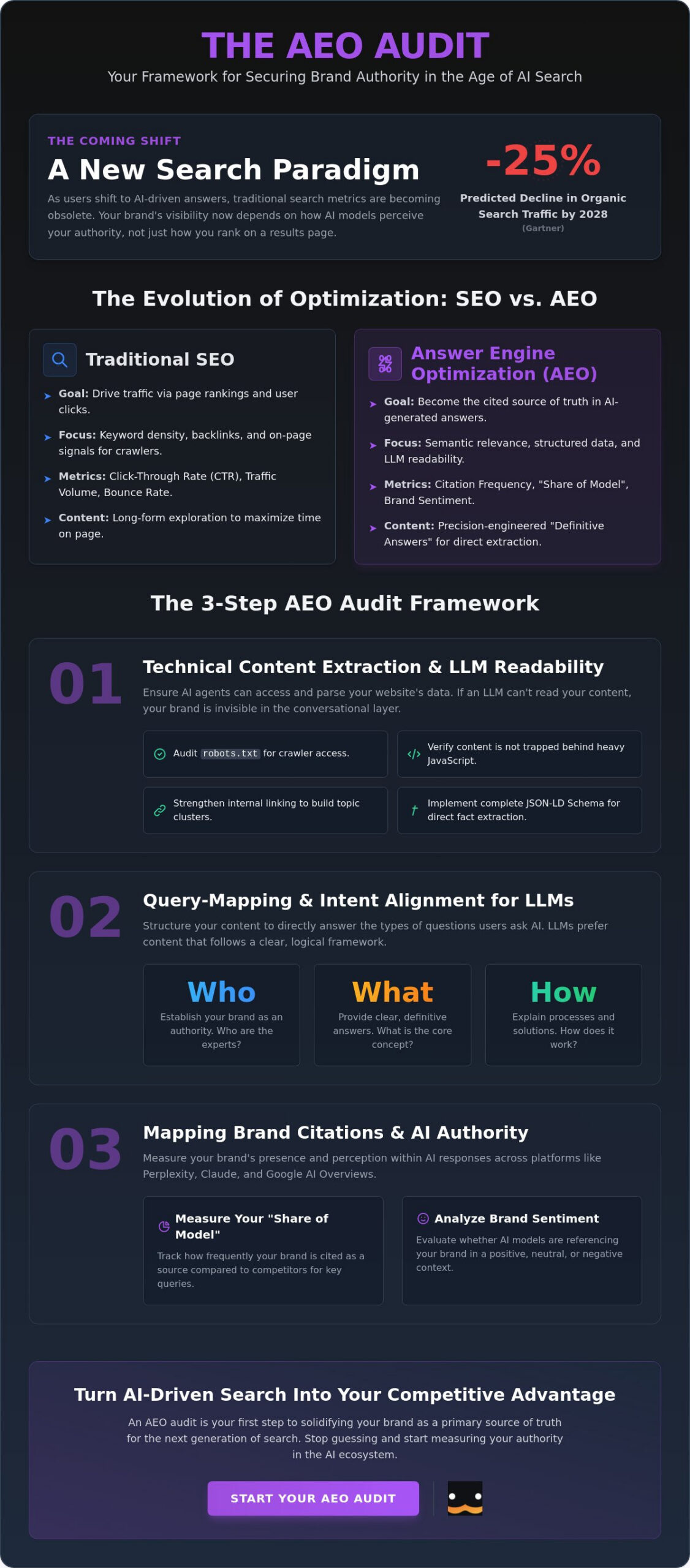
Gartner predicts that organic search traffic will decline by 25% by 2028 as users shift toward AI-driven answers. This isn’t a distant threat; it’s a fundamental shift in how your audience finds information. If you’re seeing traditional traffic stall, you need to understand how to perform an AEO audit to ensure your brand remains the primary source of truth for LLMs. We’ll move beyond legacy keyword tracking to focus on how models like Gemini and ChatGPT perceive your authority.
You likely feel the uncertainty of this new landscape. It’s difficult to optimize for a system that feels like a black box, especially when traditional metrics don’t apply. This guide provides a clear roadmap to evaluate your brand’s visibility in AI search engines and secure your place in conversational answers. We’ll show you how to fix content hallucinations and improve your citation rate in Perplexity and Claude. By the end of this article, you’ll have a strategic framework to measure your AEO score and turn AI-driven search into your strongest competitive advantage.
Key Takeaways
- Identify why traditional SEO metrics fail to capture conversational intent and how specialized audits bridge the gap.
- Learn how to perform an AEO audit to uncover technical barriers that prevent AI crawlers from parsing your website’s unstructured data.
- Master the art of query-mapping to align your content with the “Who, What, and How” structure preferred by LLMs.
- Discover how to measure your “Share of Model” and brand sentiment across emerging platforms like Perplexity and Claude.
- Develop a prioritized roadmap that focuses on high-impact citations to solidify your brand as a primary source of truth.
Defining the AEO Audit: Beyond Traditional Search Metrics
An AEO audit is a systematic review of your content for LLM interpretability. It ensures your brand’s data is structured in a way that AI models can easily digest and reproduce. Traditional SEO audits often miss the mark because they focus on page-level rankings. An AEO audit focuses on the knowledge graph. Knowing how to perform an AEO audit is now essential for maintaining visibility as conversational search replaces the standard results page.
AEO vs SEO Audits: Key Differences
The metrics for success have shifted. Traditional SEO audits prioritize Click-Through Rates (CTR) and keyword rankings. AEO audits prioritize citation frequency and sentiment within an AI’s response. We are witnessing a significant evolution of search optimization where keyword density is replaced by semantic relevance. AI models don’t just look for words; they look for relationships between concepts. This requires a transition from general content creation to precision-engineered answers.
- SEO: Focuses on long-form exploration to keep users on the page.
- AEO: Prioritizes the “Definitive Answer” provided in the first few sentences.
- SEO: Measures success by traffic volume and bounce rates.
- AEO: Measures success by “Share of Model” and brand authority.
Why 2026 is the Year of Answer Engines
The digital landscape changed permanently in 2026. With Google’s AI Mode crossing one billion monthly users in May, the “Zero-Click” reality is no longer a theory. For businesses in Miami and beyond, the goal is no longer just appearing on page one. Users now receive complete answers directly within interfaces like Perplexity, ChatGPT, and Google AI Overviews without ever visiting a website. This shift has decimated organic traffic for brands that haven’t adapted.
AEO is the process of ensuring AI models accurately retrieve and cite your brand. By learning how to perform an AEO audit, you ensure your intellectual property isn’t just consumed by training sets, but credited in real-time conversational answers. You are positioning your brand as the trusted source for the AI agents that now mediate the majority of consumer decisions. This is about securing your place in the future of information retrieval through validation and authority.
Step 1: Technical Content Extraction & LLM Readability
Technical accessibility is the first gate your content must pass. If AI agents cannot extract your data, your brand effectively doesn’t exist in the conversational layer. Most traditional SEO tools miss this because they focus on what a human sees in a browser. An AEO-focused technical review looks at how large language models (LLMs) ingest unstructured data. You must ensure your site is a readable data source, not just a visual gallery.
Start by auditing your robots.txt file and server settings. Many sites inadvertently block the very crawlers used by OpenAI or Perplexity through aggressive bot-management software. If you’re using heavy JavaScript frameworks to render content, ensure that your text is visible to simpler, non-browser-based scrapers. LLMs often prefer clean HTML for faster processing. Learning how to perform an AEO audit requires you to verify that your most valuable insights are not trapped behind complex code or paywalls.
Your internal linking structure acts as a semantic guide. AI models use these links to build topic clusters and understand the relationship between different concepts on your site. If your specific “Service” pages don’t link back to foundational “What is” content, the AI might struggle to attribute your expertise to specific queries. To secure your visibility, you can start with a professional AEO Audit to map these connections and identify technical gaps.
Schema Markup for AI Agents
Structured data is the primary map for LLMs. While humans read the prose, AI agents prioritize JSON-LD to confirm facts quickly. You must audit your FAQ, Product, and Organization schema for absolute completeness. This isn’t just about getting a rich snippet in Google anymore. It’s about providing a direct, machine-readable path that informs the model’s retrieval phase. Missing JSON-LD opportunities often lead to your competitors being cited because their data was easier for the AI to validate.
Eliminating Content Hallucination Risks
AI models are prone to hallucinations when they encounter contradictory information during the retrieval process. If your brand’s core facts, such as office locations or service descriptions, differ across various subpages, the AI may provide an incorrect answer or skip the citation entirely. This is a core pillar of Answer Engine Optimization (AEO). You must scan for outdated data, conflicting USP claims, and legacy pricing. Consistency is the foundation of trust. If your core facts are fragmented, your authority in the knowledge graph will crumble. Maintaining a single source of truth across your digital footprint is the only way to ensure AI models accurately represent your brand.
Step 2: Query-Mapping and Intent Alignment for LLMs
Query mapping is the bridge between your static content and the user’s dynamic intent. In the conversational era, users don’t just type keywords; they ask complex, multi-layered questions. Understanding how to perform an AEO audit requires a shift from targeting search volume to targeting answer accuracy. You must map your top-performing pages against specific “Who, What, and How” conversational queries to ensure your brand is the one being cited.
Large language models prioritize the “Definitive Answer.” This is a concise, authoritative statement that appears within the first 100 words of your article. If an AI agent has to dig through 500 words of fluff to find a fact, it will likely skip your site for a more direct source. You should also audit your content for “Information Gain.” This is a metric used to determine if your article provides unique value or data points that don’t exist in the training set or in competing articles. If you’re just rehashing the same information as everyone else, the AI has no incentive to cite you specifically.
Structure your data for easy extraction. Use bulleted lists and tables to present complex information. These elements act as high-signal blocks that LLMs can easily parse and reproduce in a chat interface. A well-structured table comparing service features is often more valuable to an AI agent than three paragraphs of descriptive text. This clarity is a cornerstone of What is Answer Engine Optimization, as it directly influences how models retrieve and present your brand’s data.
Identifying “Question-Answer” Gaps
Effective AEO requires knowing exactly what your audience is asking. Use tools to identify the most common questions Miami customers ask within your specific niche. Once you have this list, audit your current content to see if those questions are answered clearly and prominently. If a user asks “How do I secure my brand’s AI visibility?” and your site only offers vague marketing services, you have a gap. For a deeper dive into the foundational elements of this process, see our guide on what is an AEO audit.
Semantic Density and Topic Clusters
Semantic density is about the richness of your language. Avoid repetitive keywords and instead use “natural language” synonyms that reflect how people actually speak. Audit your topic authority by checking if you cover the entire subject or just fragments. AI models prefer comprehensive sources that demonstrate deep expertise. Ensure there is a logical flow from broad concepts to specific technical details. This structure helps the model understand that you are an authoritative entity across the entire knowledge domain, not just a single page.
Step 3: Mapping Brand Citations and AI Authority
Visibility in the AI era isn’t just about your own website. It’s about your footprint across the entire digital ecosystem. To understand how to perform an AEO audit, you must measure your “Share of Model.” This metric identifies how often an LLM cites your brand compared to your direct competitors. AI models act as digital curators. They aggregate data from across the web to provide synthesized answers that include a list of trusted sources. If you aren’t in that list, you’re invisible to the user.
Models like Perplexity and Gemini rely heavily on high-authority social signals and third-party validation. They frequently scrape Reddit threads, LinkedIn discussions, and industry news to verify a brand’s standing. If your Miami business is mentioned as a leader on these platforms, your citation probability increases. You must audit these external mentions to ensure the “source quality” associated with your brand is high. Low-quality links or outdated directory listings can dilute your authority and cause AI agents to overlook your expertise.
Tracking these mentions manually is time-consuming but necessary for a baseline. You need to know if the AI considers you a primary source or a secondary mention. To scale this process and gain deeper insights into your brand’s footprint, you can utilize the best AEO tracking tools available today. These platforms automate the discovery of brand citations across various LLMs.
Sentiment Analysis in Conversational Search
Sentiment analysis is a critical pillar of AI authority. AI models are programmed to avoid recommending brands associated with negative sentiment or unresolved controversies. You can test this by asking ChatGPT, “What is the best [industry] in Miami?” and analyzing the results. Pay close attention to the adjectives the AI uses. Is your brand described as “reliable” and “innovative,” or is the language neutral and vague? Identifying negative sentiment triggers is essential. These triggers often stem from unaddressed customer reviews or conflicting information on third-party sites that suppress your AI visibility.
Tracking Perplexity and ChatGPT Mentions
Being included in the “Sources” list of an AI answer is the new page one. This list provides the user with direct links to verify the AI’s claims. You must check for “brand hallucination” during your audit. This occurs when an AI incorrectly attributes your specific services or unique selling propositions to a competitor. Hallucinations usually happen because the AI found overlapping information and lacked a clear signal to distinguish your brand. Clearing up these inaccuracies requires a focused Tracking & Reporting strategy to ensure AI models accurately represent your brand’s identity and value.
Executing Your AEO Roadmap: From Audit to Authority
An audit is only as valuable as the actions it triggers. Once you understand how to perform an AEO audit, you must prioritize your findings based on citation impact versus technical difficulty. You don’t need to fix every minor detail simultaneously. Focus on high-impact technical barriers first, such as schema errors or bot-blocking issues that prevent models from indexing your core facts. This ensures the foundation of your digital presence is machine-readable and authoritative.
Develop a content refresh schedule to keep AI models updated with your latest expertise. In 2026, static content is a liability. LLMs prioritize sources that show recent, validated activity. Integrate your AEO findings into your broader Miami digital marketing strategy to ensure your brand remains a consistent authority across all platforms. Use a specialized AEO grader to monitor monthly changes in your AI visibility. This allows you to pivot quickly if a specific model changes how it attributes information or if a competitor begins to erode your share of model. Consistency in your data output is the only way to maintain a high trust score within the knowledge graph.
The Mustache AEO Strategic Framework
We provide a specialized AEO Audit and Strategy service designed specifically for Miami firms. Our process moves beyond the initial technical audit into ongoing content optimization. We treat AI SEO as a distinct, future-proof discipline that requires its own set of metrics and tactics. By focusing on how automated systems retrieve and validate information, we ensure your brand isn’t just part of the training set but a preferred answer in real-time queries. Our framework bridges the gap between traditional visibility and the new conversational reality.
Next Steps for Miami Businesses
Securing a professional audit today gives you a critical first-mover advantage. The 2026 landscape is unforgiving; brands that aren’t cited simply don’t exist in the eyes of the modern consumer. As organic search traffic continues to shift toward AI-driven answers, your ability to provide clear, structured, and authoritative data is your most valuable asset. Don’t let your competitors own the conversational space while you rely on declining legacy traffic methods. It’s time to validate your authority and secure your digital future through a rigorous review of how to perform an AEO audit for your specific niche.
The transition from a keyword-focused brand to a citation-focused authority requires precision and technical expertise. We are here to guide that transition with quiet confidence and proven results. Take the first step toward total AI search visibility and ensure your brand remains the primary source of truth in your industry.
Book your comprehensive AEO Audit with Mustache AEO
Secure Your Brand’s Future in the Conversational Knowledge Graph
The shift from traditional search to answer engines is no longer a prediction; it’s the current reality for every Miami business. By mastering how to perform an AEO audit, you’ve taken the first step toward reclaiming your brand’s authority in a world dominated by LLMs. You now understand that visibility depends on technical readability, semantic intent alignment, and high-quality citations across the digital ecosystem. These pillars ensure that AI agents don’t just find your content but prioritize it as a trusted source.
Don’t leave your visibility to chance as automated responses replace the standard results page. Mustache AEO provides specialized AEO Audit and Strategy services designed to position you as the definitive answer for your industry. Our Miami-based AI SEO experts deliver detailed tracking and reporting for LLM visibility to ensure your brand remains a primary source for models like Perplexity and ChatGPT. This proactive approach turns technical complexity into a distinct competitive advantage.
Get Your Professional AEO Audit from Mustache AEO and lead the transition into the next era of digital marketing. The future of information retrieval belongs to those who adapt today. You’ve got the roadmap; now it’s time to build your authority.
Frequently Asked Questions
What is the main difference between an SEO audit and an AEO audit?
Traditional SEO audits focus on search engine results pages and ranking positions based on keywords. An AEO audit focuses on large language model retrieval and brand citations within conversational answers. While SEO prioritizes clicks and traffic, AEO prioritizes semantic relevance and data interpretability for AI agents. It’s a shift from ranking for keywords to becoming the primary source of truth for machines.
How often should a Miami business perform an AEO audit?
You should conduct an audit at least quarterly to keep pace with the rapid updates in AI models. Google’s 2026 core updates and frequent shifts in LLM training data mean that information can become outdated quickly. Regular reviews ensure your brand’s facts remain consistent and authoritative as AI search behavior evolves. Staying ahead of these updates prevents your brand from losing its citation share.
Can I perform an AEO audit without specialized software?
You can perform a manual audit by testing your brand across various platforms like ChatGPT, Perplexity, and Gemini. However, manual checks lack the scale of automated data extraction. Professional tools provide the “Share of Model” metrics and sentiment analysis required to truly understand how to perform an AEO audit at scale. Relying solely on manual testing often misses technical barriers hidden in the site’s code.
How long does it take for AI engines to reflect changes from an AEO audit?
The timeline varies based on the platform’s specific retrieval mechanism. Perplexity and Google’s AI Mode often reflect real-time web updates within days. In contrast, base models like ChatGPT may take longer to update their underlying training data. Consistent technical optimization and clean schema are the fastest ways to trigger these updates across the board. Frequent content refreshes signal to the AI that your data is current.
Does an AEO audit help with ranking in Google AI Overviews?
Yes, AEO is specifically designed to target generative experiences like Google AI Overviews. By structuring your content for direct extraction and semantic clarity, you increase the likelihood that Google’s system will cite your brand as the primary source. This is a core component of modern AI SEO. Learning how to perform an AEO audit ensures your content meets the specific criteria Google uses for its AI-powered summaries.
What are the most important schema types for a successful AEO audit?
Organization, FAQ, and Product schema are the most critical for AI retrieval. These structured data types provide a machine-readable map of your brand’s identity and specific offerings. Without comprehensive JSON-LD, AI models may struggle to validate your facts. This leads to missed citation opportunities or brand hallucinations. High-quality schema acts as a direct validation signal for the models during the retrieval process.
Is an AEO audit necessary if my traditional SEO rankings are already high?
High traditional rankings don’t guarantee AI visibility. A page can rank first on Google but fail to be cited in a conversational answer if the content isn’t structured for LLM interpretability. As organic traffic shifts toward zero-click AI answers, an AEO audit protects your brand from becoming invisible. It’s about maintaining authority in a landscape where users don’t always click through to a website.
How does an AEO audit impact voice search performance?
AEO and voice search share the same goal: providing a single, definitive answer. Optimizing for answer engines naturally improves your performance on voice assistants like Siri and Alexa. By focusing on natural language patterns and direct conversational responses, you ensure your brand is the one spoken back to the user. This alignment makes your brand accessible across all automated information retrieval systems.