Gartner predicts a 25% decline in traditional organic traffic by the end of 2026. This isn’t just a minor market shift; it’s a fundamental change in how your customers discover your brand. You’ve likely noticed your organic click-through rates dropping as Google AI Overviews and platforms like Perplexity provide answers without sending a single visitor to your site. It’s frustrating to watch your traffic vanish while AI models occasionally misrepresent your brand or hallucinate details about your local services.
This AEO audit checklist for Miami businesses provides the definitive framework you need to reclaim your digital authority. We’ll show you exactly how to ensure your brand is cited, trusted, and prioritized by ChatGPT, Claude, and Perplexity. Our guide breaks down the technical requirements for Schema 30.0 and explains how to align your site with the May 2026 Core Update. You’ll gain an actionable roadmap for content optimization and AI SEO that turns these automated systems into your most powerful referral engines. We’ll move your strategy from simple keyword matching to comprehensive entity validation.
Key Takeaways
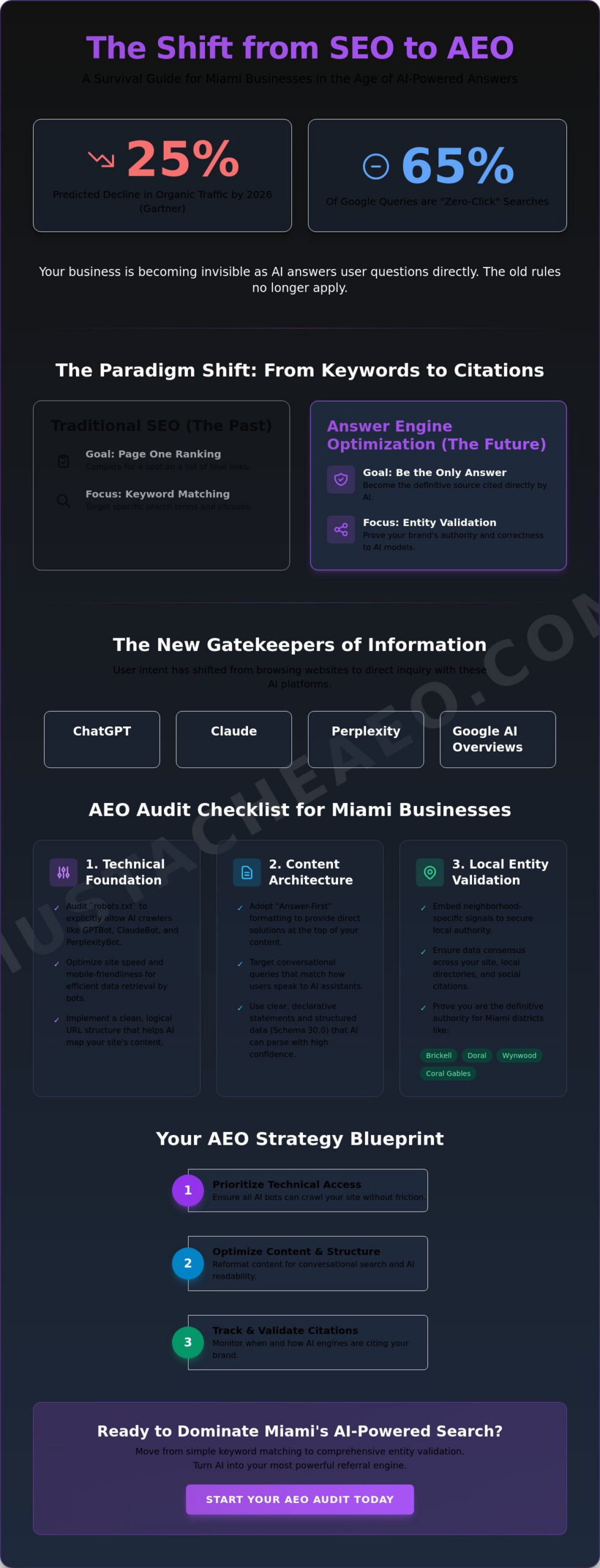
- Learn to differentiate between traditional keyword ranking and securing high-value citations within AI-generated responses.
- Audit your technical infrastructure to ensure AI crawlers like GPTBot and ClaudeBot have immediate, unblocked access to your site’s data.
- Use this AEO audit checklist for Miami businesses to restructure your content with “Answer-First” formatting that targets conversational search queries.
- Secure neighborhood-specific authority by embedding local entity signals from Miami districts like Brickell, Doral, and the Miami River.
- Develop a custom AEO strategy that prioritizes technical bot accessibility before moving to advanced content optimization and citation tracking.
The Shift from SEO to AEO in the Miami Market
Miami’s digital ecosystem is undergoing a radical transformation. Traditional search engine optimization (SEO) is no longer enough to capture local market share. We now live in an era where visibility is defined by your presence in AI-generated responses. Answer Engine Optimization (AEO) is the deliberate process of ensuring your brand is the primary source cited by artificial intelligence. While legacy tactics focused on ranking for keywords, modern AEO secures citations within generative summaries. This shift is critical because zero-click searches now account for over 65% of all Google queries in 2026. If your business isn’t the direct answer, it’s invisible. You don’t just want to be on the first page; you want to be the only answer the user sees.
Securing a spot in these summaries requires a specialized AEO audit to identify where your brand’s data is failing to meet AI standards. The Relationship between SEO and large language models has evolved into a technical handshake where your site must provide structured, verifiable evidence of its authority. Implementing a structured AEO audit checklist for Miami businesses ensures your technical foundation is ready for 2026. We move beyond simple metadata to focus on entity validation, proving to AI that your brand is the definitive authority in the Miami market, whether you’re based in Wynwood or Coral Gables.
Why AI Engines Prioritize Certain Miami Brands
AI engines use a “Probability of Correctness” metric to decide which Miami brand to recommend. They don’t just look for keywords; they synthesize information from multiple sources to form a single recommendation for the “Magic City.” To win this spot, your content must be LLM-friendly. This means using clear, declarative statements and structured data that AI models can parse with high confidence. When an AI synthesizes data, it looks for consensus. If your site, your local directories, and your social citations all align, your probability of being the chosen answer increases significantly.
The 2026 Answer Engine Landscape
In 2026, the landscape is dominated by ChatGPT, Claude, Perplexity, and Google AI Overviews. User intent has shifted from browsing to direct inquiry. This is especially evident in high-stakes Miami sectors like Real Estate and Tech, where customers demand immediate, accurate data. Conversational engines prioritize brands that offer direct solutions over those that hide information behind multiple clicks. A real estate firm in Brickell, for example, needs to provide AI-ready data on market trends to be cited as a local expert. This differs from traditional search where a user might click through three different blogs before finding a home valuation. Our AEO audit checklist for Miami businesses helps you bridge this gap by prioritizing the data structures these engines crave.
Technical Infrastructure: Granting AI Bots Access and Authority
Technical health is the foundation of AI visibility. AI models don’t just crawl your site; they synthesize your data to determine if your business is a credible answer. If your technical infrastructure is outdated, AI agents will bypass your brand in favor of more accessible competitors. A primary component of any AEO audit checklist for Miami businesses is ensuring that Large Language Model (LLM) crawlers can access your content without friction. Speed and machine readability are the new benchmarks for authority in 2026.
Start by auditing your robots.txt file. Many legacy Miami websites still use blanket “disallow” rules that inadvertently block GPTBot, ClaudeBot, and PerplexityBot. You must explicitly permit these bots to index your site if you want your brand cited in conversational answers. Beyond access, AI crawlers value efficient data retrieval. Site speed and mobile-friendliness are no longer just user experience metrics; they’re essential for optimizing websites for the agentic web. A clean, logical URL structure allows AI to map your services across different Miami neighborhoods easily.
Bot-Specific Access Management
Invite OpenAI and Perplexity to index your latest updates. Modern bot management involves more than just opening the door; it requires monitoring how these bots interact with your server. Using specialized AEO tracking tools allows you to see which bots are visiting and which pages they prioritize for synthesis. This data is vital for a proactive AEO audit checklist for Miami businesses because it reveals if your most profitable services are actually being seen by AI. If you’re unsure about your current bot accessibility, a professional AEO audit can identify hidden blocks in your server configuration.
Structured Data for AI Synthesis
Implement advanced Schema Markup to serve as your brand’s “Source of Truth.” As of March 19, 2026, Schema.org version 30.0 introduced new properties that are critical for local entity validation. Use JSON-LD to define your business as a unique Miami entity, utilizing the “SameAs” property to link your website to your verified social profiles and local directories. This creates a cohesive knowledge graph that AI can trust. Auditing for structured data errors is essential to prevent AI “hallucinations” where a model might misrepresent your hours or service areas. When your data is structured correctly, you reduce the friction between your site and the AI’s final answer.
Content Architecture for Conversational Search and AI Overviews
AI models are aggressive editors. They strip away marketing fluff to find the core answer your customer needs. To remain visible in 2026, your content must be architected for extraction, not just reading. This requires a shift to “Answer-First” formatting. You must provide the direct solution to a user’s query within the first 50 words of a section. When you lead with facts, you make it easy for AI agents to cite your brand as the definitive source. This structural clarity is a non-negotiable part of any AEO audit checklist for Miami businesses looking to dominate local search.
Audit your H2 and H3 headings to ensure they mirror natural language questions. Instead of generic titles like “Our Professional Services,” use “How can Miami law firms improve AI visibility?” This matches the conversational way users interact with ChatGPT and Perplexity. Modern businesses must redefine their digital strategy by prioritizing factual density over traditional word counts. You should also create comparison content that addresses evaluation intent. For example, a real estate developer might compare “Living in Brickell vs. Coral Gables in 2026.” This helps AI models synthesize your data when users ask for recommendations or comparisons.
Optimizing for the “Featured Answer”
Secure more citations by using definition-style sentences. State exactly what a service is before explaining the benefits. AI models prioritize LLM-digestible formats like bulleted lists and tables because they reduce the computational effort required to summarize your page. Your goal is to become the “path of least resistance” for the AI’s response. Every page on your site should serve a specific purpose, providing high-value data points that an AI can easily clip for a featured summary.
E-E-A-T in the AI Era
Preventing AI hallucinations is the most overlooked part of modern content strategy. AI models often misrepresent brand info when they encounter ambiguous or contradictory statements. Use your AEO audit checklist for Miami businesses to verify that your claims are consistent across every page. Back your insights with linkable, high-authority sources and ensure your author bios highlight genuine Miami expertise. When you provide clear credentials and verifiable facts, you eliminate the ambiguity that leads to AI skepticism. This builds a layer of protection around your brand authority, ensuring that the information AI shares about you is accurate and trustworthy.
Local Entity Validation: Securing Neighborhood-Specific Citations
AI models verify your business by cross-referencing data across the web. If your Name, Address, and Phone (NAP) information varies between your website and a local directory, AI triggers a low-confidence flag. This is why local entity validation is a critical stage in any AEO audit checklist for Miami businesses. Consistency proves you’re a real, operational entity in the Magic City. AI engines don’t just guess where you are; they look for a consensus of facts to ensure they don’t provide incorrect information to users.
Beyond basic contact details, your site must broadcast neighborhood-specific “Entity Signals.” Mentioning proximity to the Miami River, Brickell, or Doral helps AI bots connect the dots between your services and your physical location. When your Miami AEO services are explicitly tied to these geographic markers, AI engines are more likely to recommend you for hyper-local queries. We focus on building a digital knowledge graph that makes your location undeniable to any crawling bot.
Neighborhood-Level Authority
AI understands your service area through context. Don’t just list zip codes. Build specific service area pages that reference local landmarks like the Freedom Tower or the Wynwood Walls. These geographic markers anchor your brand within the “Miami Graph,” a digital map AI uses to verify local authority. Local reviews also play a massive role here. High-velocity, positive reviews from verified Miami users increase the trust score AI assigns to your brand. This directly impacts how often you appear as the chosen answer in conversational search results.
Social Proof for AI Verification
AI engines like Perplexity and ChatGPT often crawl Reddit, local forums, and news sites to gauge authentic sentiment. They’re looking for what real Miamians say about your brand. If your reputation on these platforms is negative or non-existent, AI may hesitate to cite you as a top recommendation. Managing your brand’s digital footprint ensures AI doesn’t pick up on outdated complaints or incorrect data. Press releases from local outlets are also high-value entity-building tools. They provide the third-party validation AI needs to confirm you’re a significant Miami entity. If you want to ensure your local presence is bulletproof, our team can develop a custom AEO Strategy to secure your neighborhood authority.
Moving from Audit to Action: Your Custom AEO Strategy
Executing an AEO audit checklist for Miami businesses is only the first step toward digital dominance. You must transform these technical and structural findings into a high-momentum action plan. We recommend a “Tech-First” approach to implementation. Prioritize technical fixes, such as unblocking LLM crawlers and repairing schema errors, before you begin content restructuring. If AI bots cannot access your data efficiently, even the most optimized content will fail to secure a citation. Once the technical handshake is secure, you can move toward aggressive content optimization.
Ongoing monitoring is vital in the fast-paced 2026 AI landscape. You need to track how often your brand is cited in conversational responses across ChatGPT, Claude, and Perplexity. We focus on a specific KPI called “Citation Share of Voice.” This metric measures your brand’s presence in AI answers relative to your Miami competitors. Because LLM algorithms evolve rapidly, we recommend scheduling quarterly AEO audits. These regular check-ups ensure your site remains compliant with the latest machine-learning preferences and data retrieval standards. Static strategies don’t survive in an automated ecosystem.
The Mustache AEO Roadmap
Our roadmap turns audit data into a high-impact content schedule designed for AI extraction. We specialize in AI SEO for the high-stakes Miami tech and legal sectors, where factual accuracy and authority are paramount. We don’t just add new content; we refine your existing Miami marketing stack to ensure every digital asset serves the knowledge graph. Our process integrates Tracking & Reporting into your daily operations, providing clear visibility into how AI engines perceive your brand authority. This systematic approach eliminates the guesswork from your digital growth.
Secure Your AI Visibility Today
The cost of waiting is significant. Your competitors in the Miami market are already claiming the “AI Answer” space, securing citations that will be difficult to dislodge once established. AI engines favor established entities with a history of consistent, verifiable data. Every day you delay is a day your brand remains invisible to the 65% of users performing zero-click searches. It’s time to move beyond legacy tactics and embrace the future of information retrieval. Book your specialized Miami AEO audit with Mustache AEO to secure your position as the definitive answer in your industry. We provide the authoritative, forward-looking results your brand needs to thrive in the age of artificial intelligence.
Master the Future of Miami Discovery
The shift toward automated retrieval is inevitable. By implementing a rigorous AEO audit checklist for Miami businesses, you ensure your brand isn’t left behind by the 25% decline in traditional search traffic projected for 2026. You’ve learned to prioritize technical bot access, restructure content for immediate extraction, and anchor your business within the Miami knowledge graph. These tactical steps move your strategy from passive visibility to active citation. You’re no longer just competing for a blue link; you’re securing your place as the definitive local authority.
Mustache AEO is your partner in this transition. As part of the Cognizant/Mustache family of innovators, we combine high-level technical expertise with deep Miami local expertise. We provide a specialized AI-Search focus that protects your brand authority and eliminates AI hallucinations. Get Your Professional AEO Audit from Mustache AEO today. It’s time to stop chasing clicks and start owning the answer. Your brand deserves to be the first choice for every AI engine in the city. We’re here to help you lead the way with confidence.
Frequently Asked Questions
What is the difference between an SEO audit and an AEO audit for Miami businesses?
Traditional SEO audits focus on keyword rankings and backlink profiles for legacy search results. An AEO audit prioritizes how AI models like ChatGPT and Claude synthesize your information into direct answers. We look at machine readability, entity validation, and your probability of being the chosen citation. While SEO targets clicks, AEO targets being the definitive source of truth for an AI agent.
How often should a Miami company conduct an AEO audit?
We recommend conducting an AEO audit quarterly to keep pace with rapid shifts in LLM behavior. For example, the release of Schema.org version 30.0 in March 2026 introduced new properties that changed how AI interprets local business data. Regular audits ensure your technical infrastructure remains compliant with these evolving standards. Consistent updates help you maintain a high citation share of voice against local competitors.
Can I perform a DIY AEO audit, or do I need a specialized Miami agency?
Basic checks of your robots.txt file can be done internally, but a specialized agency provides deeper technical expertise. We use proprietary tracking and reporting tools to monitor how specific bots like PerplexityBot interact with your server. Specialized firms understand the nuances of the Miami market and can implement advanced AI SEO strategies that typical internal teams might overlook. Professional audits identify hidden blocks that stop AI from citing your brand.
How long does it take to see results in ChatGPT or Perplexity after an audit?
Visibility shifts can occur within weeks as AI models update their knowledge bases. Unlike traditional search, which often takes months to reflect changes, conversational engines prioritize fresh, verifiable data. Once you unblock crawlers and implement structured data, AI agents can synthesize your new information quickly. Prompt indexing and factual density are the keys to accelerating your appearance in AI-generated answers.
Will an AEO audit help my business show up in Google AI Overviews?
Yes, implementing an AEO audit checklist for Miami businesses directly improves your chances of appearing in Google AI Overviews. Google uses similar extraction methods to ChatGPT and Perplexity, valuing structured data and E-E-A-T. By aligning your site with the May 2026 Core Update through an audit, you prove your authority to Google’s generative engine. This ensures your brand remains visible as traditional organic click-through rates decline.
What are the most common technical errors found in Miami AEO audits?
The most frequent error is inadvertently blocking AI crawlers like GPTBot or ClaudeBot in the robots.txt file. Many Miami sites also use outdated schema markup that fails to provide the “SameAs” properties necessary for entity validation. High server latency is another common issue, as AI agents prioritize sites that allow for fast data retrieval. These technical gaps prevent AI from accurately summarizing your business services.
Does social media management affect my AEO audit score?
AI engines use social signals to verify the authenticity and sentiment of your brand in the Miami market. While we don’t offer social media management, we audit how these external profiles contribute to your overall entity validation. Consistent brand information across these platforms helps AI models trust your data. This cross-platform consensus reduces the likelihood of AI skepticism and increases your chances of being recommended in conversational search.
How does an AEO audit prevent AI from hallucinating about my brand?
An AEO audit identifies and removes the ambiguity that causes AI models to invent incorrect details. By creating a clear “Source of Truth” using JSON-LD and declarative, answer-first content, you provide the facts AI needs for accuracy. We ensure your business hours, locations, and services are consistent across all digital touchpoints. When your data is verifiable and structured, AI models don’t have to guess, which protects your brand authority.