
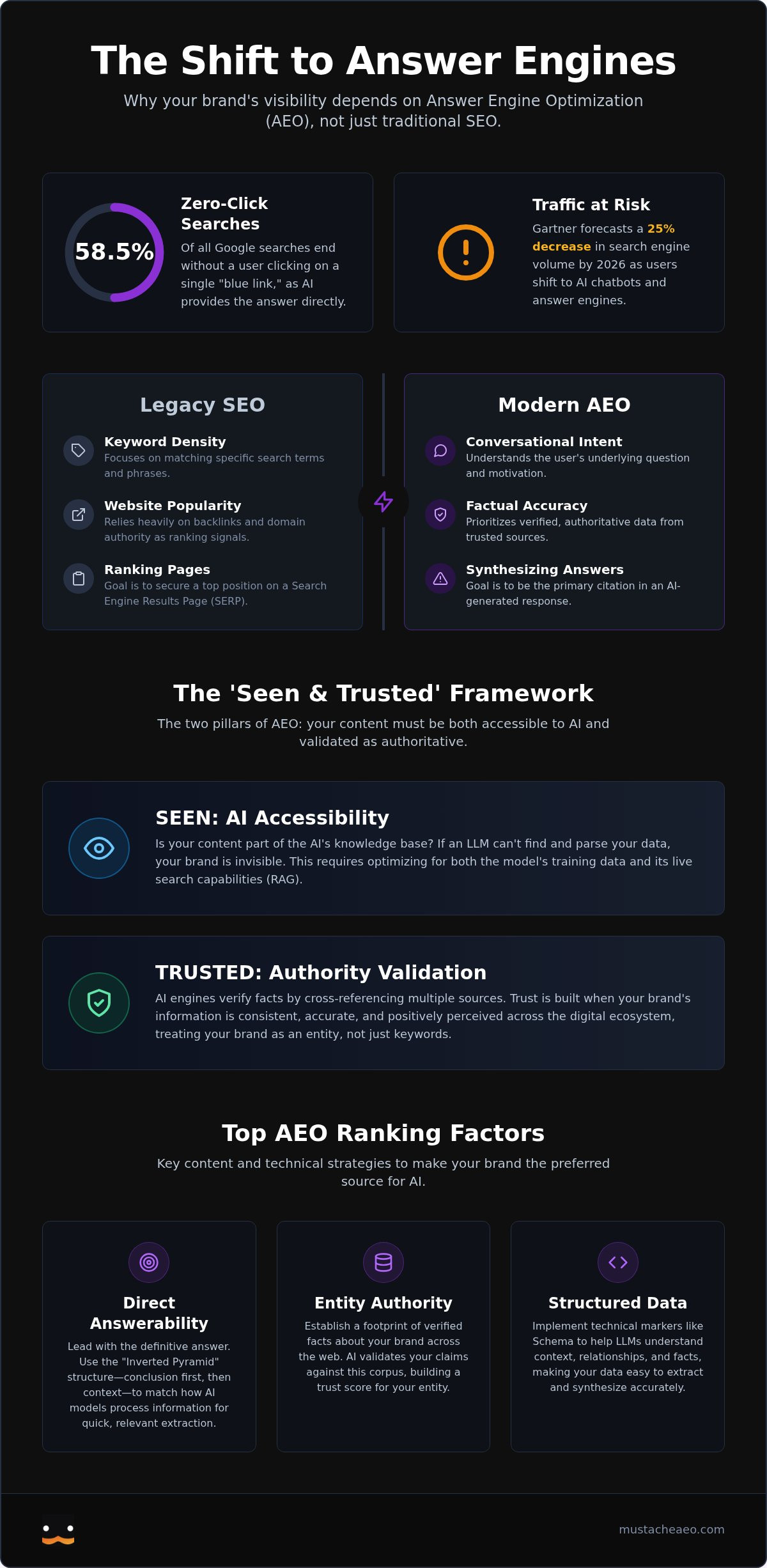
With 58.5% of Google searches ending without a single click, the era of the “blue link” is fading into history. You’ve likely felt the sting of declining traffic as conversational AI replaces traditional search results. It’s natural to feel frustrated by the confusion between legacy SEO and modern AEO; you might even fear AI engines hallucinating facts about your business. Mastering the top AEO ranking factors is the only way to ensure your brand remains visible as search volume shifts toward automated responses.
We build authority within the AI ecosystem. By following this guide, you’ll learn exactly how engines like Perplexity, ChatGPT, and Gemini cite and recommend brands. We provide a clear roadmap to ensure your business is the one providing the answers, turning AI assistants into your most reliable referral sources. This transition from general search to direct answerability is the key to maintaining market share in 2026.
This article explores the “Seen and Trusted” framework to move your brand beyond outdated methods. We’ll examine how to optimize for GPT-5.6 and Google’s latest AI Overviews. You’ll discover how to use entity validation and structured data to build authority that AI agents recognize and prioritize. We’ll also break down the specific content structures that make your data easy for LLMs to extract and validate.
Key Takeaways
- Understand the transition from traditional search results to synthesized answers and why conversational intent now outweighs keyword density.
- Implement the ‘Seen and Trusted’ framework to ensure your brand is both accessible to LLMs and validated across multiple digital platforms.
- Master the top AEO ranking factors by using semantic chunking and natural language formatting to optimize for AI tokenization and inference.
- Navigate evolving technical signals like bot efficiency and the emerging role of machine-readable files to guide AI crawlers effectively.
- Discover how a specialized AEO Audit and strategic roadmap can identify visibility gaps that general SEO agencies frequently overlook.
The Shift from SERPs to Answer Engines: Why Traditional Factors Aren’t Enough
The era of the “10 Blue Links” has ended. Traditional search engines prioritize website popularity, but modern users demand immediate, synthesized answers. This shift means that being #1 on a results page is no longer the ultimate goal; being the primary citation in an AI response is. While legacy SEO focused on keyword density, the Generative engine optimization landscape requires a focus on factual accuracy and entity authority.
Answer engines don’t just “find” your content; they interpret it. They use a process called Retrieval-Augmented Generation (RAG) to pull specific data points from the web and weave them into a conversational reply. Understanding how this process identifies the top AEO ranking factors is essential for any brand that wants to survive the 25% decrease in search engine volume forecasted by Gartner for 2026. If your content isn’t structured for this new retrieval method, it won’t be cited.
What is an Answer Engine?
Perplexity, ChatGPT Search, and Gemini have become the new gatekeepers of information. These platforms prioritize directness and factual reliability over high backlink volumes. For Miami-based businesses, this shift is already visible as local traffic moves toward conversational assistants that provide immediate solutions rather than a list of local links. This trend is global; for instance, a user who wants to discover Arete Gyms in London might receive a direct recommendation from an AI assistant based on its specific focus on body transformation. These engines value content that answers a query definitively, acting as filters that select only the most relevant and verified pieces of information to present to the user.
The Core Difference: Ranking vs. Synthesis
Google ranks pages based on popularity signals. AI search engines synthesize answers based on mathematical probability. This involves “Inference,” where the AI interprets the intent behind a brand’s content to determine if it’s the most probable correct answer to a user’s prompt. Your content must be digestible for Large Language Models (LLMs), meaning it should be structured for easy data extraction rather than just being “crawlable” for old-school bots. Aligning with the top AEO ranking factors ensures your brand is the one being synthesized, not ignored.
- Direct Answerability: Lead with the solution to the user’s problem immediately.
- Entity Authority: Build a footprint of verified facts across the AI training corpus.
- Structured Data: Use technical markers that aid LLM inference and data extraction.
Synthesized answers are the future of digital discovery. If your brand isn’t the primary source for these answers, you’re invisible to the majority of modern searchers. Success now requires moving beyond simple rankings to become a trusted, cited authority within the AI ecosystem.
The ‘Seen and Trusted’ Framework: Core AEO Ranking Factors
Visibility in 2026 requires more than just a crawlable website. Our “Seen and Trusted” framework defines the core of modern digital discovery. The “Seen” factor focuses on accessibility. Your content must be part of the LLM’s training data or reachable through real-time search tools used by models like GPT-5.6. If your data isn’t indexed within these specific pathways, your brand remains invisible to the AI. The “Trusted” factor relies on cross-platform validation. AI engines verify your claims by checking multiple sources simultaneously. This transition toward entity authority means focusing on “Things, not Strings.” LLMs treat your brand as a unique entity with defined attributes rather than just a collection of keywords. They also perform deep sentiment analysis to gauge your reputation. By analyzing the tone of mentions across the web, AI determines if your brand is a safe and reliable recommendation for the user.
Direct Answerability: The #1 AEO Ranking Signal
Answer engines prioritize speed and precision over exploration. The “Inverted Pyramid” of AEO places the definitive answer at the very top of your content, followed by supporting context and data. This structure mirrors the way AI models process tokens to identify the most relevant information quickly. You should structure every page to match the specific question-answer intent of conversational prompts. Direct Answerability is the alignment between a query and a concise, factual response. When you prioritize these top AEO ranking factors, you minimize the friction an AI experiences when trying to cite your brand. A specialized AEO Audit can reveal exactly where your current content lacks this necessary directness.
Entity Validation Across the Web
AI search engines rely on Knowledge Graphs to verify your business details. Your presence on high-authority nodes like Wikipedia, LinkedIn, and local Miami directories provides the necessary proof points for an AI to trust you. This creates “Nodal Authority,” where your brand is validated by other established entities. LLMs use these connections to build a comprehensive web of trust. If your LinkedIn data contradicts your official website, the AI detects an inconsistency. Maintaining a consistent factual footprint across these platforms ensures the AI perceives your business as a stable, authoritative entity. This reduces the risk of brand hallucinations and increases the likelihood of being the primary citation in a generated answer. Consistent validation across these nodes is one of the top AEO ranking factors for building long-term brand authority.
Content Structure: Optimizing for LLM Tokenization and Inference
Content structure is the bridge between human value and machine inference. Large Language Models (LLMs) don’t consume pages like people do; they process tokens and predict the most probable next word. To succeed, your content must be optimized for this extraction process. Semantic chunking is the practice of breaking information into logical, self-contained blocks. Each block should stand alone as a complete answer. This is one of the top AEO ranking factors because it allows an AI to identify and cite specific data points without sifting through irrelevant context.
Conversational formatting is equally vital. Your prose should mimic the natural way people ask questions. Use direct language and avoid the redundant fluff that traditional SEO often encouraged for word count. LLMs prioritize high information density. If a paragraph doesn’t deliver new facts, it’s a liability. FAQ sections are particularly effective here. They provide snippet-ready answers that are easily ingested by engines like Perplexity and ChatGPT. This directness ensures your brand’s voice remains clear during the AI’s synthesis phase. For platforms providing preparation for specialized exams like EPSO AD5 or AD7, this clarity is essential for accurate citation; read more about the intersection of high-density content and AI discovery.
Structured Data and Schema.org for AI
Explicit facts reduce the risk of AI hallucinations. While traditional SEO uses Schema for rich snippets, AEO uses it to provide a ground-truth for LLMs. Advanced Schema types like Product, FAQ, and LocalBusiness act as a direct data feed for the engine. This removes ambiguity and ensures your brand details are cited accurately. Implementing Speakable Schema is also a proactive step for voice-activated answer engines. It tells the AI exactly which parts of your content are best suited for verbal responses, ensuring you’re heard in every conversational environment.
The Power of Lists and Tables in AEO
LLMs are highly efficient at extracting data from well-formatted tables. Tables provide a clear relationship between different data points, which aids in machine inference. Similarly, bulleted lists improve your citation probability in generated summaries. They make your key points impossible to miss during the retrieval process. In a recent Miami AEO strategy, we observed that businesses using data tables to compare services saw significantly higher citation rates in conversational results. This structural clarity is a fundamental component of the top AEO ranking factors used by modern engines.
Technical AEO Signals: Schema, LLMs.txt, and Authority Validation
Technical infrastructure determines how effectively an AI can ingest your data. While legacy SEO focused on human readability, technical AEO focuses on machine efficiency. The emergence of the llms.txt file is a prime example. Although studies from May 2026 show this file has no measurable impact on general search citations yet, it’s a critical signal for Business-to-Agent (B2A) applications. It provides a clean, machine-readable roadmap for AI agents tasked with specific data retrieval. Aligning your technical backend with these emerging standards is one of the top AEO ranking factors for brands looking toward 2027.
Page speed has also evolved into “Bot Efficiency.” Answer engines use significant computational resources to crawl and synthesize information. If your site is slow or poorly structured, an AI agent may timeout before it extracts the necessary facts. This creates a “Citation Loop” where being cited once by a major model like GPT-5.6 leads to more citations. Other AI models often use these generated responses as part of their ongoing training data. Establishing a fast, reliable technical foundation ensures you enter this loop early and stay there.
Managing Your Brand’s AI Footprint
AI models can sometimes inherit outdated or incorrect information from the vast web. You must actively manage what an AI “thinks” about your business. The first step is a specialized AEO Audit to identify gaps between your current web presence and AI perceptions. If an LLM is hallucinating details about your services, it’s often due to inconsistent data across your digital touchpoints. Persistent web updates and consistent brand messaging across all platforms help correct these training sets. High information density and factual accuracy are the top AEO ranking factors that prevent AI misinformation from damaging your reputation.
Local AEO: Dominating the Miami AI Search Landscape
Dominating the Miami market requires specific geo-signals that AI can validate. Perplexity and other conversational engines often use local maps and real-time reviews to answer “near me” queries. You should anchor your local authority by using Miami-specific entities like Brickell, Wynwood, or the Design District within your metadata. This provides the AI with the necessary context to recommend you to local users. Optimizing your NAP (Name, Address, Phone) data is no longer just for Google Maps; it’s a validation signal for the entire AI ecosystem. When an AI sees your business mentioned alongside local landmarks and verified reviews, it increases your nodal authority in that specific geographic area.
Your technical setup should serve as a clear invitation to AI crawlers. If you’re ready to secure your place in the conversational search era, request your specialized strategy today and let us build your AI-ready roadmap.
Securing Your Brand’s Future with a Specialized AEO Roadmap
General SEO agencies often miss 80% of the AEO picture. They prioritize rankings on a results page that fewer people are visiting every month. We focus on the conversational frontier. Our approach integrates a specialized AEO Audit, AEO Strategy, and precise Content Optimization to ensure your brand is the primary citation. We track the untrackable by moving beyond legacy metrics. Traditional search volume is a vanity metric in 2026. We focus on Share of Model (SoM). This metric measures the probability of an LLM choosing your brand as the definitive response to a user prompt. Mastering the top AEO ranking factors is the only way to increase this share and maintain dominance.
We provide the Tracking & Reporting necessary to prove your authority in real-time. This involves monitoring how often your brand appears in synthesized answers across platforms like ChatGPT and Perplexity. Our methodology ensures that your brand isn’t just seen; it’s validated. By aligning your digital footprint with the way AI models process information, we turn your website into a high-density data source that engines trust. This roadmap is the difference between being a forgotten link and a cited authority.
The ROI of AEO for Miami Firms
Building brand equity in the AI era requires a shift in perspective. Being the “Recommended” answer significantly lowers your customer acquisition costs. You aren’t just one of many options; you are the solution provided by the AI. Answer Engine Optimization content optimization in Miami is the most effective investment for 2026. It ensures your business remains a dominant entity as search volume continues to migrate toward conversational platforms. This transition builds long-term equity that legacy methods simply can’t match.
Next Steps: Your AEO Audit
Your roadmap starts with a clear understanding of your current AI footprint. A Mustache AEO audit provides a deep analysis of your technical, content, and entity signals. We identify exactly where LLMs lose trust in your brand or where information gaps exist. This allows us to build a precise strategy that turns your existing marketing efforts into an AEO powerhouse. We focus on the top AEO ranking factors that drive real-world business outcomes. Get your specialized AEO Audit from Mustache AEO today.
Command the Conversational Search Frontier
The transition from legacy search to AI-driven discovery is an opportunity to redefine your brand’s authority. By mastering the top AEO ranking factors, you ensure that your business isn’t just a link in a list but the definitive answer provided by GPT-5.6 or Perplexity. We’ve explored how the “Seen and Trusted” framework and precise semantic chunking create the nodal authority required for AI citations. These aren’t just technical adjustments; they’re the building blocks of long-term brand equity in a zero-click world.
Mustache AEO is a pioneer in Answer Engine Optimization. We combine Miami-based tech expertise with a deep focus on LLM visibility and entity authority. Our specialized approach moves beyond the limitations of general agencies to identify the specific gaps in your AI footprint. It’s time to move from general search volume to a dominant share of the model. Secure your brand’s AI future with a Mustache AEO Audit and lead the shift into 2027 with confidence. Your brand deserves to be the voice that AI search engines trust.
Frequently Asked Questions
What is the most important AEO ranking factor in 2026?
Direct answerability is the primary signal. AI engines prioritize content that solves a user’s prompt immediately. Mastering the top AEO ranking factors starts with leading your content with a concise, factual statement. This structural clarity allows the model to extract your data with high confidence. It’s the foundation of being the primary citation in conversational results.
How is AEO different from traditional SEO ranking factors?
SEO focuses on page popularity and backlink volume. AEO focuses on entity validation and the probability of being the correct answer. While SEO helps you rank in a list, AEO ensures you are the synthesized response itself. It moves from “strings” to “things,” treating your brand as a verified entity with specific attributes within a Knowledge Graph.
Can I use my existing SEO content for Answer Engine Optimization?
Existing content is a starting point, but it usually needs Content Optimization. Traditional SEO often includes low-density fluff to meet word count targets. AEO requires semantic chunking and direct, conversational formatting. You must restructure your pages to provide snippet-ready answers that LLMs can easily tokenize. This process turns your legacy articles into high-value data sources.
Does social media impact my AEO ranking?
Social media provides validation nodes for your brand’s reputation. AI models perform sentiment analysis on public mentions to determine if your brand is a trustworthy recommendation. While these signals contribute to your overall authority, they are secondary to on-site technical signals. We focus on the core technical and content optimizations that directly influence how LLMs ingest your business data.
How long does it take to see results from an AEO strategy?
Visibility timelines depend on the specific engine’s retrieval method. Real-time search tools like Perplexity or ChatGPT with Search can reflect changes in a matter of days. Larger foundational models like GPT-5.6 may take longer, as they rely on periodic training data updates. A consistent strategy ensures you are ready whenever the next model refresh occurs.
What is an LLMs.txt file and do I need one for my Miami business?
An LLMs.txt file is a proposed standard for guiding AI crawlers through your site’s most important data. For a Miami business, it acts as a machine-readable invitation for AI agents. While it doesn’t directly boost search rankings today, it improves bot efficiency. This ensures that the agents retrieving data for specialized tools can find your facts without unnecessary friction.
How do I track my brand’s ranking in ChatGPT or Perplexity?
Traditional rank tracking doesn’t work for conversational search. You need specialized Tracking & Reporting that measures Share of Model (SoM). This involves analyzing how frequently and accurately your brand is cited across different LLM prompts. We provide the tools to monitor these citations, giving you a clear view of your brand’s authority within the AI ecosystem.
Will AEO help my brand appear in Google’s AI Overviews?
Yes, Google’s AI Overviews use similar retrieval-augmented generation (RAG) principles. By optimizing for the top AEO ranking factors, you align your content with how Google’s generative engine extracts information. This cross-platform approach ensures your brand remains visible whether a user is using a dedicated answer engine or a traditional search engine’s AI features.