
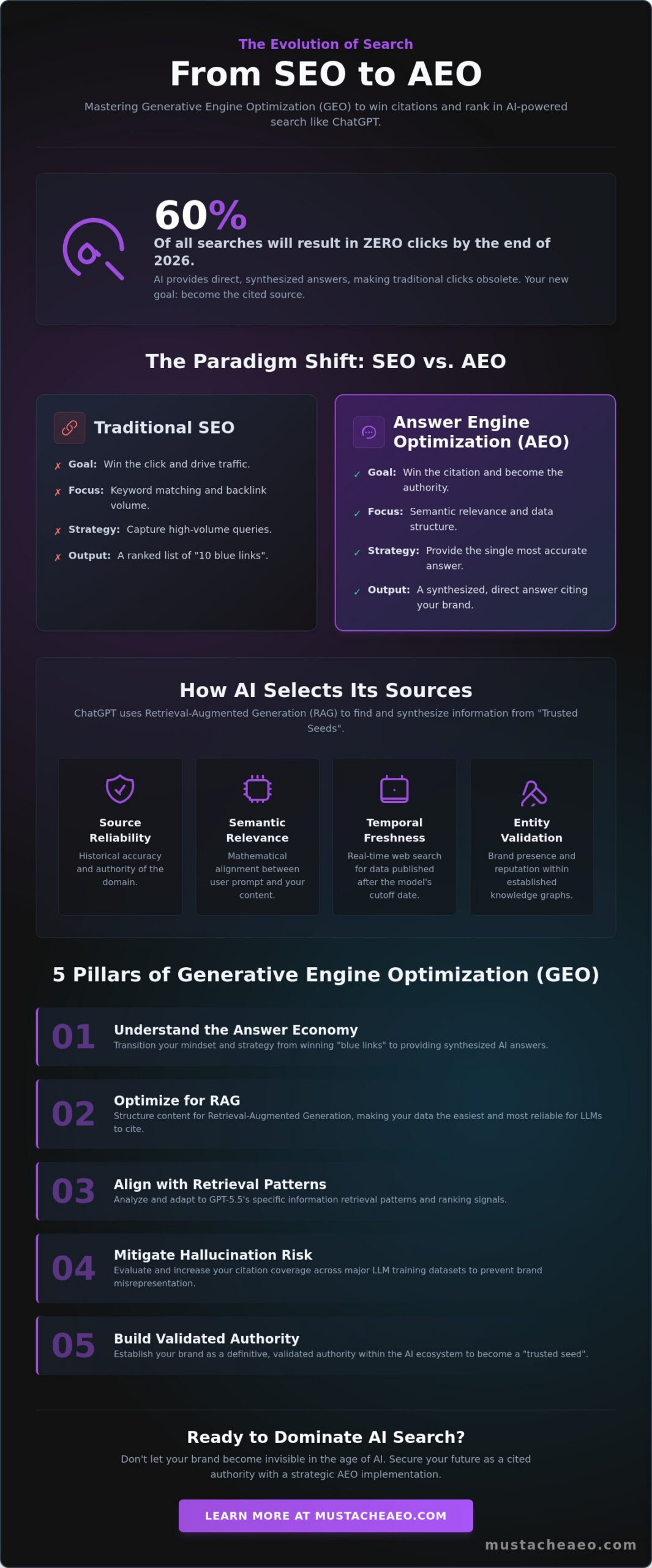
By the end of 2026, an estimated 60% of all searches will result in zero clicks as AI provides direct answers. You’ve likely noticed your organic traffic from Google dipping while your brand’s presence in conversational AI remains a mystery. It’s frustrating to feel like your authority is being swallowed by a black box. You’re right to worry about being “hallucinated” away or ignored by the latest LLMs. We understand that the shift from traditional SEO to Answer Engine Optimization (AEO) feels like moving targets in the dark.
This guide will show you exactly how to rank in chatgpt search by mastering Generative Engine Optimization (GEO). We’ll help you transition from chasing legacy links to becoming a cited authority in GPT-5.5 responses. You’ll learn how to secure your brand’s visibility within the 700 million weekly active users currently engaging with AI. We’ll break down the technical differences between SEO and AEO; then we’ll provide a clear roadmap for increasing your brand mentions in the LLM index. It’s time to claim your place as the definitive source in the age of agentic search.
Key Takeaways
- Understand the shift from “blue link” results to synthesized AI answers and why this transformation requires a dedicated AEO strategy.
- Learn how Retrieval-Augmented Generation (RAG) selects “trusted seeds” to form the basis of all conversational responses.
- Discover the technical framework for how to rank in chatgpt search by optimizing for GPT-5.5’s specific retrieval patterns.
- Identify your brand’s “Hallucination Risk” and evaluate your current citation coverage across major LLM training datasets.
- Master the five pillars of Generative Engine Optimization (GEO) to ensure your brand remains a validated authority in the AI ecosystem.
The Evolution of Search: Why Ranking in ChatGPT Search is Different
Search has fundamentally changed. The era of scrolling through ten blue links is ending as users migrate toward synthesized, conversational answers. ChatGPT Search is no longer just a chatbot; it’s a real-time retrieval engine that prioritizes direct utility over a list of options. While legacy models like GPT-4o provided static responses, the current GPT-5.5 family uses agentic reasoning to browse the live web and construct answers. This shift means that knowing how to rank in chatgpt search is no longer about winning a click. It’s about winning the citation.
Traditional SEO metrics like backlink counts and keyword density are now secondary to the technical requirements of Answer Engine Optimization. In this new landscape, visibility is binary: you are either the cited authority or you are invisible. By 2026, an estimated 60% of searches result in no website clicks because the AI provides the answer directly within the interface. To survive this transition, brands must move toward Generative Engine Optimization (GEO), a strategy focused on making your content the primary source for AI synthesis.
Answer Engine Optimization (AEO) vs. Traditional SEO
AEO prioritizes intent-based semantic retrieval over simple keyword matching. Traditional SEO focused on capturing high-volume traffic, but AEO focuses on providing the single most accurate answer to a specific prompt. Structure matters more than volume in this ecosystem. LLMs require highly organized, machine-readable data to validate your authority. As a Modern Specialist in this field, we focus on how these models parse information through Retrieval-Augmented Generation (RAG). We ensure your content is structured so that GPT-5.5 identifies your brand as the most reliable “trusted seed” for its response.
The Rise of Conversational Intent in Miami
Miami’s tech hub is at the forefront of this conversational shift. Local users are no longer typing “best agency Miami” into a search bar. Instead, they’re asking their AI agents, “Who is the most reliable AEO partner for a growing business in Miami?” This change in behavior requires a move toward natural language alignment. Early adoption in a competitive market like Miami provides a significant moat. When you master how to rank in chatgpt search before your competitors, you secure your position as the default recommendation in the local AI index. This proactive attitude builds long-term trust in an automated world. Local brands that have already invested in generative AI optimization services Miami are seeing firsthand how early adoption translates into dominant citation share across conversational engines.
Decoding the LLM Index: How ChatGPT Selects Its Sources
ChatGPT operates as a Retrieval-Augmented Generation (RAG) system. It doesn’t just retrieve a list of links; it synthesizes a cohesive answer from the most relevant data it finds. Understanding this mechanism is the first step in learning how to rank in chatgpt search. The model identifies specific chunks of information from the web and uses them to ground its response, ensuring the output is factually anchored rather than purely creative. This process relies on a few critical factors:
- Source Reliability: The historical accuracy and authority of the citing domain.
- Semantic Relevance: The mathematical alignment between the user’s prompt and your content in a vector space.
- Temporal Freshness: The use of real-time web search for data published after August 2025.
- Entity Validation: Your brand’s presence and reputation within established knowledge graphs.
High-authority “Trusted Seeds” are the priority. These are the sources the AI deems most reliable for a given topic. If your brand is frequently cited by reputable third-party platforms, you become a primary candidate for a ChatGPT mention. The system calculates semantic proximity, measuring how closely your content’s meaning aligns with the user’s specific intent. This is far more complex than legacy keyword matching; it’s about the conceptual depth of your information.
Real-time crawling bridges the gap between the model’s training and current events. GPT-5.5 Instant uses web search to find data released after its August 2025 knowledge cutoff. This means your strategy for how to rank in chatgpt search must account for how rapidly the AI parses new information. Following established Generative Engine Optimization best practices allows the AI to validate your claims instantly. If you’re unsure where your brand stands in this new index, a comprehensive AEO Audit can reveal your current visibility gaps.
Understanding the ChatGPT Citation Loop
The AI doesn’t look at your website in isolation. It cross-references your claims with external reviews, news articles, and social validation to create a citation loop. If the sentiment surrounding your brand is negative or inconsistent, the AI will likely ignore you to avoid “hallucinations.” Hallucination protection is now a major ranking factor. The model will choose a slightly less relevant but more verifiable source over one that seems unreliable or unverified by third parties.
The Role of Knowledge Graphs and Entities
Your brand must exist as a “Node” in the global knowledge graph. The AI identifies relationships between entities. It understands the connection between your business and Miami landmarks or specific industry terms discussed in the previous section. Maintaining a consistent digital footprint across all platforms ensures the AI can map these relationships accurately. When your brand is firmly embedded in the knowledge graph, you become the logical answer for localized or niche-specific queries.
Evaluating Your Brand’s AI-Readiness: A Commercial Framework
Visibility in 2026 is a diagnostic challenge. Simply existing on the web is no longer sufficient for commercial success. You must move beyond being “indexed” by a crawler and aim to be “cited” by an agent. To understand how to rank in chatgpt search, you must first evaluate your brand through a structured AI-readiness framework. This involves measuring three critical metrics: your Hallucination Risk score, Citation Coverage, and Direct Answer Potential (DAP).
Your Hallucination Risk score determines how likely an LLM is to ignore your brand due to conflicting or unverified data. If your digital footprint is fragmented, the AI will prioritize a more “stable” competitor to avoid providing inaccurate information. Citation Coverage analyzes whether your brand appears in the primary training sets or the real-time RAG stream. Finally, Direct Answer Potential measures how easily your content can be converted into a concise, conversational response without manual editing by the AI. These factors determine if you’re a primary source or a secondary thought.
The AEO Audit: Your First Step to AI Visibility
Diagnosing these metrics requires a technical deep dive. A professional AEO Audit identifies the specific technical gaps in your AI indexing. We look specifically at your schema markup to ensure LLM readability. Without structured microdata, GPT-5.5 may fail to parse your service offerings correctly. We also utilize a specialized AEO tracker to benchmark your current performance against AI-native competitors. This proactive approach turns anxiety into a clear roadmap for results. It’s about moving from guesswork to validation.
Verifiability: The New Currency of Search
Verifiability is the primary metric for modern authority. AI models prioritize content that links directly to primary data sources or verifiable third-party validation. When discussing the debate of ChatGPT Search vs Google Search, the winner is usually the platform that provides the most grounded evidence. You must structure your claims so they are easily validated by LLM crawlers. Freshness also plays a vital role. Since the GPT-5.3 Instant model has a knowledge cutoff of August 2025, your 2026 strategy must leverage real-time web search capabilities. We help you stay ahead of the curve by ensuring your most important brand updates are instantly accessible to the AI’s retrieval agents. This ensures you master how to rank in chatgpt search while your competitors remain stuck in the legacy index.
Strategic Implementation: 5 Pillars of Generative Engine Optimization (GEO)
Strategic implementation requires a shift from keyword targets to architectural pillars. To master how to rank in chatgpt search, you must build a digital presence that LLMs can ingest and validate without friction. We categorize this work into five specific pillars of Generative Engine Optimization (GEO). These pillars ensure your brand moves from a passive mention to a primary citation.
- Structural Integrity: Use LLM-friendly formatting like JSON-LD microdata and clear HTML hierarchies to help crawlers parse your data.
- Conversational Alignment: Map your content directly to natural language prompts rather than fragmented, legacy keywords.
- Entity Authority: Secure high-value citations from trusted third-party seeds to validate your brand’s expertise.
- Semantic Depth: Utilize best answer engine optimization techniques 2026 to ensure your content covers the “why” and “how” of your niche.
- Citation Velocity: Increase the frequency of your brand references across diverse, high-authority datasets to signal relevance to the LLM index.
Mentions are passive; citations are active validations. A mention is just a name on a page, but a citation occurs when the AI uses your specific data to answer a user’s question. This distinction is the core of our AEO Strategy. We focus on making your brand the indispensable source for the AI’s reasoning process. This is the most effective way to learn how to rank in chatgpt search in a competitive market.
Optimizing for Natural Language Prompts
AI agents search for answers, not pages. You must write a single, punchy sentence defining your core service that an AI can easily extract. We recommend the “Question-Answer-Evidence” (QAE) content structure. State the common user question, provide a direct answer in the first sentence, and follow with verifiable evidence. This transition from “Keywords” to “Dialogue Triggers” ensures you capture the conversational flow of GPT-5.5. It’s about being helpful, direct, and authoritative.
Building Semantic Authority with Topic Clusters
Building a moat around your niche requires linking related concepts into a dense network of information. Internal linking isn’t just for users anymore; it establishes context for the LLM. Deep-dive guides perform better in ChatGPT than short blog posts because they offer the semantic depth required for complex reasoning tasks. When you connect your services to broader industry topics, you solidify your brand as a primary node in the knowledge graph. This technical consistency builds the trust necessary for AI prioritization.
Navigating the AI Shift with a Mustache AEO Strategy
General SEO agencies are struggling to keep pace with the rapid evolution of LLM updates. They continue to prioritize legacy tactics like backlink volume and keyword density while GPT-5.5 ignores those signals in favor of synthesized truth. Modern search demands a specialist who understands the mechanics of retrieval and agentic reasoning. Our Mustache AEO approach provides a distinct competitive edge by focusing on three core pillars: Authority, Validation, and Visibility. We don’t just aim for a spot on a list; we ensure your brand is the definitive source the AI chooses to trust.
Authority means your brand is the primary node for a specific topic in the global knowledge graph. Validation involves cross-referencing your data with trusted seeds to eliminate the risk of being ignored as a “hallucination.” Visibility is the final outcome where your brand becomes the primary citation in a conversational prompt. Integrating AEO content optimization Miami into your existing marketing stack ensures your content is machine-readable and semantically aligned. This is the only way to future-proof your brand against the next generation of AI search models. It’s time to move beyond the click and start winning the answer.
The Miami Advantage: Local AEO Specialist
Local AEO is a specialized discipline that requires deep context. AI agents are increasingly used for geo-specific discovery and “near me” conversational queries. We optimize Miami brands by connecting their services to local entities and landmarks within the LLM index. This ensures that when a user asks for a service in the Magic City, the AI recommends your business with high confidence. Understanding the nuances of the Miami tech ecosystem allows us to build a local moat that generic national agencies cannot replicate. We make sure the AI knows exactly where you are and why you’re the best choice in the region. Our generative AI optimization services Miami case study demonstrates exactly how South Florida brands are achieving verified citations and converting AI search visitors at dramatically higher rates than traditional organic traffic.
Actionable Next Steps for 2026
Transitioning from a legacy SEO retainer to an AI-driven AEO strategy is essential for survival. You need a personalized roadmap that accounts for the reasoning capabilities of the GPT-5.5 family. We help you move from outdated tracking metrics to sophisticated Tracking & Reporting that measures your citation share in conversational search. Don’t let your brand’s visibility fade as traditional search volume declines. Take a proactive stance and claim your position in the automated world. Secure your brand’s spot in the AI future with a Mustache AEO Audit.
Own the Future of Conversational Search
The transition from traditional blue links to agentic AI responses is the most significant shift in digital history. You’ve learned that visibility in 2026 isn’t about capturing clicks; it’s about securing citations within the Retrieval-Augmented Generation loop. By implementing the five pillars of GEO and reducing your hallucination risk, you position your brand as a trusted seed in the GPT-5.5 index. Mastering how to rank in chatgpt search is the only way to protect your authority as zero-click searches become the standard.
We specialize exclusively in AEO and GEO strategies to help you stay ahead of these rapid LLM updates. As a Miami-based team and a proud member of the Cognizant/Mustache creative family, we combine local expertise with global technical scale. We don’t just follow trends; we build the frameworks that define them. It’s time to stop reacting to the shift and start leading it. Start your journey to AI Search dominance with a professional AEO Audit. Your brand deserves to be the definitive answer in the automated age.
Frequently Asked Questions
How long does it take to rank in ChatGPT search compared to Google?
Ranking in ChatGPT can be significantly faster for real-time queries. While Google indexing might take weeks, the SearchGPT RAG system can pick up authoritative updates in hours. However, becoming a core “trusted seed” in the underlying model takes more time. Your strategy for how to rank in chatgpt search should focus on building long-term authority while maintaining a fresh, crawlable digital presence for real-time retrieval.
Can I use AI-generated content to rank in ChatGPT?
You can use AI content, but it must be grounded in original data. LLMs prioritize content that demonstrates Experience and Expertise. If your content is just a copy of existing AI outputs, the model will likely ignore it. Focus on Content Optimization that adds unique value. This ensures your brand provides the factual evidence the AI needs to cite you as a primary source.
What is the most important technical factor for ChatGPT visibility?
Semantic structure is the most important technical factor. LLMs use JSON-LD and other microdata to parse your brand’s entity relationships. Without this, the AI might struggle to understand your specific offerings. A technical AI SEO approach ensures your site is machine-readable. This structure is the foundation of how to rank in chatgpt search effectively across different model versions and search agents.
How does SearchGPT handle local business results in Miami?
SearchGPT uses conversational intent to map Miami businesses to local landmarks and regional entities. It doesn’t just look for keywords; it looks for your brand’s relationship to the local ecosystem. By leveraging local citations and verified entity data, we help Miami brands dominate geo-specific conversational prompts. This ensures the AI recommends your business when users ask for local expertise in the Magic City.
Do backlinks still matter for ranking in ChatGPT search?
Backlinks are becoming secondary to high-authority brand mentions and citations. While links still help with crawling, the AI prioritizes being mentioned in high-authority “trusted seeds.” You want your brand referenced in news articles, reviews, and industry reports. This builds a citation loop that validates your authority. A modern AEO Strategy focuses on these high-value mentions rather than just link quantity.
How can I track my brand’s performance in conversational AI?
You can track performance through specialized Tracking & Reporting services. Traditional search consoles don’t provide data on AI citation share. You need tools that monitor conversational prompts to see how often your brand is recommended. We provide these metrics to help you understand your visibility in the LLM index. This data allows you to refine your strategy based on real-time AI responses.
What happens if ChatGPT “hallucinates” information about my business?
Hallucinations usually stem from a lack of consistent, verifiable data. If the AI provides incorrect info about your brand, it’s a signal that your digital footprint is fragmented. You can fix this by ensuring all third-party mentions and your own site provide a unified message. Our AEO Strategy includes a validation phase to clean up these inconsistencies and protect your brand’s reputation in the AI index.
Is AEO more expensive than traditional SEO services?
AEO requires a more technical and specialized investment than legacy SEO. The work involves deep data restructuring and semantic mapping rather than just keyword adjustments. While we don’t provide specific pricing, many businesses report that the ROI on AI visibility is higher due to the quality of the leads. It’s a strategic shift from chasing clicks to owning the definitive answer in your niche.